Hands Down Animals · Printable fact sheet
Beluga Whale
Delphinapterus leucas
Quick facts
| Scientific name | Delphinapterus leucas |
|---|---|
| Size | Typically 3.5 to 5.5 meters (11.5–18 feet) long |
| Weight | Typically 1,100 to 1,800 kg (2,425–3,968 lbs) |
| Lifespan | Average 35–40 years; up to 70 years in rare cases |
| Diet | Beluga whales eat fish (such as salmon, capelin, smelt, herring), cephalopods, and crustaceans. Diet varies… |
| Habitat | Coastal shallow waters, Estuaries and river mouths, Sea ice edges |
| Where it lives | Beaufort Sea, Bering Sea, Chukchi Sea, Hudson Bay |
| IUCN status | Least Concern (global); select subpopulations Endangered |
| Population | 120,000 – 150,000 |
| Top speed | 22 km/h |
| Family | Monodontidae |
About the beluga whale
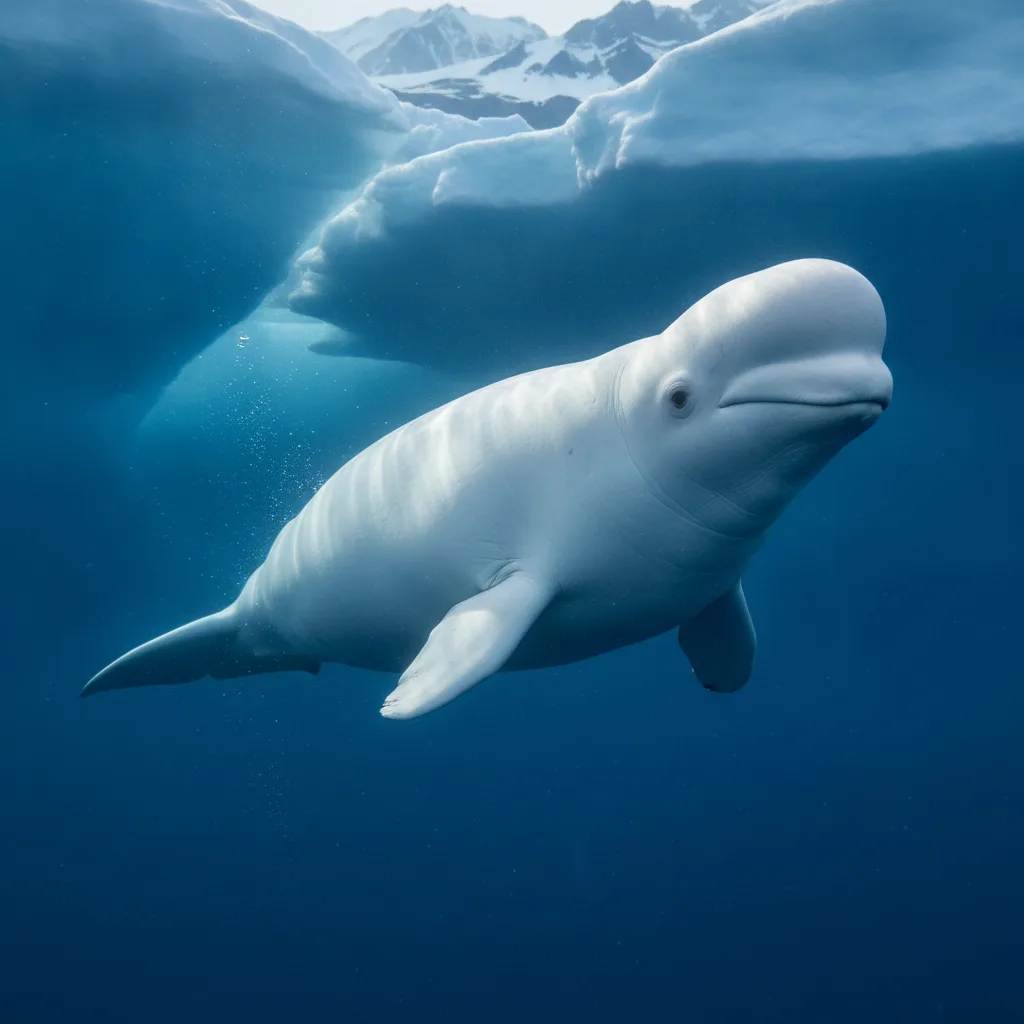
Beluga whales are white Arctic whales with no dorsal fin, a rounded forehead called a melon that they can change in shape, and unusually flexible necks that let them turn their heads. Among the most vocal of whales — sailors nicknamed them sea canaries — they gather in estuaries each summer, sometimes thousands at a time, to feed and moult in warmer water. Most populations are stable, but the isolated Cook Inlet group in Alaska is Critically Endangered.
Five things to know
- Belugas are also known as the 'canaries of the sea' due to their wide range of vocalizations.
- Unlike most whales, belugas can turn their heads side to side thanks to unfused neck vertebrae.
- They can live in both saltwater and freshwater and are commonly found far up rivers.
- Belugas undergo seasonal migrations, moving from wintering areas in the sea to summer areas in estuaries and river mouths.
- Their white coloration provides camouflage within Arctic ice.
Homeschool unit: Ocean homeschool guide — An ocean unit on marine food webs, tides and conservation, with the beluga whale as a case study.