Hands Down Animals · Printable fact sheet
Meerkat
Suricata suricatta
Quick facts
| Scientific name | Suricata suricatta |
|---|---|
| Size | 23–35 cm (9–13.8 in) in body length, tail adds 17–25 cm (6.7–9.8 in) |
| Weight | 0.62–1.0 kg (1.4–2.2 lbs) |
| Lifespan | Average 6–7 years in the wild, up to 12–14 in captivity |
| Diet | Mainly insects (beetles, larvae, termites), but also small vertebrates, eggs, roots, tubers, and some fruit… |
| Habitat | Open savannas, Grasslands, Dry scrubland |
| Where it lives | Kalahari Desert, Namib Desert, Botswana, South Africa |
| IUCN status | Least Concern |
| Population | Unknown, but considered common within its range |
| Top speed | 32 km/h |
| Family | Herpestidae |
About the meerkat
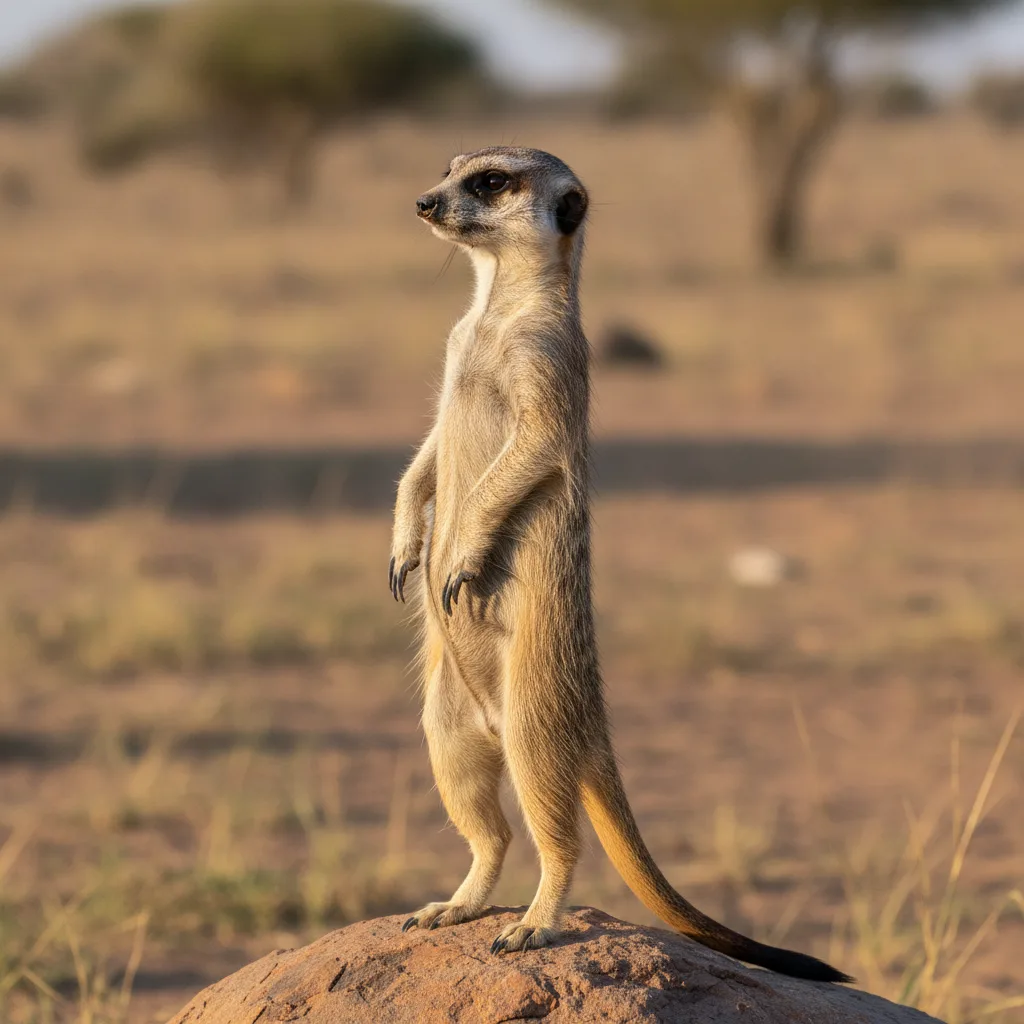
Meerkats are small mongooses of the Kalahari and other dry parts of southern Africa, living in groups of up to around 50 that share a network of burrows. While the rest of the mob digs for beetles, scorpions and larvae, one animal stands upright as a sentinel and gives one alarm call for hawks and another for jackals. They can eat scorpions because they are partly resistant to the venom, and adults teach pups to handle them by presenting prey with the sting already removed.
Five things to know
- Meerkats are highly social and form cooperative groups known as mobs, gangs, or clans of up to 50 individuals.
- They display sentinel behavior, with one meerkat standing guard to warn others of approaching danger.
- Meerkats exhibit highly coordinated group foraging and use over 30 different types of vocalizations.
- They are immune to certain types of venom, allowing them to eat scorpions.
- Despite their popularity in media, meerkats exist only in southern Africa.
Homeschool unit: Animals homeschool guide — Habitats, adaptations and food chains as a graded unit, with the meerkat as one of its worked examples.