Hands Down Animals · Printable fact sheet
Monarch Butterfly
Danaus
Quick facts
| Scientific name | Danaus |
|---|---|
| Size | 8-10 cm (wingspan) |
| Weight | 0.5-0.75 g |
| Lifespan | 2-6 weeks (adults in summer), up to 8 months… |
| Diet | Larvae eat exclusively milkweed (Asclepias spp.); adults feed on nectar from a variety of flowers, including… |
| Habitat | Open meadows, Prairies, Grasslands |
| Where it lives | Eastern United States, Western United States, Canada, Mexico (central mountains for… |
| IUCN status | Endangered |
| Population | 50,000,000 - 100,000,000 (North American migration… |
| Top speed | 48 km/h |
| Family | Nymphalidae |
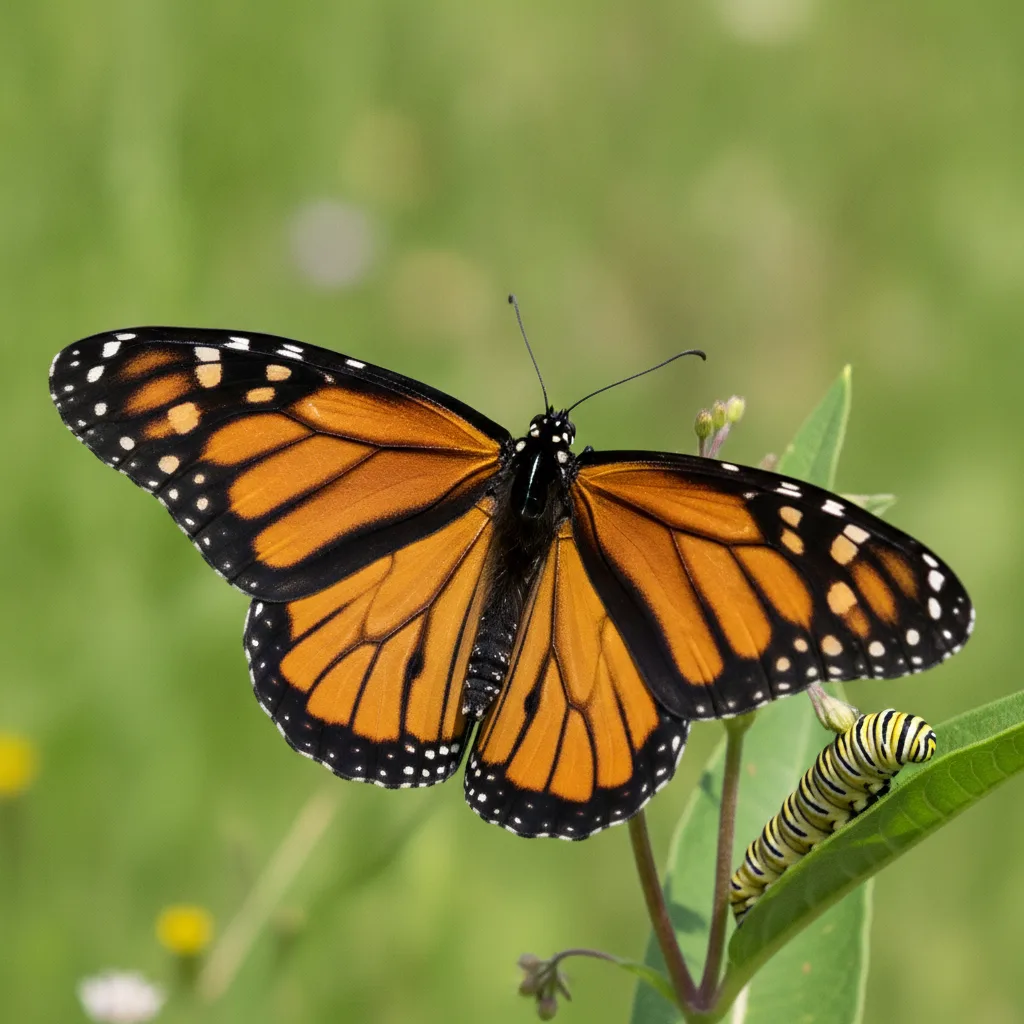
About the monarch butterfly
Monarch butterflies make one of the longest insect migrations on Earth: each autumn, monarchs from across eastern North America fly up to 4,800 kilometres to a few mountain forests in central Mexico, where millions cluster on oyamel fir trees for the winter. The butterflies that leave Mexico in spring are the great-grandparents of the ones that return, so no individual has made the journey before. Caterpillars feed only on milkweed, whose toxins make the adults distasteful to birds.
Five things to know
- The Monarch Butterfly is best known for its epic multi-generational migration from Canada and the United States to central Mexico.
- Monarch caterpillars feed exclusively on milkweed, which contains toxins that make them unpalatable to predators.
- Adult monarchs have brilliant orange wings with black and white markings, serving as a warning to would-be predators.
- Monarchs can fly up to 4,800 km (3,000 miles) during migration, one of nature’s greatest insect journeys.
- Recent decades have seen their populations sharply decline due to habitat loss and pesticide use.
Homeschool unit: Animals homeschool guide — Habitats, adaptations and food chains as a graded unit, with the monarch butterfly as one of its worked examples.