Hands Down Animals · Printable fact sheet
Red Panda
Ailurus
Quick facts
| Scientific name | Ailurus |
|---|---|
| Size | 56–64 cm (head and body) plus 37–47 cm tail |
| Weight | 3–7 kg |
| Lifespan | 8 years in the wild; up to 15 in captivity |
| Diet | Primarily bamboo leaves and shoots, but also fruit, berries, acorns, roots, eggs, insects, and occasional… |
| Habitat | Temperate broadleaf forests, Montane mixed forests, Dense bamboo thickets |
| Where it lives | Eastern Nepal, Bhutan, Northeast India, Northern Myanmar |
| IUCN status | Endangered |
| Population | 10,000 - 12,000 |
| Top speed | 38 km/h |
| Family | Ailuridae |
About the red panda
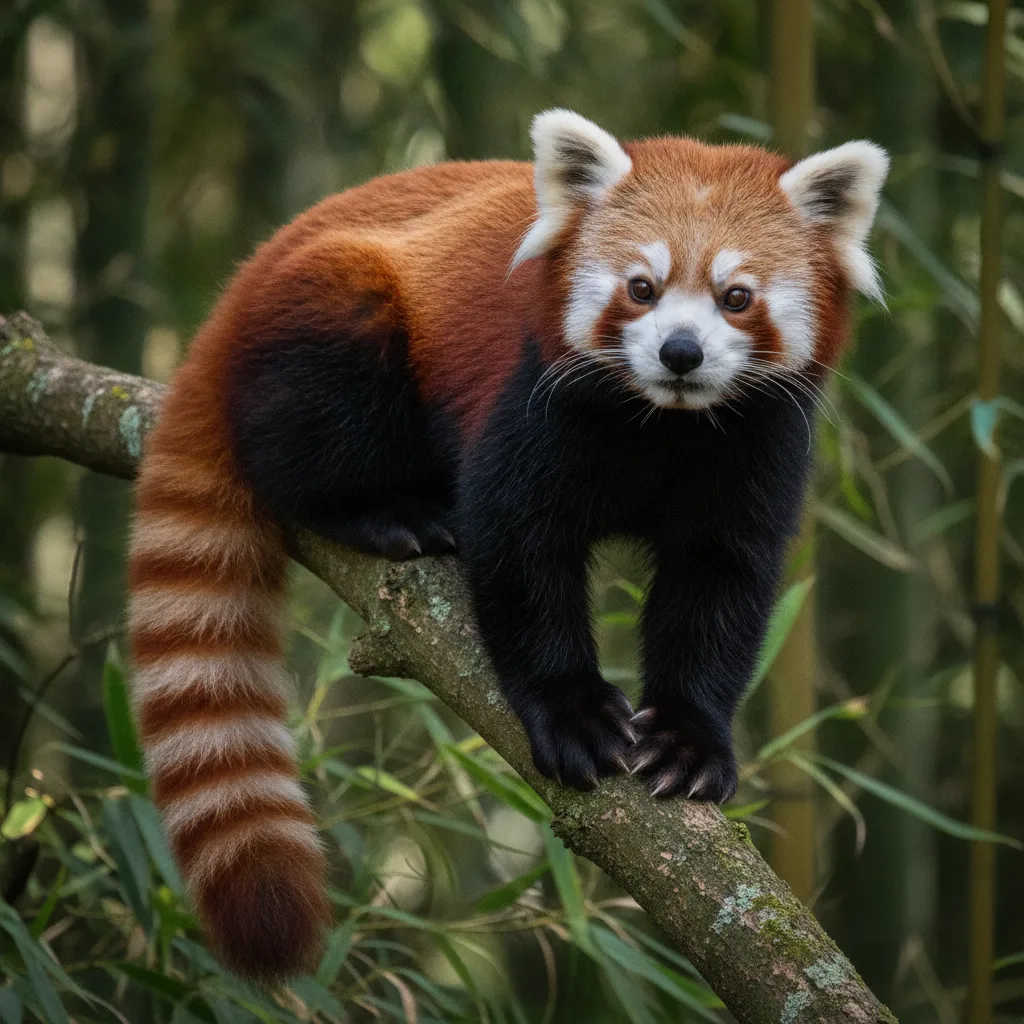
The red panda lives in the temperate mountain forests of the eastern Himalaya and southwest China, at elevations of roughly 2,200 to 4,800 metres, where bamboo grows thickly under the trees. Despite the name it is not a close relative of the giant panda; it sits in a family of its own, Ailuridae, though it uses the same kind of false thumb to grip bamboo stems. Fewer than 10,000 are thought to remain, and the IUCN lists the species as Endangered.
Five things to know
- Red pandas are NOT closely related to giant pandas; they are in their own unique family, Ailuridae.
- They are primarily bamboo eaters but are taxonomically carnivores.
- Red pandas are excellent climbers and spend much of their lives in trees.
- Their thick fur covers even the soles of their feet for protection against cold.
- Red pandas can use their bushy tails as a wraparound blanket in winter.
Homeschool unit: Animals homeschool guide — Habitats, adaptations and food chains as a graded unit, with the red panda as one of its worked examples.