Hands Down Animals · Printable fact sheet
Snowy Owl
Bubo scandiacus
Quick facts
| Scientific name | Bubo scandiacus |
|---|---|
| Size | 53 to 66 cm (21–26 in) in length, wingspan 125–150 cm (49–59 in) |
| Weight | 1.6 to 3 kg (3.5–6.6 lbs) |
| Lifespan | average 10 years in the wild; up to 23 in captivity |
| Diet | Primarily lemmings and voles; also eats small birds, hares, and occasionally fish. |
| Habitat | arctic tundra, open grasslands, coastal dunes |
| Where it lives | Arctic tundra of Canada, Arctic tundra of Alaska, northern Russia, northern Scandinavia |
| IUCN status | Vulnerable |
| Population | 100,000 - 200,000 |
| Top speed | 80 km/h |
| Family | Strigidae |
About the snowy owl
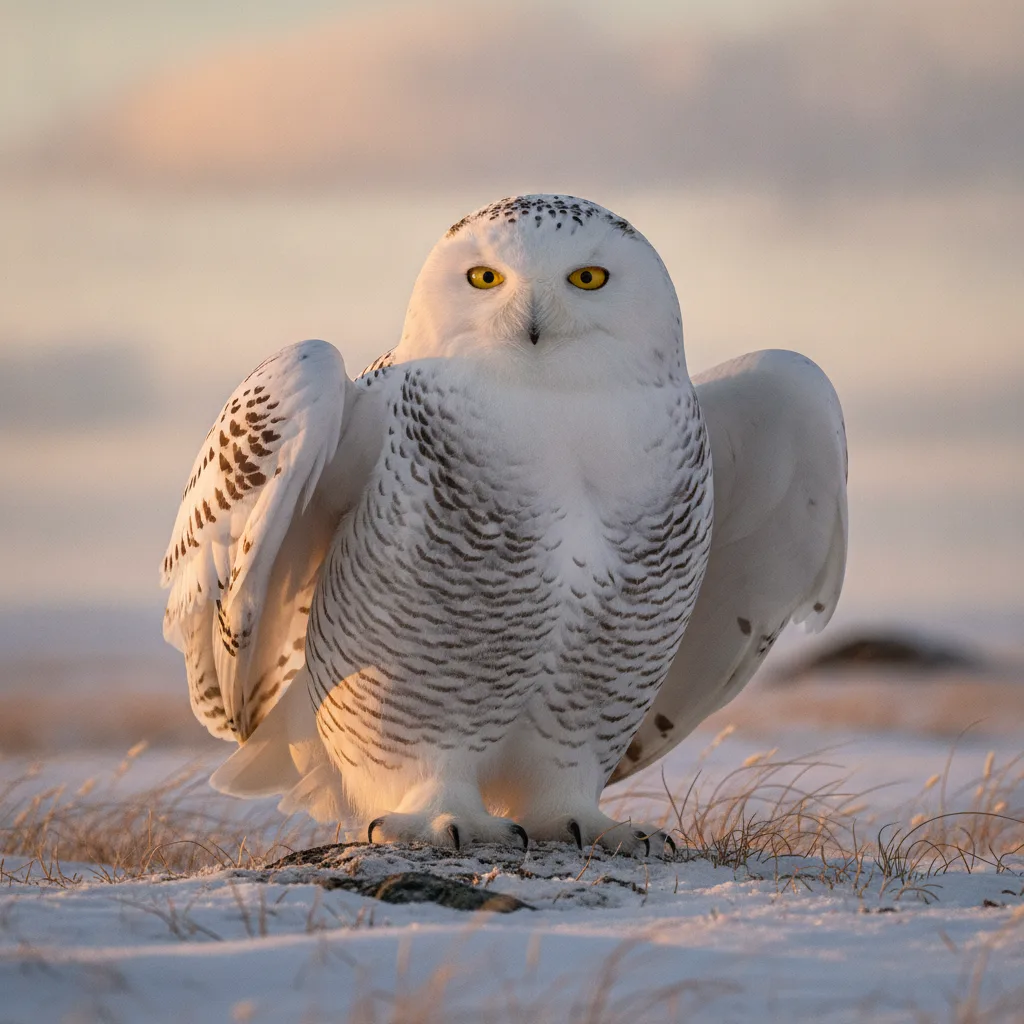
The snowy owl breeds on the open Arctic tundra of North America, Europe and Asia, where its white plumage — nearly pure in older males, barred with black in females and young birds — blends into the snow. Unlike most owls it hunts by day as well as by night, taking lemmings almost exclusively when they are abundant, and in years when lemming numbers crash it may not breed at all. Winter irruptions carry some birds far to the south, and the IUCN lists the species as Vulnerable.
Five things to know
- Snowy Owls are one of the few owl species adapted to the Arctic tundra.
- They hunt mainly by day, unlike most other owls.
- Plumage color helps them blend into snowy environments for camouflage.
- During irruption years, they can be seen far south of their usual range.
- Males are almost entirely white, while females and juveniles have dark barring.
Homeschool unit: Birds homeschool guide — Flight, feathers and migration: a bird unit that uses raptors like the snowy owl as its worked examples.