Hands Down Animals · Printable fact sheet
Black Rhino
Diceros bicornis
Quick facts
| Scientific name | Diceros bicornis |
|---|---|
| Size | 3.0–3.75 meters in length, 1.4–1.8 meters at shoulders |
| Weight | 800–1,400 kg |
| Lifespan | 30–35 years in the wild, up to 50 years in captivity |
| Diet | Herbivorous browser; feeds mainly on leafy plants, twigs, shoots, thorny bushes, fruit, and bark. |
| Habitat | Acacia and scrub savanna, Dry bushland, Arid and semi-arid woodlands |
| Where it lives | South Africa, Namibia, Kenya, Zimbabwe |
| IUCN status | Critically Endangered |
| Population | 5,600 - 6,200 |
| Top speed | 55 km/h |
| Family | Rhinocerotidae |
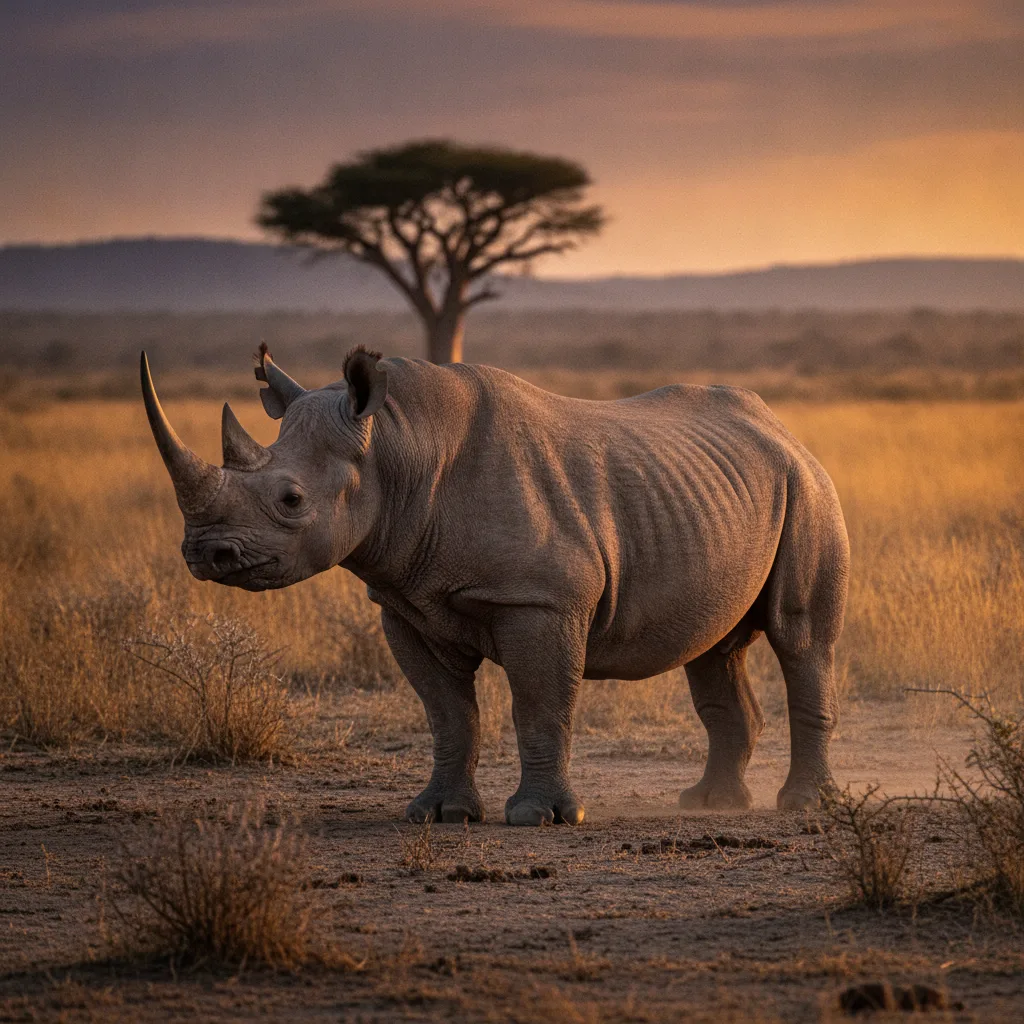
About the black rhino
Black rhinos live in the savannas and scrublands of eastern and southern Africa, using a hooked, prehensile upper lip to browse twigs and leaves from bushes rather than grazing. Despite weighing over a tonne they can run at 55 km/h and are known for charging when startled. Poaching for horn cut numbers from about 65,000 in 1970 to under 2,500 by the mid-1990s; protection has raised them to over 6,000, but the species remains Critically Endangered.
Five things to know
- The black rhino is distinguished from the white rhino by its pointed, prehensile upper lip used for grasping leaves and twigs.
- Populations fell over 96% between 1970 and 1995 due to intense poaching, but have increased in the 21st century through conservation.
- Black rhinos can run at speeds up to 55 km/h (34 mph) despite their size.
- Their two horns are made of keratin and are highly prized on the black market, leading to severe poaching threats.
- Black rhinos are generally solitary and highly territorial with a keen sense of smell but poor eyesight.
Homeschool unit: Animals homeschool guide — Habitats, adaptations and food chains as a graded unit, with the black rhino as one of its worked examples.