Black Rhino
Diceros bicornis
Black rhinos live in the savannas and scrublands of eastern and southern Africa, using a hooked, prehensile upper lip to browse twigs and leaves from bushes rather than grazing. Despite weighing over a tonne they can run at 55 km/h and are known for charging when startled. Poaching for horn cut numbers from about 65,000 in 1970 to under 2,500 by the mid-1990s; protection has raised them to over 6,000, but the species remains Critically Endangered.
Quick facts: Size 3.0–3.75 meters in length, 1.4–1.8 meters at shoulders · Lifespan 30–35 years in the wild, up to 50 years in captivity · IUCN status Critically Endangered
Print the fact sheet — a free one-page PDF for homeschool and classroom use
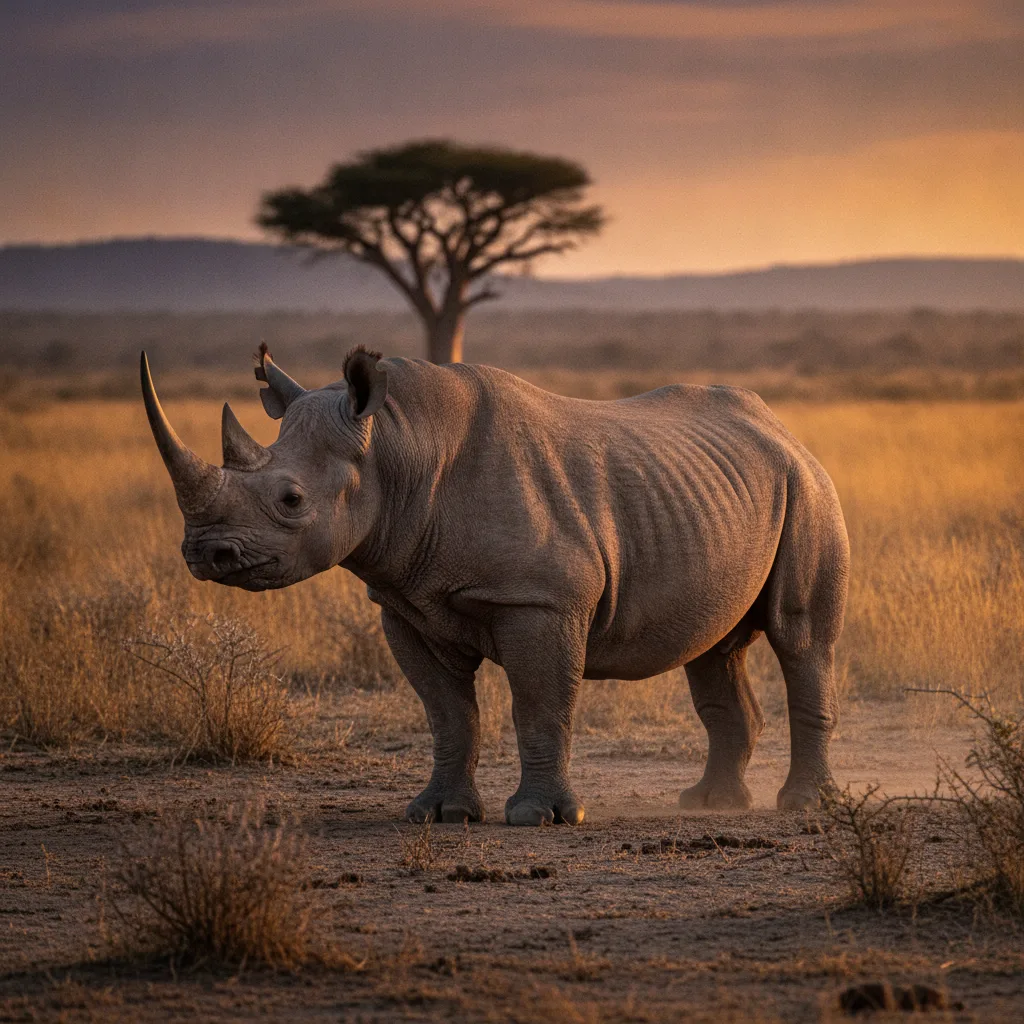
Black Rhinoceros at a glance
| Scientific name | Diceros bicornis |
|---|---|
| IUCN status | Critically Endangered |
| Population | 5,600 - 6,200 |
| Population trend | increasing |
| Weight | 1100–1400 kg |
| Length | 3.4–3.75 m |
| Lifespan | 35–50 years |
| Top speed | 55 km/h |
| Class | Mammalia |
| Order | Perissodactyla |
| Family | Rhinocerotidae |
| Known species | 4 |
Need to know
- The black rhino is distinguished from the white rhino by its pointed, prehensile upper lip used for grasping leaves and twigs.
- Populations fell over 96% between 1970 and 1995 due to intense poaching, but have increased in the 21st century through conservation.
- Black rhinos can run at speeds up to 55 km/h (34 mph) despite their size.
- Their two horns are made of keratin and are highly prized on the black market, leading to severe poaching threats.
- Black rhinos are generally solitary and highly territorial with a keen sense of smell but poor eyesight.
- They are considered one of Africa's most aggressive large mammals and are known to charge threats.
About the Black Rhinoceros
The black rhinoceros (Diceros bicornis), often simply called the black rhino, is a critically endangered species native to Africa. Known for its two distinct horns and pointed prehensile upper lip, the black rhino is a browser, eating leaves, branches, and twigs from shrubs and trees rather than grazing on grass like the white rhino. Once found across vast swathes of sub-Saharan Africa, black rhino populations plummeted in the late 20th century due to intense poaching for their coveted horns and habitat loss.
Thanks to significant conservation initiatives, black rhino numbers have slowly begun to recover in recent years though they remain vulnerable. Black rhinos play an important ecological role, shaping the landscape and providing habitat diversity for other species. Despite their power and bulk, they remain one of the more elusive and unpredictable large mammals, attracting both scientific interest and ecotourists seeking a glimpse of these armored giants in the wild.
Physical characteristics
Size: 3.0–3.75 meters in length, 1.4–1.8 meters at shoulders. Weight: 800–1,400 kg. Lifespan: 30–35 years in the wild, up to 50 years in captivity.
- Two keratinous horns on the snout (front horn larger)
- Prehensile, hooked upper lip for browsing
- Thick, gray or brown skin with relatively hairless surface
- Short tail with tufted end
- Small eyes with relatively poor eyesight
Notable species
- South-central Black Rhinoceros (Diceros bicornis minor) — Critically Endangered. Open woodland, bushland, and savanna Regions: South Africa, Namibia, Zimbabwe, Southern Tanzania.
- South-western Black Rhinoceros (Diceros bicornis bicornis) — Near Threatened. Arid savannas and desert dunes Regions: Namibia, Southwestern Angola.
- East African Black Rhinoceros (Diceros bicornis michaeli) — Critically Endangered. Wooded savanna and bushland Regions: Kenya, Northern Tanzania, Rwanda, Ethiopia.
- West African Black Rhinoceros (Diceros bicornis longipes) — Extinct. Acacia savanna and open woodland Regions: Western and Central Africa (historical), Cameroon (last confirmed population).
Habitat and range
Original range: Widespread across sub-Saharan Africa from northeastern and southern Africa through central Africa to the west.
Current distribution: Now primarily restricted to southern and eastern Africa, including key populations in South Africa, Namibia, Kenya, Tanzania, and Zimbabwe.
Preferred environments: Acacia and scrub savanna, Dry bushland, Arid and semi-arid woodlands, Open plains with scattered trees
Regions: South Africa, Namibia, Kenya, Zimbabwe, Southern Tanzania, Ethiopia, Rwanda, Southwestern Angola
Where to see Black Rhinoceros
- Etosha National Park, Namibia — July to October (dry season). Look for rhinos at waterholes early morning or evening when they come to drink.
- Hluhluwe-Imfolozi Park, South Africa — May to September. One of the oldest reserves dedicated to rhino conservation; best sightings on guided game drives.
- Ol Pejeta Conservancy, Kenya — June to September. Home to significant populations of both black and white rhinos, with excellent viewing opportunities.
Behavior and diet
Diet: Herbivorous browser; feeds mainly on leafy plants, twigs, shoots, thorny bushes, fruit, and bark.
Social structure: Primarily solitary, except for mothers with young; highly territorial but home ranges may overlap.
Communication: Communicate by scent-marking (dung piles, urine spraying), vocalizations (grunts, growls, snorts), and body language.
- Frequent use of dung middens for marking territory and social information.
- Wallowing in mud to regulate temperature and deter parasites.
- Charging perceived threats, including vehicles, if startled or provoked.
- Browsing at night and during cooler times to avoid heat.
Interactions with other animals
- Humans (threat (predator/hunter)): Historically and currently threatened by poaching for their horn and loss of habitat due to human expansion.
- Oxpeckers (symbiotic): Oxpecker birds ride on rhinos' backs, feeding on ticks and warning of approaching danger.
- African Lion (predator (rare, mainly calves)): Lions may prey on young black rhinos if opportunity arises, though adults have few natural predators.
Conservation
IUCN Red List status: Critically Endangered
Threats
- Poaching for horn (illegal wildlife trade)
- Habitat loss and fragmentation
- Political instability preventing conservation
- Competition with livestock for resources
Conservation efforts
- Anti-poaching patrols and ranger teams
- Translocation and reintroduction programs
- Protected area expansion and management
- International ban on rhino horn trade
How to help
- Support reputable wildlife conservation organizations focused on rhino protection.
- Refuse to purchase products made from rhino horn and spread awareness.
- Participate in ecotourism that directly funds rhino conservation and employs local communities.
- Advocate for stronger protections and anti-poaching laws.
Black Rhinoceros facts for kids
The black rhino is a large, horned animal from Africa with a hooked lip for eating leaves. Once there were many, but now they need protection because people hunt them for their horns. Conservationists are working hard so black rhinos won't disappear.
- Black rhinos aren't really black – they're usually gray or brown.
- They have two horns made of the same stuff as your fingernails!
- Rhinos love rolling in mud to cool off and protect their skin.
- Baby rhinos are called calves and stay with their moms for up to 2-3 years.
- Rhinos can't see very well, but their hearing is amazing.
Did you know? Did you know a black rhino can run as fast as a car on a city street—up to 55 kilometers per hour?
Watch & learn
- Black Rhino: The Comeback - Restoration of a Critically Endangered Species — BBC Earth. An in-depth look at the biology, behavior, and conservation efforts surrounding the Black Rhinoceros, showcasing stunning footage and expert commentary. Highlights urgent conservation actions and successes in protecting Diceros bicornis.
- Surviving Against the Odds: The Life of Black Rhino — National Geographic Wild. Follow the daily challenges faced by the Black Rhinoceros in Africa, including interactions with other wildlife and threats from poaching. Features vivid visuals and fieldwork by National Geographic explorers.
- The Black Rhino’s Secret Life Revealed — Smithsonian Channel. Explore previously unseen behaviors of Black Rhinos through advanced camera technology, revealing the unique adaptations and survival strategies of this elusive mammal.
- Black Rhino: Racing Extinction — PBS Nature. A sobering and informative episode that highlights the plight of Black Rhinos, their ecological role, and the complex efforts made to secure their future in the wild.
- Tracking the Last Black Rhinos: Conservation in Action — Nat Geo WILD. Go behind the scenes with field biologists working to protect and relocate Black Rhinos, featuring real footage of anti-poaching operations and calf rescues.
Sources
Facts on this page are checked against these references. Follow them for the primary data.
- IUCN Red List — Conservation status, population trend and range assessment for Diceros bicornis
- Encyclopaedia Britannica — Reviewed encyclopaedia entry on the black rhinoceros
- National Geographic — Articles, photographs and field reporting on the black rhinoceros