Hands Down Animals · Printable fact sheet
Cheetah
Acinonyx jubatus
Quick facts
| Scientific name | Acinonyx jubatus |
|---|---|
| Size | 1.1–1.5 meters (head-body) with a 0.6–0.8 meter tail |
| Weight | 34–72 kg |
| Lifespan | Around 10 years in the wild (up to 14 years max) |
| Diet | Small to medium-sized ungulates, especially gazelles (Thomson’s, Grant’s), impalas, young wildebeest, hares… |
| Habitat | Open grasslands, Savannahs, Arid and semi-arid regions |
| Where it lives | Southern Africa, Eastern Africa, Sahara Desert, Central Iran |
| IUCN status | Vulnerable |
| Population | 7,100 - 7,500 |
| Top speed | 112 km/h |
| Family | Felidae |
About the cheetah
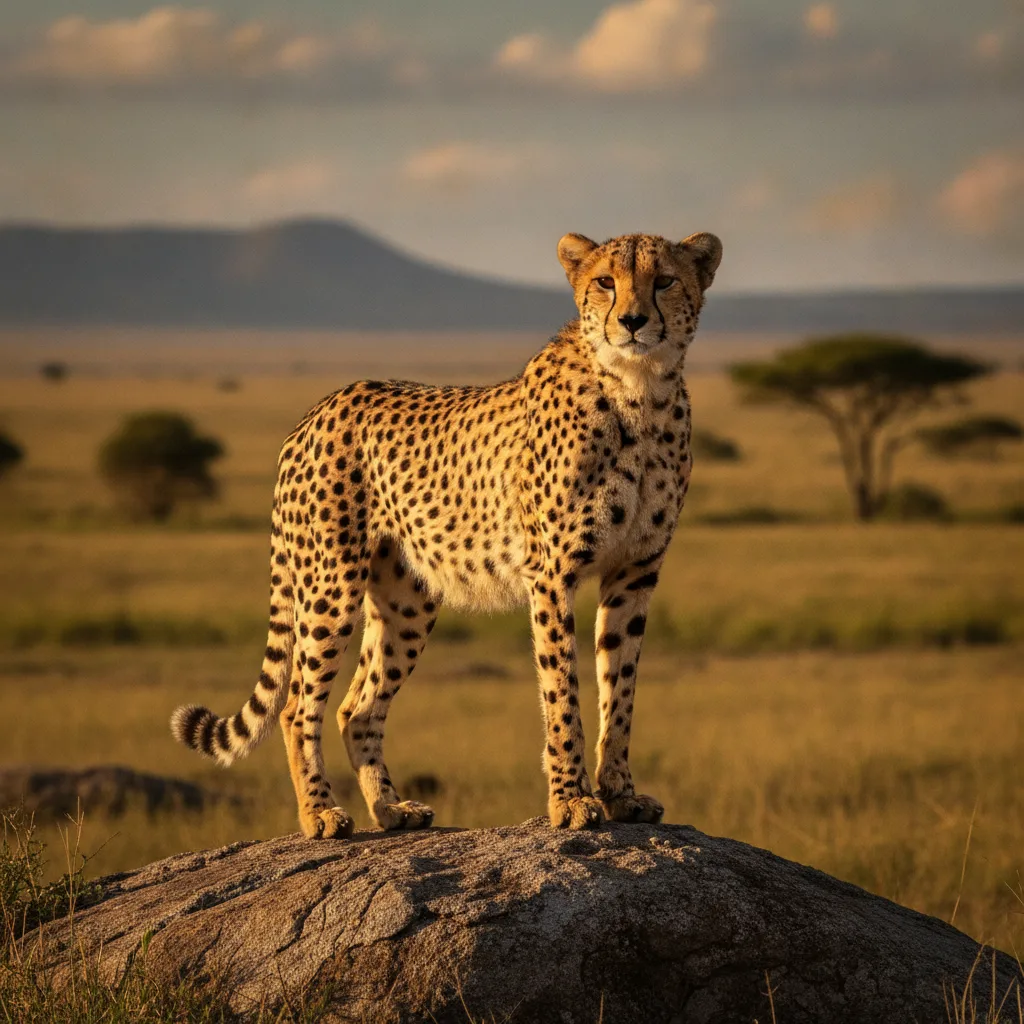
The cheetah is the fastest land animal, accelerating from a standstill to over 100 km/h in about three seconds, though a sprint lasts only a few hundred metres. Unlike other big cats it hunts by day, relying on speed rather than ambush across the open grasslands of eastern and southern Africa, with a tiny population hanging on in Iran. Around 7,000 adults remain and the species is listed as Vulnerable.
Five things to know
- Cheetahs are the fastest land animals, capable of reaching speeds up to 112 km/h (70 mph) in short bursts.
- Unlike other big cats, cheetahs cannot roar—they chirp, hiss, growl, and purr.
- Cheetahs have black 'tear marks' running from the corners of their eyes to their mouth, helping reduce sun glare.
- Their claws are only semi-retractable, aiding in traction during sprints.
- The cheetah population has declined by more than 90% in the past century.
Homeschool unit: Animals homeschool guide — Habitats, adaptations and food chains as a graded unit, with the cheetah as one of its worked examples.