Cheetah
Acinonyx jubatus
The cheetah is the fastest land animal, accelerating from a standstill to over 100 km/h in about three seconds, though a sprint lasts only a few hundred metres. Unlike other big cats it hunts by day, relying on speed rather than ambush across the open grasslands of eastern and southern Africa, with a tiny population hanging on in Iran. Around 7,000 adults remain and the species is listed as Vulnerable.
Quick facts: Size 1.1–1.5 meters (head-body) with a 0.6–0.8 meter tail · Lifespan Around 10 years in the wild (up to 14 years max) · IUCN status Vulnerable
Print the fact sheet — a free one-page PDF for homeschool and classroom use
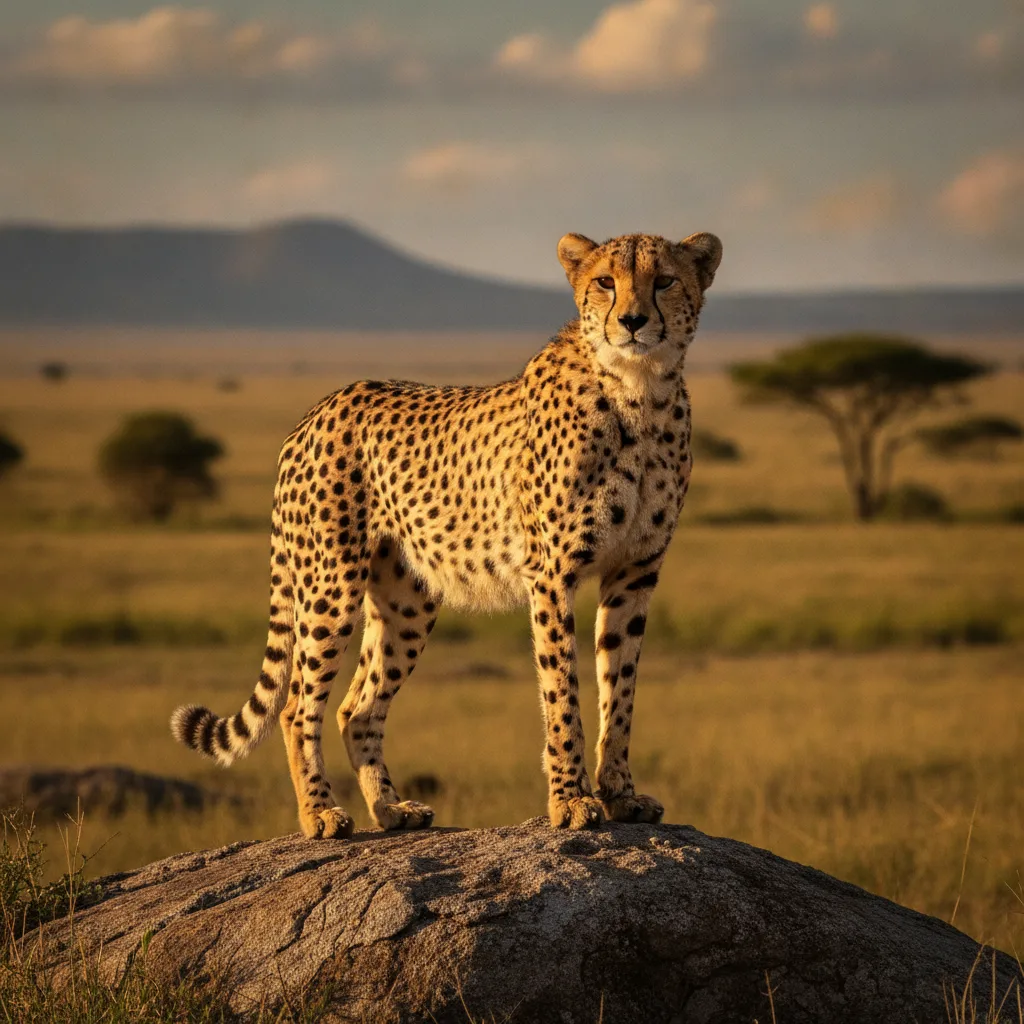
Cheetah at a glance
| Scientific name | Acinonyx jubatus |
|---|---|
| IUCN status | Vulnerable |
| Population | 7,100 - 7,500 |
| Population trend | decreasing |
| Weight | 50–72 kg |
| Length | 1.3–1.5 m |
| Lifespan | 10–14 years |
| Top speed | 112 km/h |
| Class | Mammalia |
| Order | Carnivora |
| Family | Felidae |
| Known species | 5 |
Need to know
- Cheetahs are the fastest land animals, capable of reaching speeds up to 112 km/h (70 mph) in short bursts.
- Unlike other big cats, cheetahs cannot roar—they chirp, hiss, growl, and purr.
- Cheetahs have black 'tear marks' running from the corners of their eyes to their mouth, helping reduce sun glare.
- Their claws are only semi-retractable, aiding in traction during sprints.
- The cheetah population has declined by more than 90% in the past century.
- The Asiatic cheetah is one of the world’s rarest cats, with fewer than 50 left in the wild.
About the Cheetah
The cheetah (Acinonyx jubatus) is a highly specialized member of the cat family renowned for its unrivaled speed and agility. Evolved for sprinting, cheetahs possess a lightweight frame, elongated limbs, deep chest, and a flexible spine, allowing them to accelerate from 0 to 96 km/h (0 to 60 mph) in just a few seconds. Originally widespread across Africa, the Middle East, and southern Asia, cheetahs are now mostly confined to patches of sub-Saharan Africa, with a critically endangered population surviving in Iran.
Cheetahs differ from other big cats in both appearance and behavior. Their spotted golden-yellow coats, distinctive black tear marks on the face, small heads, and deep chests set them apart. Cheetahs rely on sight rather than smell for hunting and must chase down their prey in open landscapes. Threatened by habitat loss, conflict with humans, and illegal wildlife trade, cheetahs are classified as Vulnerable, with some subspecies, like the Asiatic and Saharan cheetahs, being Critically Endangered.
Physical characteristics
Size: 1.1–1.5 meters (head-body) with a 0.6–0.8 meter tail. Weight: 34–72 kg. Lifespan: Around 10 years in the wild (up to 14 years max).
- Slender, lightweight build
- Deep chest and small, rounded head
- Long legs and flexible spine
- Short, coarse golden-yellow fur covered in solid black spots
- Black 'tear marks' from eye to mouth
Notable species
- Southeast African Cheetah (Acinonyx jubatus jubatus) — Vulnerable. Savannahs, grasslands, and arid regions Regions: South Africa, Namibia, Botswana, Zambia, Zimbabwe, Mozambique.
- Northeast African Cheetah (Acinonyx jubatus soemmeringii) — Endangered. Semi-desert grasslands and shrublands Regions: Ethiopia, South Sudan, Northern Kenya, Somalia.
- Northwest African Cheetah (Acinonyx jubatus hecki) — Critically Endangered. Sahara and arid desert regions Regions: Sahara Desert, Central and Western Sahara, Mali, Niger, Algeria, Benin.
- Asiatic Cheetah (Acinonyx jubatus venaticus) — Critically Endangered. Remote desert and steppe habitats Regions: Central Iran, Dasht-e Kavir desert, Dasht-e Lut desert.
- East African Cheetah (Acinonyx jubatus raineyi) — Vulnerable. Savannahs and open plains Regions: Kenya, Tanzania, Uganda, Somalia.
Habitat and range
Original range: Widespread across Africa, the Middle East, Arabian Peninsula, and Indian Subcontinent
Current distribution: Mostly sub-Saharan Africa with a remnant population in Iran
Preferred environments: Open grasslands, Savannahs, Arid and semi-arid regions, Open plains, Occasionally light woodlands
Regions: Southern Africa, Eastern Africa, Sahara Desert, Central Iran, Northern Africa (remnants), Horn of Africa
Where to see Cheetah
- Serengeti National Park, Tanzania — June to October (dry season). Open plains make cheetah sightings relatively common during big game drives.
- Okavango Delta, Botswana — May to September. Track cheetahs in open grasslands at dawn or dusk.
- Kgalagadi Transfrontier Park, South Africa/Botswana — March to October. Good chance of sightings in the open Kalahari landscape.
- Dasht-e Kavir, Iran — Winter-Spring (November–April). Rare and difficult to see; require local guides and permits.
Behavior and diet
Diet: Small to medium-sized ungulates, especially gazelles (Thomson’s, Grant’s), impalas, young wildebeest, hares, birds and their eggs.
Social structure: Solitary or small family groups; males may form coalitions of brothers, females generally solitary with cubs.
Communication: Cheetahs communicate through chirps, purrs, hisses, meows, and scent markings.
- Uses sight rather than smell for hunting
- Accelerates rapidly to chase down prey in open habitat
- Employs stealth and stalking up to 30 meters before launching a high-speed chase
- Females are highly mobile, with large home ranges
Interactions with other animals
- Lion (competitive): Lions frequently kill cheetah cubs and steal cheetah kills; cheetahs avoid areas with high lion density.
- Leopard (competitive): Leopards can outcompete cheetahs and sometimes kill them; both are solitary at adult stage.
- Spotted Hyena (competitive): Hyenas regularly steal cheetah kills and may kill cubs if given the chance.
- Gazelle (prey): Thomson’s and Grant’s gazelles are primary prey species.
Conservation
IUCN Red List status: Vulnerable
Threats
- Habitat loss and fragmentation
- Human-wildlife conflict
- Illegal wildlife trade and cub trafficking
- Decline in prey populations
- Genetic bottleneck and reduced diversity
- Retaliatory killings by farmers
Conservation efforts
- Protected reserves and national parks
- Cheetah relocation and reintroduction projects
- Community-based conservation programs
- Anti-poaching patrols with rangers and technology
- Education and outreach to reduce livestock conflict
How to help
- Support wildlife charities focused on cheetah conservation
- Raise awareness about illegal wildlife trade
- Promote coexistence initiatives for local communities and cheetahs
- Avoid products made from wild animals
- Participate in eco-tourism and responsible safaris
Cheetah facts for kids
Cheetahs are the fastest animals on land, able to run as fast as a car on the highway! These beautiful big cats live in grasslands and hunt by sprinting very quickly to catch their food. Sadly, there aren't many cheetahs left, and people are working hard to protect them.
- Cheetahs can run up to 112 km/h (70 mph) for short distances!
- Baby cheetahs have a soft, fluffy 'mohawk' down their back.
- Each cheetah has a unique pattern of spots, like fingerprints.
- Cheetahs meow and chirp, but can't roar.
- They use their long tails to help balance while running super fast.
Did you know? Did you know a cheetah can go from 0 to 96 km/h (60 mph) in just three seconds—faster than most cars?
Watch & learn
- Cheetahs: Fastest Animals on Land – BBC Earth Documentary — BBC Earth. BBC Earth explores the remarkable hunting strategies, unique physiology, and survival challenges faced by the cheetah (Acinonyx jubatus) across the African savannah, delivering stunning slow-motion footage of their record-breaking sprints.
- Cheetah Family Dynamics – Nat Geo Wild’s Ultimate Predator Series — National Geographic Wild. National Geographic Wild presents in-depth coverage of a cheetah family's daily life, from cub rearing to high-stakes hunts, highlighting their role as vulnerable apex predators.
- The Secret Life of Cheetahs – PBS Nature Full Episode — PBS Nature. PBS Nature delivers a beautifully shot documentary that follows conservationists trying to save the cheetah, focusing on their ecology, behavior, and the threats these felines face in the wild.
- Cheetah: Race Against Extinction – Smithsonian Channel Wildlife Special — Smithsonian Channel. Smithsonian Channel examines the evolutionary adaptations that make the cheetah the world’s fastest land animal, while also addressing the fragility of their populations and urgent conservation needs.
- Cheetah Cubs Growing Up – Baby Animals Documentary — BBC Earth. Experience the incredible journey of cheetah cubs from playful innocence to skilled hunters in this BBC Earth segment focusing on the challenges of cub survival in the wild.
Sources
Facts on this page are checked against these references. Follow them for the primary data.
- IUCN Red List — Conservation status, population trend and range assessment for Acinonyx jubatus
- Encyclopaedia Britannica — Reviewed encyclopaedia entry on the cheetah
- National Geographic — Articles, photographs and field reporting on the cheetah