Hands Down Animals · Printable fact sheet
Hawksbill Turtle
Eretmochelys imbricata
Quick facts
| Scientific name | Eretmochelys imbricata |
|---|---|
| Size | 60-90 cm shell length (adults) |
| Weight | 45-80 kg (adults) |
| Lifespan | 30-50 years |
| Diet | Primarily sponges; also feeds on tunicates, anemones, jellyfish, algae, and occasionally mollusks. |
| Habitat | Coral reefs, Rocky coastal areas, Shallow lagoons |
| Where it lives | Caribbean Sea, Western Atlantic Ocean, Indian Ocean, Coral Triangle |
| IUCN status | Critically Endangered |
| Population | 15,000 - 25,000 mature individuals |
| Top speed | 24 km/h |
| Family | Cheloniidae |
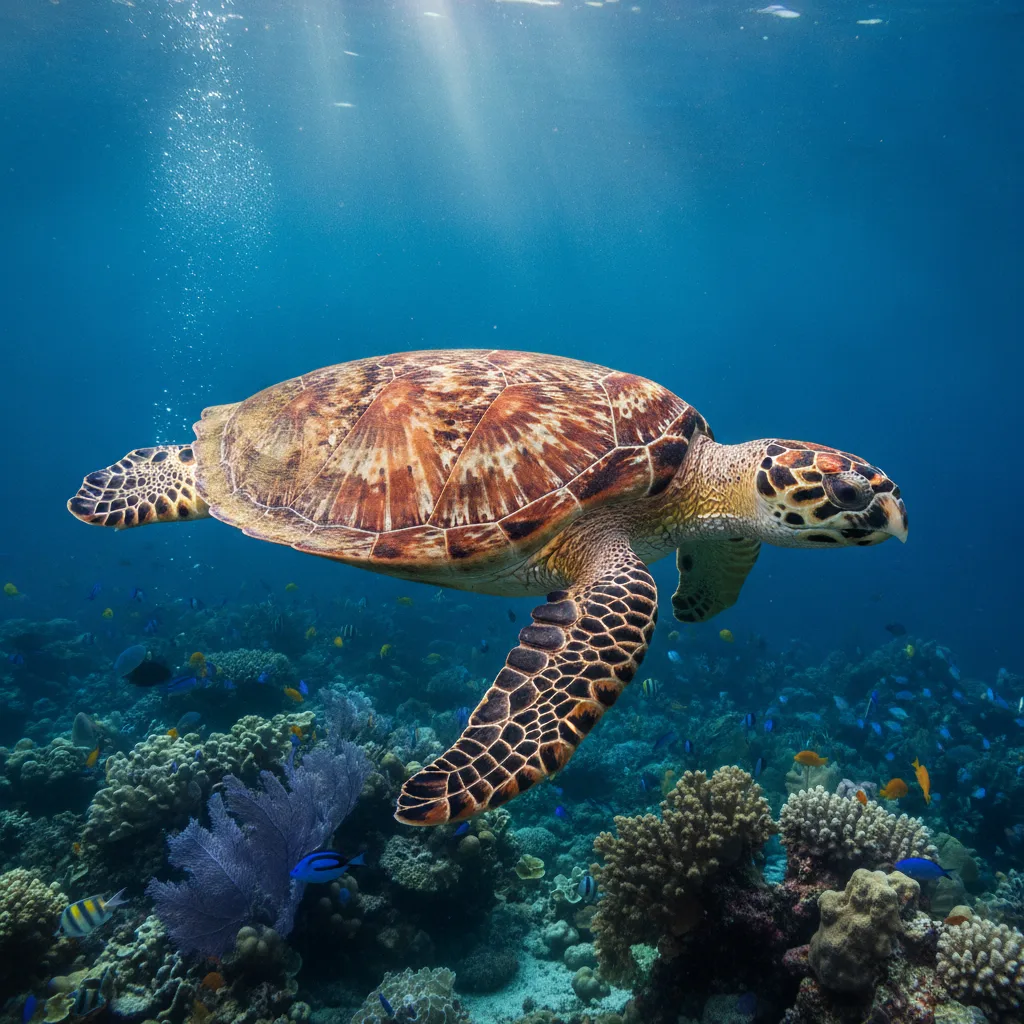
About the hawksbill turtle
The hawksbill turtle lives around coral reefs throughout the tropics, using its narrow, beak-like jaw to pull sponges from crevices; sponges make up most of its diet. Its overlapping amber-and-brown shell plates were the source of 'tortoiseshell', and centuries of trade in that material are the main reason the species is Critically Endangered. Adults are small for sea turtles, usually under a metre long.
Five things to know
- Hawksbill Turtles are the most tropical of all sea turtles and depend heavily on coral reefs.
- Their sharp, narrow, hawk-like beak allows them to extract sponges from crevices in coral.
- Their beautiful shells, known as 'tortoiseshell,' have led to centuries of exploitation.
- They are one of the few animals specialized to eat toxic marine sponges.
- Hawksbill nesting beaches are most common in the Caribbean and Indo-Pacific.
Homeschool unit: Ocean homeschool guide — An ocean unit on marine food webs, tides and conservation, with the hawksbill turtle as a case study.