Hawksbill Turtle
Eretmochelys imbricata
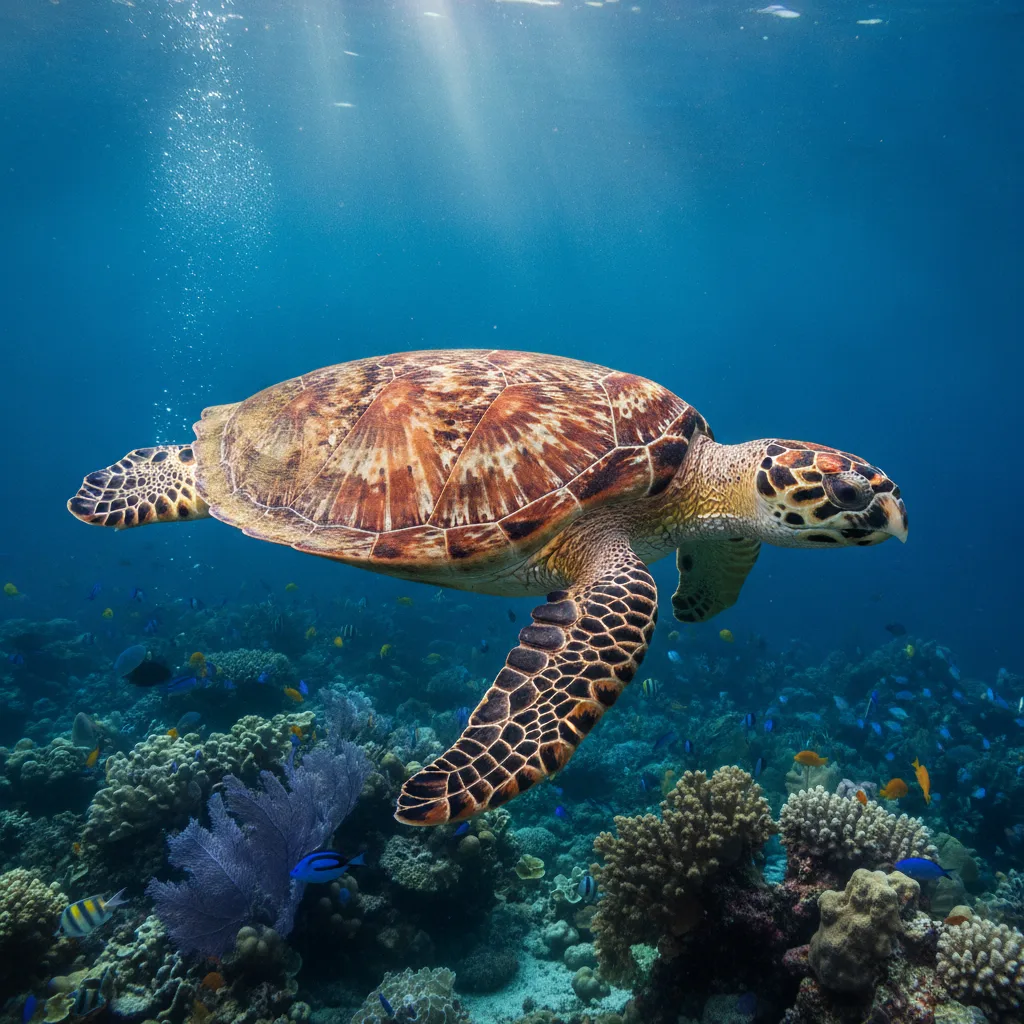
The hawksbill turtle lives around coral reefs throughout the tropics, using its narrow, beak-like jaw to pull sponges from crevices; sponges make up most of its diet. Its overlapping amber-and-brown shell plates were the source of 'tortoiseshell', and centuries of trade in that material are the main reason the species is Critically Endangered. Adults are small for sea turtles, usually under a metre long.
Quick facts: Size 60-90 cm shell length (adults) · Lifespan 30-50 years · IUCN status Critically Endangered
Print the fact sheet — a free one-page PDF for homeschool and classroom use
Hawksbill Turtle at a glance
| Scientific name | Eretmochelys imbricata |
|---|---|
| IUCN status | Critically Endangered |
| Population | 15,000 - 25,000 mature individuals |
| Population trend | decreasing |
| Weight | 60–80 kg |
| Length | 0.75–1.1 m |
| Lifespan | 30–50 years |
| Top speed | 24 km/h |
| Class | Reptilia |
| Order | Testudines |
| Family | Cheloniidae |
Need to know
- Hawksbill Turtles are the most tropical of all sea turtles and depend heavily on coral reefs.
- Their sharp, narrow, hawk-like beak allows them to extract sponges from crevices in coral.
- Their beautiful shells, known as 'tortoiseshell,' have led to centuries of exploitation.
- They are one of the few animals specialized to eat toxic marine sponges.
- Hawksbill nesting beaches are most common in the Caribbean and Indo-Pacific.
About the Hawksbill Turtle
The Hawksbill Turtle (Eretmochelys imbricata) is a critically endangered marine reptile celebrated for its stunning shell and essential role in coral reef ecosystems. It inhabits tropical oceans around the world, especially favoring coral reefs where it feeds primarily on sponges, thus helping maintain reef health by controlling sponge populations. Their populations have plummeted due to historic and ongoing exploitation for their attractive shells, coastal habitat loss, entanglement in fishing gear, and climate change impacts on nesting beaches.
With only one recognized species in the genus, hawksbill turtles are highly migratory, traveling between nesting beaches and feeding grounds across vast stretches of ocean. They are solitary for most of their lives, coming ashore only to nest, and are critical to marine biodiversity. Their distinctive hook-like beak, vibrant carapace pattern, and ecological significance make them one of the most iconic and ecologically important sea turtles worldwide.
Physical characteristics
Size: 60-90 cm shell length (adults). Weight: 45-80 kg (adults). Lifespan: 30-50 years.
- Overlapping (imbricated) amber-and-dark-brown scutes with a radiating pattern
- Narrow, pointed beak resembling a hawk's bill
- Two pairs of prefrontal scales between the eyes
- Serrated rear edge of carapace
- Long, paddle-like forelimbs
Notable species
- Hawksbill Turtle (Eretmochelys imbricata) — Critically Endangered. Shallow tropical coral reefs, rocky coastal areas, lagoons, and semi-enclosed marine environments Regions: Caribbean Sea, Western Atlantic Ocean, Indian Ocean, Eastern Pacific Ocean, Coral Triangle, Coral Sea, Red Sea, waters off Southeast Asia.
Habitat and range
Original range: Tropical and subtropical reefs of the Atlantic, Indian, and Pacific Oceans
Current distribution: Still present in tropical coral reefs across the Atlantic, Indian, and Pacific Oceans, with significant declines in many areas
Preferred environments: Coral reefs, Rocky coastal areas, Shallow lagoons, Estuaries, Occasionally seagrass beds
Regions: Caribbean Sea, Western Atlantic Ocean, Indian Ocean, Coral Triangle, Red Sea, Coral Sea, Eastern Pacific Ocean, waters off northern Australia, waters off East Africa, waters off Southeast Asia
Where to see Hawksbill Turtle
- Bonaire Marine Park, Caribbean Sea — May to December (nesting and hatching season). Best observed while snorkeling or diving over shallow reefs.
- Great Barrier Reef, Coral Sea — September to February. Dive operators can guide responsible encounters; observe from a safe distance.
- Maldives, Indian Ocean — Year-round. Frequent on outer reefs; watch for feeding at cleaning stations.
Behavior and diet
Diet: Primarily sponges; also feeds on tunicates, anemones, jellyfish, algae, and occasionally mollusks.
Social structure: Mostly solitary except during mating season; juveniles sometimes aggregate in coastal nurseries.
Communication: Communicate through tactile signals, visual cues, and possible low-frequency sounds while underwater.
- Uses narrow beak to extract sponges and invertebrates from crevices in coral reef
- Females return to the same beach they hatched on to nest (natal homing)
- Rest during the day in ledges or crevices of coral reefs to avoid predators
- Nighttime nesting is synchronized with lunar cycles to minimize predation risk
Interactions with other animals
- Reef sponges (prey): Hawksbills are one of the main predators of reef sponges, helping maintain coral health.
- Tiger Sharks (predator): Tiger sharks are one of the main natural predators, preying on both juveniles and adults.
- Remora fish (symbiotic): Remoras attach to hawksbill turtles, taking advantage of currents and scraps while providing cleaning.
Conservation
IUCN Red List status: Critically Endangered
Threats
- Illegal trade in tortoiseshell ('bekko')
- Bycatch in fishing gear (gillnets, trawls, longlines)
- Coastal development and habitat loss
- Pollution, especially plastic ingestion
- Climate change impacting nesting beaches and sex ratios
Conservation efforts
- International ban on tortoiseshell trade (CITES Appendix I)
- Nest protection and hatchery programs
- Marine Protected Areas (MPAs) and coral reef conservation
- Bycatch reduction devices and sustainable fisheries education
- Global awareness and ecotourism to support local conservation
How to help
- Never purchase tortoiseshell products or souvenirs
- Support certified ecotourism and turtle conservation organizations
- Participate in or donate to beach clean-ups
- Advocate for responsible fishing practices and bycatch reduction
- Raise awareness about marine plastic pollution
Hawksbill Turtle facts for kids
Hawksbill turtles are beautiful sea turtles that live in warm, tropical oceans and help coral reefs stay healthy. Their beak looks like a bird’s beak, and their colorful shells have made people want to collect them, which has caused the turtles to become really rare. Today, people all over the world are helping protect hawksbill turtles and their homes!
- Hawksbill turtles get their name because their mouth looks just like a bird’s beak!
- They eat sponges—even ones that are poisonous to other animals!
- Baby hawksbills are the size of a potato chip when they hatch.
- If you see a turtle with a super colorful shell on a coral reef, it might be a hawksbill!
- They can swim fast—up to 24 kilometers per hour!
Did you know? Did you know? One hawksbill turtle can eat more than a thousand sponges each year, helping keep coral reefs healthy!
Watch & learn
- Hawksbill Turtle: Jewel of the Coral Reefs — BBC Earth. Experience breathtaking footage of the critically endangered Hawksbill Turtle as it navigates vibrant coral reefs, highlighting its role in maintaining reef health. BBC Earth's expert commentary showcases rare nesting behavior and conservation efforts.
- The Life Cycle of Hawksbill Sea Turtles — National Geographic. This in-depth feature from National Geographic follows the extraordinary journey of Eretmochelys imbricata from hatchling to adulthood, focusing on migration, predators, and human threats.
- Saving the Hawksbill Turtle: Coral Triangle Adventures — Smithsonian Channel. Join marine biologists as they study and protect Hawksbill Turtles within the biologically rich Coral Triangle, capturing stunning underwater behavior and innovative conservation methods.
- Hawksbill Turtles: Guardians of the Reef — PBS Nature. PBS Nature presents a compelling look at how Hawksbill Turtles interact with their environment and the ecological consequences of their decline, including interviews with global conservationists.
- Hawksbill Sea Turtles: Underwater Architects — OceanX & National Geographic. This collaboration provides incredible close-up encounters with Hawksbill Turtles, explaining their unique shell structure and their essential contribution to coral reef architecture.
Sources
Facts on this page are checked against these references. Follow them for the primary data.
- IUCN Red List — Conservation status, population trend and range assessment for Eretmochelys imbricata
- Encyclopaedia Britannica — Reviewed encyclopaedia entry on the hawksbill turtle
- National Geographic — Articles, photographs and field reporting on the hawksbill turtle