Hands Down Animals · Printable fact sheet
Humpback Whale
Megaptera novaeangliae
Quick facts
| Scientific name | Megaptera novaeangliae |
|---|---|
| Size | Typical adult size 12–16 meters; maximum up to 18 meters |
| Weight | Average 25,000–30,000 kg; up to 40,000 kg |
| Lifespan | Typically 45–50 years, maximum known close to 95 years |
| Diet | Small schooling fish (e.g., herring, anchovy, capelin), krill, and other zooplankton. |
| Habitat | Open ocean, Coastal shelf waters, Subpolar and temperate feeding grounds |
| Where it lives | North Atlantic Ocean, North Pacific Ocean, South Atlantic Ocean, Southern Ocean |
| IUCN status | Least Concern |
| Population | 80,000 - 90,000 |
| Top speed | 27 km/h |
| Family | Balaenopteridae |
About the humpback whale
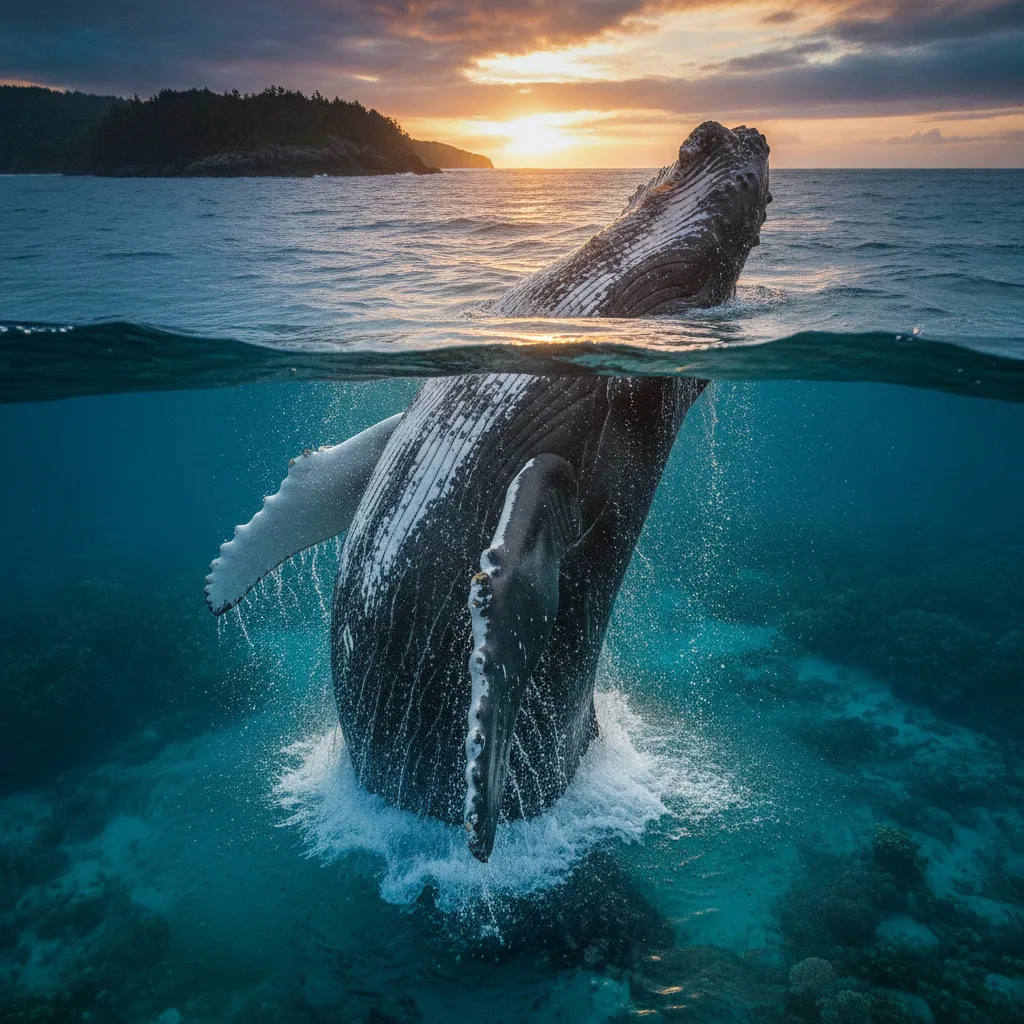
Humpback whales are found in every ocean, feeding in cold polar waters in summer and migrating thousands of kilometres to tropical breeding grounds in winter. Males sing long, structured songs that change across a whole population over the course of a season, and groups sometimes corral fish by blowing curtains of bubbles around them. Whaling cut the species to a few thousand, but most populations have rebounded and it is now listed as Least Concern.
Five things to know
- Humpback whales are famous for their haunting, complex songs that can travel for miles underwater.
- They perform spectacular aerial displays, including breaching and fin-slapping.
- Humpbacks have the longest pectoral fins of any whale, up to one-third their body length.
- Annual migrations can exceed 8,000 km between polar feeding and tropical breeding grounds.
- Once hunted almost to extinction, humpbacks have made a significant comeback since the 1966 global whaling ban.
Homeschool unit: Ocean homeschool guide — An ocean unit on marine food webs, tides and conservation, with the humpback whale as a case study.