Humpback Whale
Megaptera novaeangliae
Humpback whales are found in every ocean, feeding in cold polar waters in summer and migrating thousands of kilometres to tropical breeding grounds in winter. Males sing long, structured songs that change across a whole population over the course of a season, and groups sometimes corral fish by blowing curtains of bubbles around them. Whaling cut the species to a few thousand, but most populations have rebounded and it is now listed as Least Concern.
Quick facts: Size Typical adult size 12–16 meters; maximum up to 18 meters · Lifespan Typically 45–50 years, maximum known close to 95 years · IUCN status Least Concern
Print the fact sheet — a free one-page PDF for homeschool and classroom use
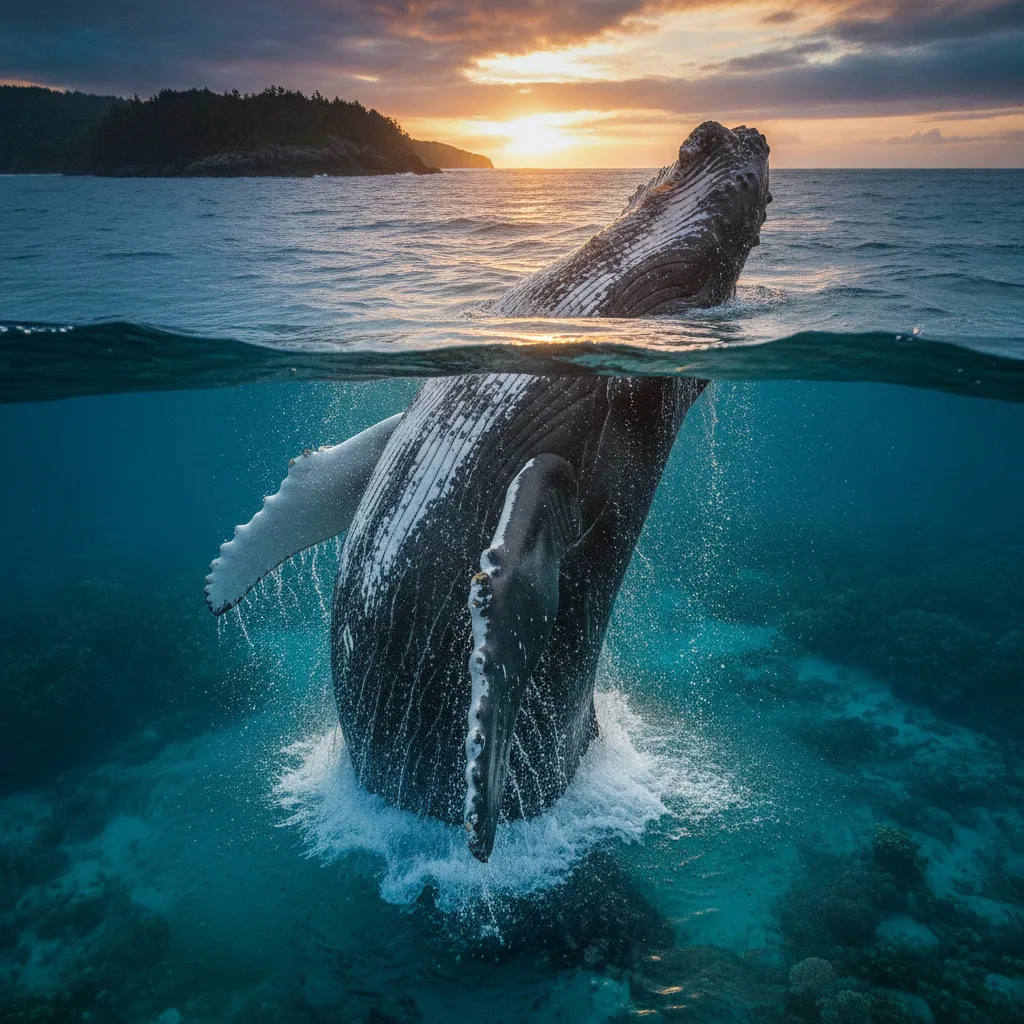
Humpback Whale at a glance
| Scientific name | Megaptera novaeangliae |
|---|---|
| IUCN status | Least Concern |
| Population | 80,000 - 90,000 |
| Population trend | increasing |
| Weight | 30000–40000 kg |
| Length | 14–18 m |
| Lifespan | 45–95 years |
| Top speed | 27 km/h |
| Class | Mammalia |
| Order | Cetacea |
| Family | Balaenopteridae |
Need to know
- Humpback whales are famous for their haunting, complex songs that can travel for miles underwater.
- They perform spectacular aerial displays, including breaching and fin-slapping.
- Humpbacks have the longest pectoral fins of any whale, up to one-third their body length.
- Annual migrations can exceed 8,000 km between polar feeding and tropical breeding grounds.
- Once hunted almost to extinction, humpbacks have made a significant comeback since the 1966 global whaling ban.
- Each individual has a unique pattern underneath its tail flukes, used by scientists for identification.
About the Humpback Whale
The Humpback Whale (Megaptera novaeangliae) is a large baleen whale renowned for its acrobatics, hauntingly beautiful vocalizations, and extraordinary migrations. Found in oceans worldwide, these marine giants were decimated by commercial whaling but have shown a remarkable recovery thanks to conservation measures.
Humpbacks make some of the longest known animal migrations, traveling thousands of kilometers between cold, food-rich polar waters and warm breeding grounds. Their dramatic breaches and complex songs make them a favorite among whale watchers and marine researchers alike.
Physical characteristics
Size: Typical adult size 12–16 meters; maximum up to 18 meters. Weight: Average 25,000–30,000 kg; up to 40,000 kg. Lifespan: Typically 45–50 years, maximum known close to 95 years.
- Elongated pectoral fins (one-third of body length)
- Knobby protuberances (tubercles) on head and lower jaw
- Unique black-and-white tail fluke patterns
- Deeply notched flukes
- Robust, muscular bodies with variable dorsal fin
Notable species
- Humpback Whale (North Atlantic population) (Megaptera novaeangliae) — Least Concern. Open ocean and continental shelf waters; migrates between tropical breeding and colder feeding areas Regions: North Atlantic Ocean, Caribbean Sea, waters off Iceland, Norwegian Sea, Gulf of Maine.
- Humpback Whale (North Pacific population) (Megaptera novaeangliae) — Least Concern. Coastal and offshore waters, migrates between Mexican/Hawaiian breeding grounds and North Pacific feeding grounds Regions: North Pacific Ocean, waters off Alaska, Gulf of Alaska, Bering Sea, Sea of Japan.
- Humpback Whale (Southern Ocean population) (Megaptera novaeangliae) — Least Concern. Migratory from polar feeding zones to tropical/subtropical breeding waters Regions: Southern Ocean, South Atlantic Ocean, Indian Ocean, waters off Antarctica, Coral Sea.
- Humpback Whale (Arabian Sea population) (Megaptera novaeangliae) — Endangered. Confined to the Arabian Sea and surrounding coastal waters, year-round residence Regions: Arabian Sea, Gulf of Oman, coastal waters off Oman, Laccadive Sea.
Habitat and range
Original range: Humpbacks evolved in oceanic waters, primarily inhabiting temperate and polar regions.
Current distribution: Today, humpback whales are found in every major ocean, with populations occupying the North Pacific, North Atlantic, Southern Ocean, Indian Ocean, and a unique population in the Arabian Sea.
Preferred environments: Open ocean, Coastal shelf waters, Subpolar and temperate feeding grounds, Tropical and subtropical breeding regions
Regions: North Atlantic Ocean, North Pacific Ocean, South Atlantic Ocean, Southern Ocean, Indian Ocean, Caribbean Sea, Coral Sea, Gulf of Alaska, Waters off Antarctica, Arabian Sea, Laccadive Sea, Norwegian Sea, Gulf of Maine
Where to see Humpback Whale
- Stellwagen Bank, Gulf of Maine — May to October. Whale watching cruises offer reliable sightings and displays of feeding and breaching.
- Hervey Bay, Queensland, Australia — July to November. Sheltered bay attracts mothers and calves during migration.
- Silver Bank, Caribbean Sea — January to March. One of the world’s main breeding and calving grounds.
- Húsavík, Iceland (North Atlantic) — June to August. Rich feeding grounds, high encounter rates.
Behavior and diet
Diet: Small schooling fish (e.g., herring, anchovy, capelin), krill, and other zooplankton.
Social structure: Generally solitary or found in small, temporary groups, except during breeding and feeding; mother-calf bonds are strong during the first year.
Communication: Use complex vocalizations, especially the males, producing intricate 'songs' during the breeding season; also use slaps with pectoral fins and tails as signals.
- Bubble-net feeding: cooperative hunting method to herd prey
- Spectacular breaching and pectoral fin slapping on the surface
- Long-distance singing by males during the breeding season
- Migration between polar feeding and tropical breeding areas
Interactions with other animals
- Krill (prey): Major food source during feeding season in polar regions.
- Orca (Killer Whale) (predator): Orcas occasionally prey on calves and rarely adults.
- Seabirds (commensal): Feed on fish driven to the surface by humpback bubble-net feeding.
- Dolphins (competitive): Occasionally compete for the same prey species in some regions.
Conservation
IUCN Red List status: Least Concern
Threats
- Entanglement in fishing gear
- Ship strikes
- Noise pollution
- Climate change affecting food supply
- Plastic and marine debris ingestion
Conservation efforts
- Global moratorium on commercial whaling (IWC, since 1966)
- Protection in marine sanctuaries and critical habitats
- Mandatory vessel speed restrictions in migration/breeding areas
- Ongoing monitoring of population and health
How to help
- Support organizations working on whale conservation
- Advocate for responsible whale-watching practices
- Reduce use of plastics and prevent ocean pollution
- Be aware of vessel regulations in whale habitats
- Report stranded or entangled whales to local authorities
Humpback Whale facts for kids
Humpback whales are huge, gentle giants of the sea that swim all over the world’s oceans. They leap out of the water and sing beautiful songs that can be heard from far away. Many people love to watch them as they travel long distances every year.
- A humpback whale’s flipper can be as long as a car.
- They make huge splashes when they jump out of the water!
- Baby humpbacks, called calves, drink hundreds of liters of milk every day.
- Some humpback whales travel farther in a year than any other mammal.
- Scientists can tell whales apart by the patterns on their tails.
Did you know? Did you know? Humpback whales use bubbles to catch their food—they swim in circles and blow bubbles to trap fish in a net of bubbles!
Watch & learn
- Humpback Whales: Giants of the Ocean — BBC Earth. This documentary showcases the remarkable behaviors of Megaptera novaeangliae, including their migration, songs, and bubble-net feeding. Featuring breathtaking footage and expert commentary, it's an essential watch for humpback whale enthusiasts.
- Humpback Whale Songs and Social Lives — PBS Nature. Dive into the fascinating social structure of humpback whales and the science behind their iconic songs in this beautifully filmed special. The episode highlights recent research and stunning underwater videography.
- Epic Migrations: The Journey of the Humpback Whale — National Geographic. Follow the awe-inspiring migration of humpback whales as they travel thousands of miles across the ocean. National Geographic's specialists provide insights into the challenges these marine giants face along their route.
- Humpback Whale Feeding Frenzy — Smithsonian Channel. Watch as humpback whales execute their ingenious bubble-net feeding technique in this action-packed Smithsonian Channel spotlight. The footage captures the unique teamwork and communication skills of Megaptera novaeangliae.
- The Intelligence of Humpback Whales — BBC Earth Unplugged. Explore the intelligence, communication, and problem-solving skills of humpback whales with BBC Earth Unplugged's scientific perspective. Biologists reveal the complexity of these mammals' behaviors through incredible encounters.
Sources
Facts on this page are checked against these references. Follow them for the primary data.
- IUCN Red List — Conservation status, population trend and range assessment for Megaptera novaeangliae
- Encyclopaedia Britannica — Reviewed encyclopaedia entry on the humpback whale
- National Geographic — Articles, photographs and field reporting on the humpback whale