Hands Down Animals · Printable fact sheet
Kangaroo
Macropus
Quick facts
| Scientific name | Macropus |
|---|---|
| Size | 1.3 to 2.2 meters tall (head and body, excluding tail) |
| Weight | 25 to 90 kg depending on species and sex |
| Lifespan | Average 12 years in the wild, up to 23 years in captivity |
| Diet | Herbivorous; primarily grasses, leaves, some shrubs and flowering plants. |
| Habitat | Grasslands, Open woodlands, Savanna |
| Where it lives | Western Australia, Northern Territory, South Australia, Queensland |
| IUCN status | Least Concern |
| Population | 45,000,000 - 50,000,000 |
| Top speed | 65 km/h |
| Family | Macropodidae |
About the kangaroo
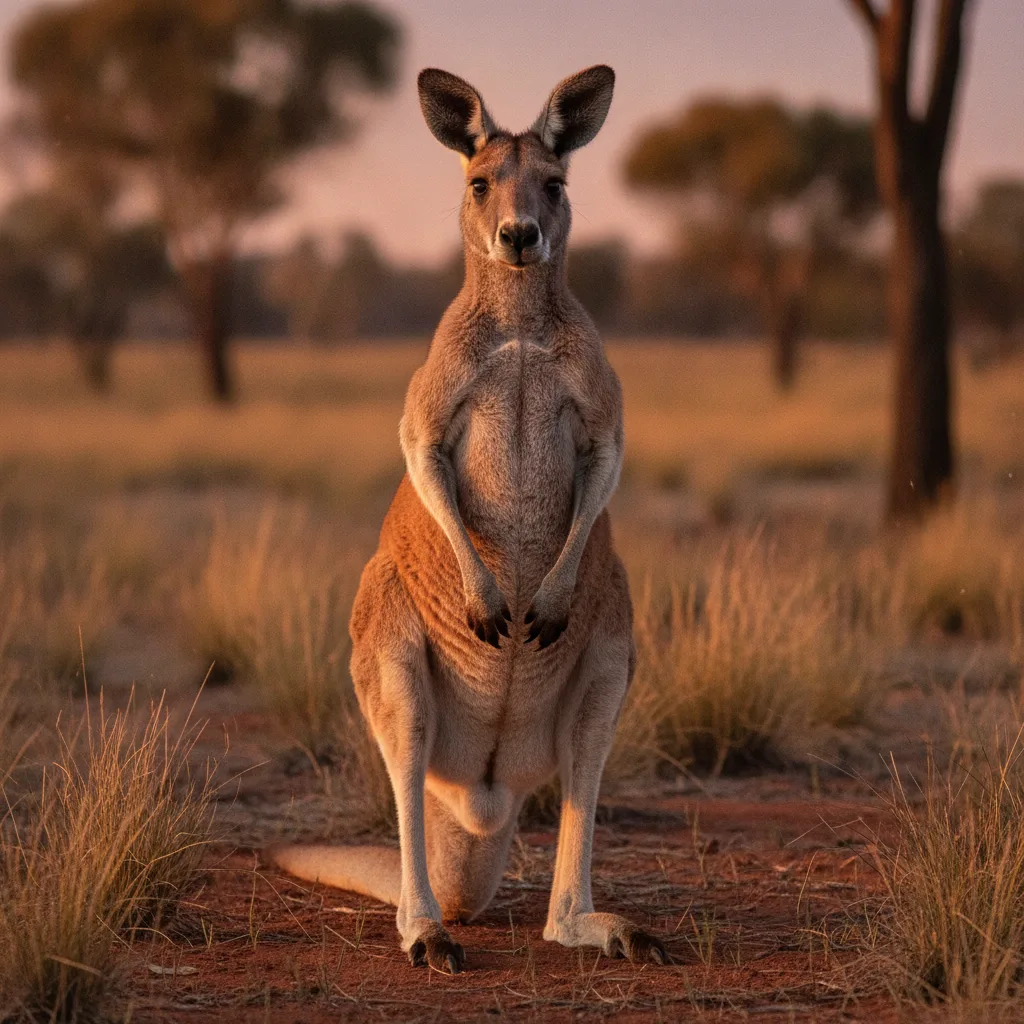
Kangaroos are Australia's largest marsupials, and a big male red kangaroo can stand as tall as an adult human. Hopping is remarkably efficient: elastic tendons store energy with each bound, so a kangaroo cruising at 25 km/h uses little more energy than at walking pace, and it can top 60 km/h in bursts. All four large species are Least Concern, with tens of millions living wild — more than Australia's human population.
Five things to know
- Kangaroos are the largest marsupials and unique to Australia.
- They use powerful hind legs to hop at speeds up to 65 km/h.
- A kangaroo's tail acts as a fifth limb for balance and support.
- Female kangaroos have pouches and can pause embryo development (embryonic diapause).
- Kangaroos are social, often found grazing in groups called 'mobs'.
Homeschool unit: Animals homeschool guide — Habitats, adaptations and food chains as a graded unit, with the kangaroo as one of its worked examples.