Kangaroo
Macropus
Kangaroos are Australia's largest marsupials, and a big male red kangaroo can stand as tall as an adult human. Hopping is remarkably efficient: elastic tendons store energy with each bound, so a kangaroo cruising at 25 km/h uses little more energy than at walking pace, and it can top 60 km/h in bursts. All four large species are Least Concern, with tens of millions living wild — more than Australia's human population.
Quick facts: Size 1.3 to 2.2 meters tall (head and body, excluding tail) · Lifespan Average 12 years in the wild, up to 23 years in captivity · IUCN status Least Concern
Print the fact sheet — a free one-page PDF for homeschool and classroom use
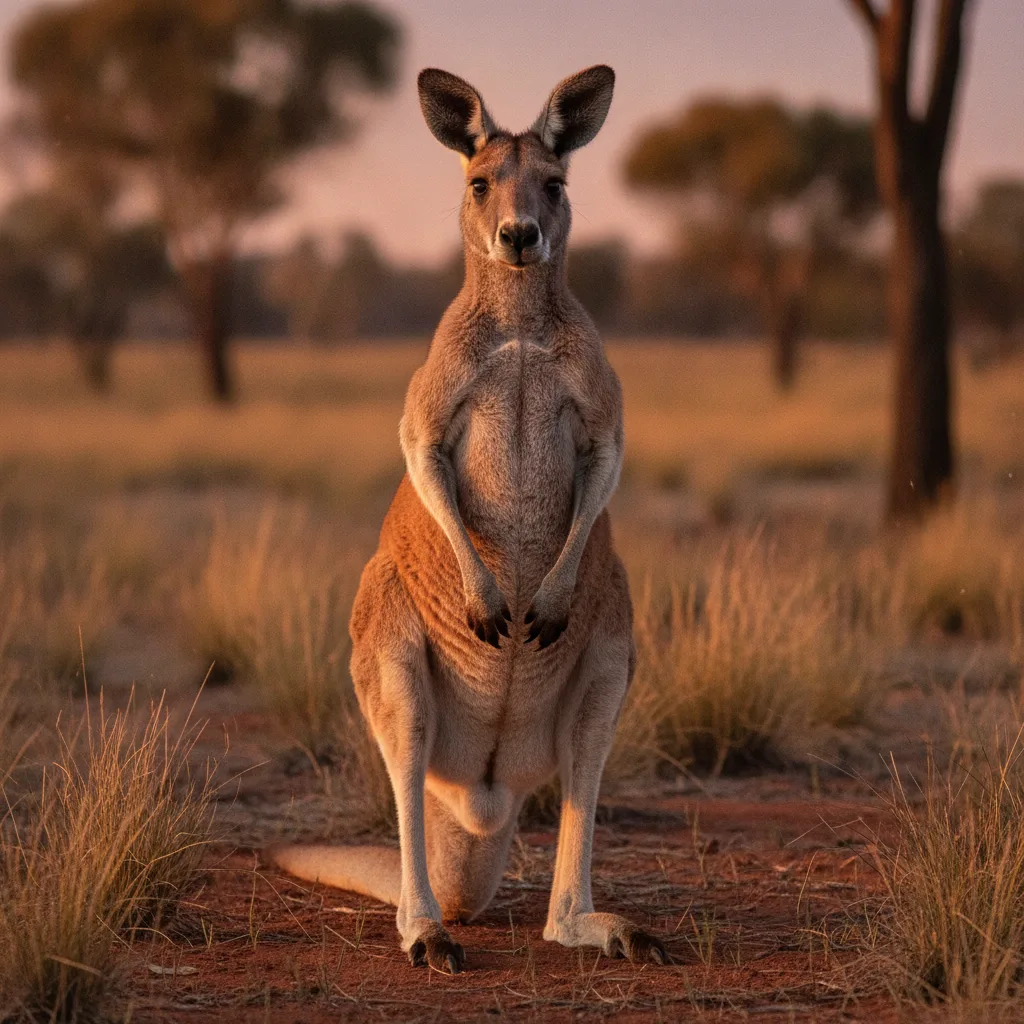
Kangaroos at a glance
| Scientific name | Macropus |
|---|---|
| IUCN status | Least Concern |
| Population | 45,000,000 - 50,000,000 |
| Population trend | stable |
| Weight | 55–90 kg |
| Length | 1.5–2.2 m |
| Lifespan | 12–23 years |
| Top speed | 65 km/h |
| Class | Mammalia |
| Order | Diprotodontia |
| Family | Macropodidae |
| Known species | 4 |
Need to know
- Kangaroos are the largest marsupials and unique to Australia.
- They use powerful hind legs to hop at speeds up to 65 km/h.
- A kangaroo's tail acts as a fifth limb for balance and support.
- Female kangaroos have pouches and can pause embryo development (embryonic diapause).
- Kangaroos are social, often found grazing in groups called 'mobs'.
- They can travel long distances in search of food and water.
About the Kangaroos
Kangaroos are iconic marsupial mammals native to Australia, instantly recognized for their long, strong hind legs, massive tails, and upright posture. Members of the genus Macropus, kangaroos are perfectly adapted for traveling vast distances across the Australian landscape by bounding, or hopping. Their mode of locomotion is one of nature's best examples of energy efficiency, allowing them to move swiftly with minimal effort.
Kangaroos play a crucial ecological role as grazers in Australia’s grasslands, woodlands, and arid regions. Social animals by nature, they mostly live in loose groups called mobs, which provide safety from predators and social interactions. The four main kangaroo species differ in size, range, and preferred environment, but all exhibit the pouch-bearing characteristic (marsupium) where females care for their young (joeys).
Physical characteristics
Size: 1.3 to 2.2 meters tall (head and body, excluding tail). Weight: 25 to 90 kg depending on species and sex. Lifespan: Average 12 years in the wild, up to 23 years in captivity.
- Powerful hind legs adapted for hopping
- Thick, muscular tail for balance
- Large, elongated feet
- Pouch for nurturing young
- Soft, variable-colored fur (red, grey, or brown depending on species)
Notable species
- Red Kangaroo (Macropus rufus) — Least Concern. Open arid and semi-arid plains, grasslands, and scrubland Regions: Central Australia, Western Australia, South Australia, New South Wales (inland), Queensland (arid interior), Northern Territory.
- Eastern Grey Kangaroo (Macropus giganteus) — Least Concern. Open forests, woodlands, coastlines, and grasslands Regions: Eastern Australia, Tasmania, Victoria, New South Wales (coastal and inland), Queensland (eastern).
- Western Grey Kangaroo (Macropus fuliginosus) — Least Concern. Woodlands, shrublands, and open plains Regions: Western Australia, South Australia, Western Victoria, New South Wales (far west), Kangaroo Island.
- Antilopine Kangaroo (Macropus antilopinus) — Least Concern. Tropical grasslands and open woodlands Regions: Northern Queensland, Northern Territory (Top End), Kimberley (Western Australia).
Habitat and range
Original range: Australia’s open grasslands and woodlands
Current distribution: Widespread across Australia (excluding dense forests, extreme deserts, and Tasmania for some species); none in the wild outside Australia
Preferred environments: Grasslands, Open woodlands, Savanna, Arid scrub, Tropical savanna
Regions: Western Australia, Northern Territory, South Australia, Queensland, New South Wales, Victoria, Tasmania (some eastern greys), Kangaroo Island
Where to see Kangaroos
- Flinders Ranges National Park, South Australia — March to October (cooler months). Look for kangaroos in early morning or late afternoon when they graze near open areas.
- Kakadu National Park, Northern Territory — May to September (dry season). Antilopine kangaroos seen in open woodlands and floodplains.
- Grampians National Park, Victoria — All year. Eastern grey kangaroos common around grassland edges and picnic areas.
- Kangaroo Island, South Australia — March to October. Western grey kangaroos seen grazing in woodlands and open fields.
Behavior and diet
Diet: Herbivorous; primarily grasses, leaves, some shrubs and flowering plants.
Social structure: Kangaroos live in loose groups called mobs (generally 10–50 individuals), led by a dominant male.
Communication: They communicate with grunts, coughs, clicks, and foot thumping; visual cues and scent marking are also important.
- Hopping is the primary mode of movement, using elastic tendons to conserve energy.
- Females practice embryonic diapause, pausing development of a new embryo until the pouch is free.
- Kangaroos box: males fight by standing upright, balancing on their tails, and striking with forelimbs.
- Licking of forearms to cool down in hot weather.
Interactions with other animals
- Dingo (predator): Dingoes are primary natural predators of kangaroos, especially the young and weaker individuals.
- Cattle (competitive): Kangaroos and livestock may compete for grazing resources, especially during droughts.
- European Red Fox (predator): Foxes sometimes prey on very young kangaroo joeys.
Conservation
IUCN Red List status: Least Concern
Threats
- Habitat loss and fragmentation due to agriculture and development
- Vehicle collisions (roadkill)
- Commercial harvesting for meat and hides
- Climate variability (droughts impact food supply)
- Predation by introduced species (e.g., dogs, foxes)
Conservation efforts
- Regulated and sustainable population management programs
- Habitat conservation and restoration initiatives
- Research and monitoring of population trends
- Road signage and mitigation for vehicle collisions
How to help
- Support organizations involved in wildlife research and habitat conservation
- Drive carefully in kangaroo zones to reduce roadkill
- Participate in citizen science monitoring programs
- Advocate for protection and restoration of native Australian habitats
Kangaroos facts for kids
Kangaroos are big, hopping animals from Australia that carry their babies in a pouch. They jump really far and fast, and live in groups called mobs. Only female kangaroos have pouches where their tiny babies (joeys) grow bigger and stronger.
- Kangaroos jump instead of walking and can go super fast!
- Baby kangaroos are called joeys and are born as tiny as a jellybean.
- A group of kangaroos is called a mob.
- Kangaroos use their big, strong tails to balance while hopping.
- Kangaroos can’t walk backwards!
Did you know? Did you know a kangaroo can leap almost 3 times the length of a car in one single jump?
Watch & learn
- Life of Kangaroos: Outback Survival Stories — BBC Earth. This documentary explores the fascinating adaptations and day-to-day lives of kangaroos (Macropus) in the harsh Australian outback, featuring dramatic footage and natural history insights.
- Kangaroo Families and Social Behavior — National Geographic. National Geographic presents the complex social dynamics of kangaroo mobs, focusing on mating battles, parenting, and survival against predators.
- World's Strongest Kangaroos: Boxing and Power — Smithsonian Channel. A close-up look at the competitive world of kangaroo boxing matches, highlighting their strength, anatomy, and dominance battles for territory and mates.
- Raising Marsupials: The Life of a Kangaroo Joey — PBS Nature. PBS Nature follows the incredible journey of a joey, revealing the challenges of marsupial life and the maternal care provided by mother kangaroos from birth to independence.
- Kangaroo Megafauna: Australia’s Giant Marsupials — BBC Earth. Discover the evolutionary history of kangaroos, including extinct giant species, and explore their place in Australia’s natural heritage.
Sources
Facts on this page are checked against these references. Follow them for the primary data.
- IUCN Red List — Conservation status, population trend and range assessment for Macropus
- Encyclopaedia Britannica — Reviewed encyclopaedia entry on the kangaroos
- National Geographic — Articles, photographs and field reporting on the kangaroos