Hands Down Animals · Printable fact sheet
Koala
Phascolarctos cinereus
Quick facts
| Scientific name | Phascolarctos cinereus |
|---|---|
| Size | 60–85 cm in length |
| Weight | 6–14 kg, with southern koalas being larger |
| Lifespan | 10–12 years in the wild, up to 18 in captivity |
| Diet | Almost exclusively eucalyptus leaves from select tree species. |
| Habitat | Eucalyptus forests, Open woodlands, Lowland forests |
| Where it lives | Queensland, New South Wales, Victoria, South Australia |
| IUCN status | Vulnerable |
| Population | 80,000 - 120,000 |
| Top speed | 10 km/h |
| Family | Phascolarctidae |
About the koala
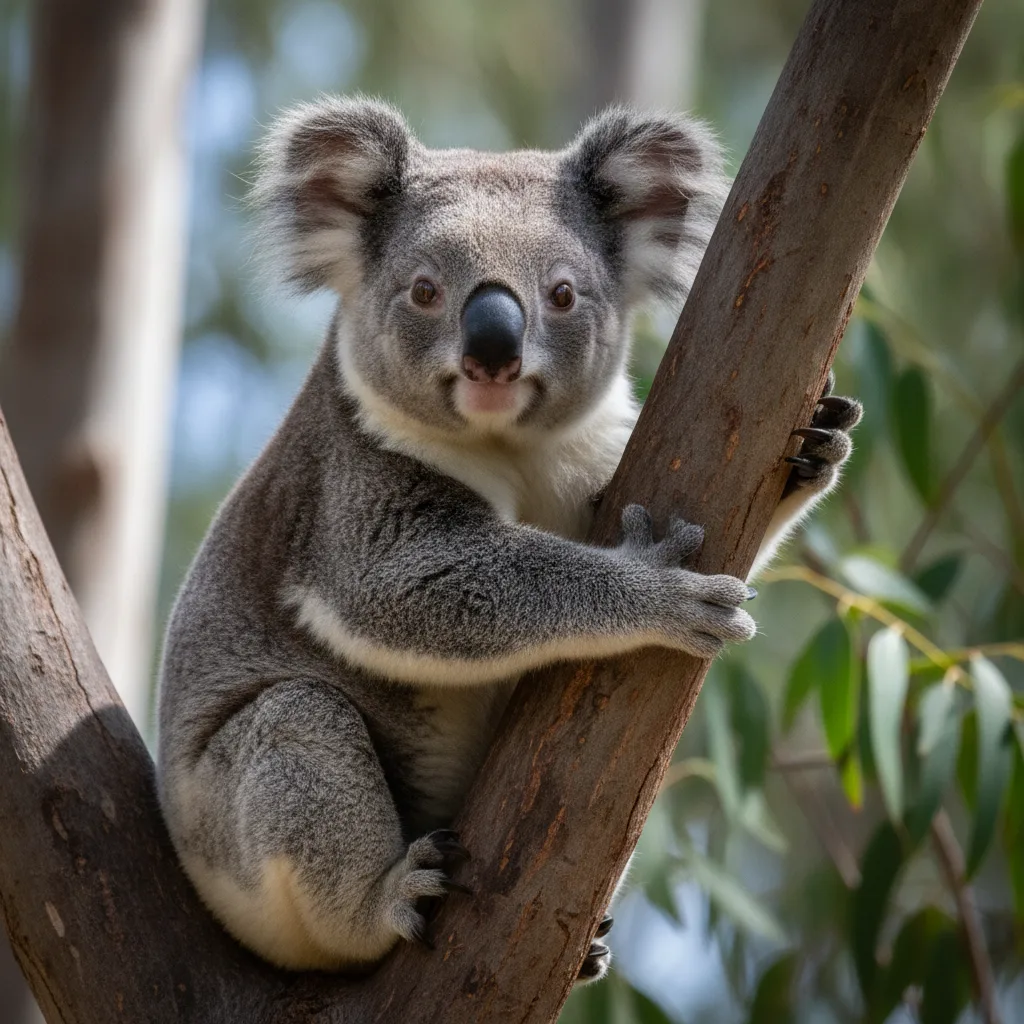
Koalas are marsupials, not bears, and they live in the eucalyptus forests of eastern and southern Australia, sleeping up to 20 hours a day to cope with a leaf diet that is low in energy and high in toxins. A newborn is about the size of a jellybean and spends roughly six months in its mother's pouch. The species is listed as Vulnerable, and in 2022 Australia declared koalas endangered in Queensland, New South Wales and the ACT after bushfires and land clearing.
Five things to know
- Koalas are not bears; they are marsupials, more closely related to wombats.
- Their specialized diet consists almost exclusively of eucalyptus leaves.
- Koalas have fingerprints that are nearly indistinguishable from human fingerprints.
- Young koalas, called joeys, spend about six months inside their mother’s pouch.
- Koalas sleep up to 18-20 hours a day due to their nutrient-poor diet.
Homeschool unit: Animals homeschool guide — Habitats, adaptations and food chains as a graded unit, with the koala as one of its worked examples.