Koala
Phascolarctos cinereus
Koalas are marsupials, not bears, and they live in the eucalyptus forests of eastern and southern Australia, sleeping up to 20 hours a day to cope with a leaf diet that is low in energy and high in toxins. A newborn is about the size of a jellybean and spends roughly six months in its mother's pouch. The species is listed as Vulnerable, and in 2022 Australia declared koalas endangered in Queensland, New South Wales and the ACT after bushfires and land clearing.
Quick facts: Size 60–85 cm in length · Lifespan 10–12 years in the wild, up to 18 in captivity · IUCN status Vulnerable
Print the fact sheet — a free one-page PDF for homeschool and classroom use
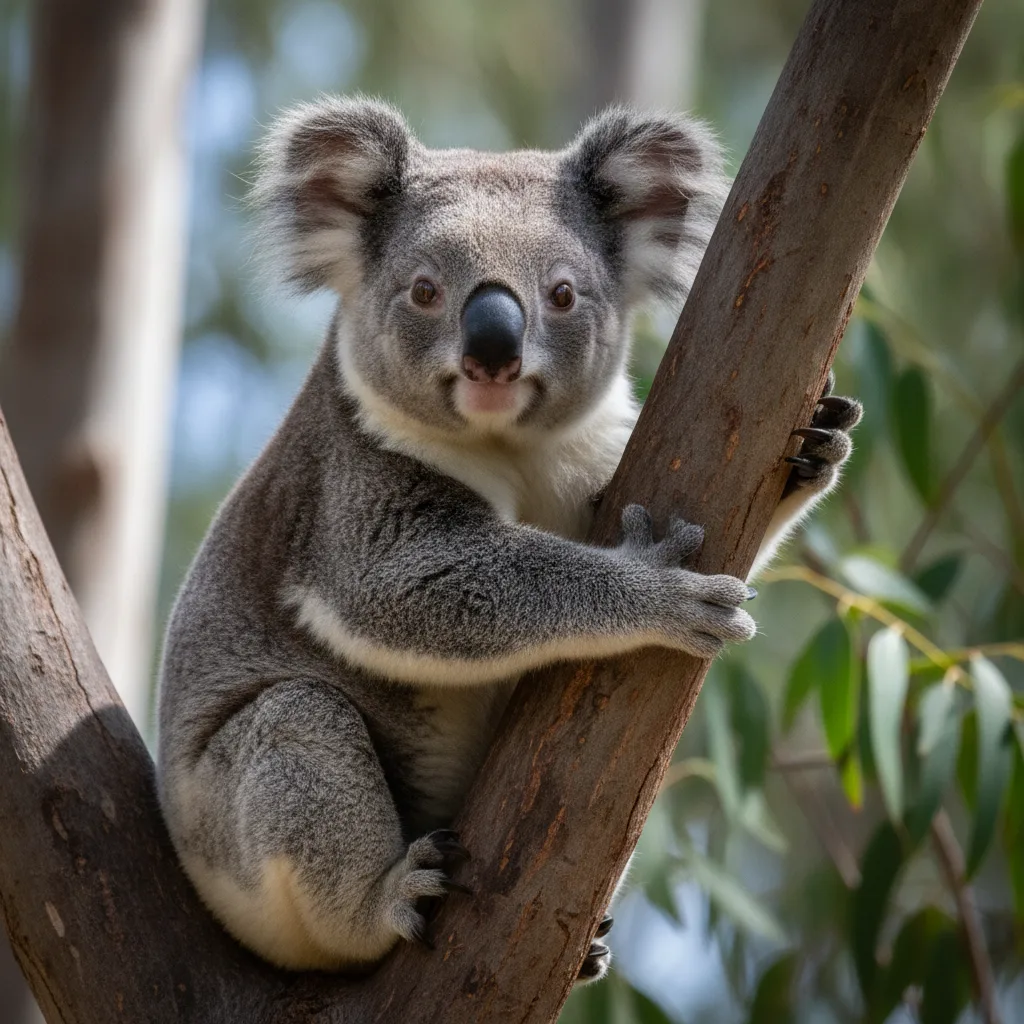
Koala at a glance
| Scientific name | Phascolarctos cinereus |
|---|---|
| IUCN status | Vulnerable |
| Population | 80,000 - 120,000 |
| Population trend | decreasing |
| Weight | 8–14 kg |
| Length | 70–85 cm |
| Lifespan | 10–18 years |
| Top speed | 10 km/h |
| Class | Mammalia |
| Order | Diprotodontia |
| Family | Phascolarctidae |
Need to know
- Koalas are not bears; they are marsupials, more closely related to wombats.
- Their specialized diet consists almost exclusively of eucalyptus leaves.
- Koalas have fingerprints that are nearly indistinguishable from human fingerprints.
- Young koalas, called joeys, spend about six months inside their mother’s pouch.
- Koalas sleep up to 18-20 hours a day due to their nutrient-poor diet.
- Koalas are threatened by habitat loss, disease (e.g., chlamydia), and climate change.
About the Koala
The koala is one of Australia's most iconic marsupials. Adapted to life in the trees, this unique animal spends the vast majority of its time nestled in eucalyptus forests, where it both feeds and rests. Although often called a 'koala bear', it is not a bear at all, but a highly specialized arboreal mammal. The koala's unique diet of almost exclusively eucalyptus leaves means it relies heavily on specific types of forest for survival. Koalas have suffered dramatic range reductions due to habitat fragmentation and disease, making conservation efforts critical today. Despite their sleepy, peaceful demeanor, koalas have surprising adaptations like a highly developed sense of smell and distinctive vocalizations.
Physical characteristics
Size: 60–85 cm in length. Weight: 6–14 kg, with southern koalas being larger. Lifespan: 10–12 years in the wild, up to 18 in captivity.
- Large, hairy, rounded ears
- Broad, flat nose
- Thick grey or brown-tinged fur
- Stout, tailless body
- Long sharp claws for climbing
Notable species
- Koala (Phascolarctos cinereus) — Vulnerable. Eucalyptus forests and woodlands Regions: Queensland, New South Wales, Victoria, South Australia, Eastern Australia, Southeast Queensland, Northern New South Wales.
Habitat and range
Original range: Eastern and southeastern Australia, primarily in eucalyptus forests and woodlands.
Current distribution: Significantly reduced and fragmented populations in eastern, southeastern, and some southern parts of Australia.
Preferred environments: Eucalyptus forests, Open woodlands, Lowland forests, Riparian areas
Regions: Queensland, New South Wales, Victoria, South Australia, Eastern Australia, Southeast Queensland, Northern New South Wales
Where to see Koala
- Great Otway National Park, Victoria — Year-round. Look for them high in eucalyptus trees along scenic drives.
- Noosa National Park, Queensland — Dry season (June to October). Early morning or late afternoon increases chances for sightings.
- Port Stephens, New South Wales — Spring and autumn. Visit koala sanctuaries and nearby forests for best viewing.
Behavior and diet
Diet: Almost exclusively eucalyptus leaves from select tree species.
Social structure: Mostly solitary with overlapping home ranges, except for mother-joey pairs.
Communication: Deep bellows, grunts, and squeaks; scent marking for territorial boundaries.
- Prolonged sleeping (up to 20 hours a day) to conserve energy.
- Joeys ingest ‘pap’ from mother for gut bacteria needed to digest toxic leaves.
- Climbing and moving between trees using powerful limbs and sharp claws.
- Occasionally descend to the ground to move between trees, especially in fragmented habitats.
Interactions with other animals
- Eucalyptus trees (specialist herbivore): Koalas depend on very specific eucalyptus species for food and shelter.
- Dingoes (predator): Dingoes prey on koalas when they descend to the ground.
- Humans (competitive): Habitat destruction, car strikes, and domestic dogs pose major threats to koalas.
Conservation
IUCN Red List status: Vulnerable
Threats
- Habitat loss and fragmentation
- Bushfires
- Chlamydia infection
- Climate change and drought
- Vehicle collisions
- Predation by dogs
Conservation efforts
- Habitat restoration and revegetation projects
- Wildlife corridors to link fragmented habitats
- Vaccination programs against chlamydia
- Population monitoring and mapping
- Community education and advocacy
How to help
- Support land conservation organizations
- Participate in local tree planting initiatives
- Drive cautiously in koala regions
- Keep dogs under control near koala habitats
- Support scientific research and wildlife hospitals
Koala facts for kids
Koalas are cute, sleepy animals that live high up in the trees of eastern Australia. They eat special leaves called eucalyptus and spend most of their day sleeping and cuddled up in the branches. Koalas aren't bears—they are a type of marsupial with a pouch for their babies.
- A baby koala is called a 'joey' and is only the size of a jellybean at birth!
- Koalas eat so many eucalyptus leaves that they even smell like the leaves!
- They have two thumbs on each front paw to help them grip trees.
- Koalas can sleep up to 20 hours a day.
- Every koala has a unique nose pattern, just like a fingerprint.
Did you know? Did you know koalas have fingerprints almost exactly like humans? Even under a microscope, they're hard to tell apart!
Watch & learn
- Koalas: Surviving the Wild — National Geographic Wild. This documentary explores the unique adaptations, behavior, and habitat of the koala (Phascolarctos cinereus), offering stunning footage of these iconic Australian marsupials in their natural environment.
- Baby Koalas: Growing Up in the Eucalyptus Forest — BBC Earth. Follow the early life of a koala joey and its relationship with its mother, featuring touching scenes and expert commentary on koala development and survival in the eucalyptus forests.
- Australia’s Iconic Koala: Life in the Treetops — PBS Nature. Discover how koalas spend their days in the treetops, why their specialized diet of eucalyptus leaves is both a blessing and a challenge, and the threats facing their populations today.
- Koalas: The Science of Survival — Smithsonian Channel. Delve into the science behind koalas’ unique physiology, including their digestive systems and responses to environmental changes, with insights from leading marsupial researchers.
- Urban Koalas: Adapting to a Changing World — ABC Australia. Observe koalas navigating suburban environments as urbanization encroaches on their habitats, and learn about conservation efforts to ensure the future of this vulnerable species.
Sources
Facts on this page are checked against these references. Follow them for the primary data.
- IUCN Red List — Conservation status, population trend and range assessment for Phascolarctos cinereus
- Encyclopaedia Britannica — Reviewed encyclopaedia entry on the koala
- National Geographic — Articles, photographs and field reporting on the koala