Hands Down Animals · Printable fact sheet
Mountain Gorilla
Gorilla beringei
Quick facts
| Scientific name | Gorilla beringei |
|---|---|
| Size | 1.4–1.7 meters standing height |
| Weight | 100–160 kg for females; 140–220 kg for males |
| Lifespan | 35 years in the wild (up to 40 in rare cases) |
| Diet | Primarily herbivorous: eats leaves, stems, shoots, bark, roots, and occasionally fruit and small… |
| Habitat | Montane rainforests, Subalpine bamboo forests, Mixed bamboo and forest edge |
| Where it lives | Virunga Mountains, Bwindi Impenetrable Forest, Volcanoes National Park, Mgahinga Gorilla… |
| IUCN status | Endangered |
| Population | 1063 |
| Top speed | 32 km/h |
| Family | Hominidae |
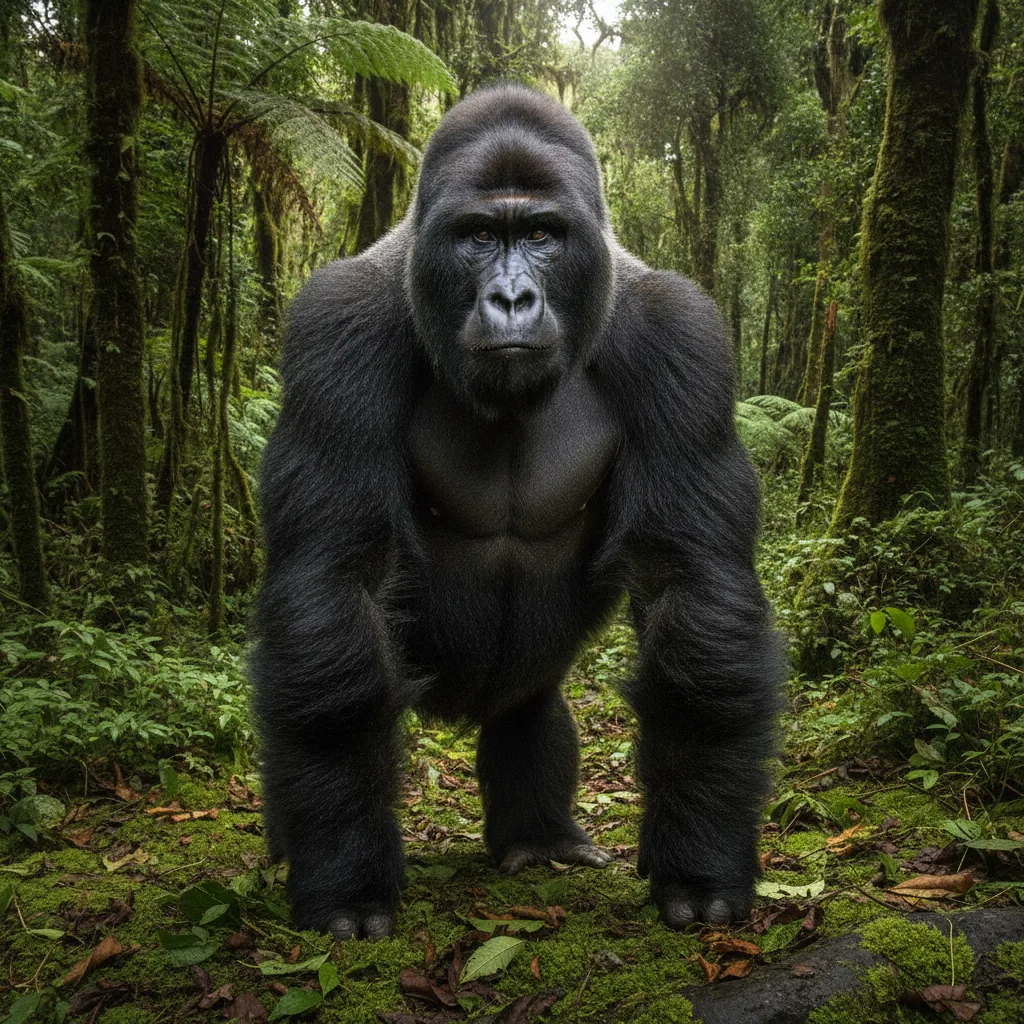
About the mountain gorilla
Mountain gorillas live in just two places: the Virunga volcanoes shared by Rwanda, Uganda and the Democratic Republic of the Congo, and Uganda's Bwindi Impenetrable Forest, at altitudes up to 4,000 metres. Thicker fur than other gorillas suits the cold, wet montane forest, where family groups led by a silverback feed on leaves, shoots and bamboo. Intensive protection lifted the population from about 620 in 1989 to over 1,000, and in 2018 the subspecies was downlisted from Critically Endangered to Endangered.
Five things to know
- Mountain gorillas are only found in two isolated forest areas in central Africa.
- Their populations were once as low as 250 individuals in the 1980s.
- Mountain gorillas live in family groups, led by a dominant silverback male.
- They are herbivores and spend most of their day eating leaves, stems, and shoots.
- Each gorilla's nose print is unique, much like human fingerprints.
Homeschool unit: Animals homeschool guide — Habitats, adaptations and food chains as a graded unit, with the mountain gorilla as one of its worked examples.