Mountain Gorilla
Gorilla beringei
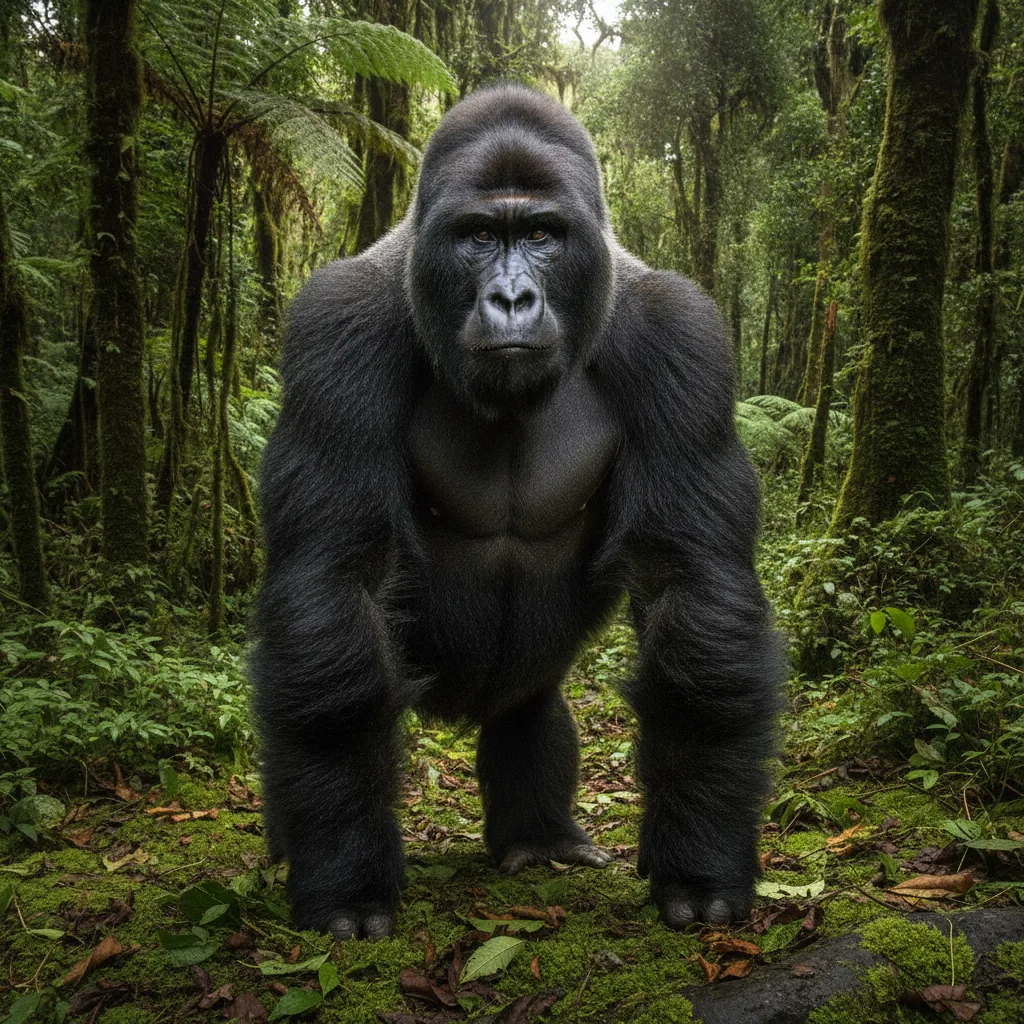
Mountain gorillas live in just two places: the Virunga volcanoes shared by Rwanda, Uganda and the Democratic Republic of the Congo, and Uganda's Bwindi Impenetrable Forest, at altitudes up to 4,000 metres. Thicker fur than other gorillas suits the cold, wet montane forest, where family groups led by a silverback feed on leaves, shoots and bamboo. Intensive protection lifted the population from about 620 in 1989 to over 1,000, and in 2018 the subspecies was downlisted from Critically Endangered to Endangered.
Quick facts: Size 1.4–1.7 meters standing height · Lifespan 35 years in the wild (up to 40 in rare cases) · IUCN status Endangered
Print the fact sheet — a free one-page PDF for homeschool and classroom use
Mountain Gorilla at a glance
| Scientific name | Gorilla beringei |
|---|---|
| IUCN status | Endangered |
| Population | 1063 |
| Population trend | increasing |
| Weight | 160–220 kg |
| Length | 1.6–1.85 m |
| Lifespan | 35–40 years |
| Top speed | 32 km/h |
| Class | Mammalia |
| Order | Primates |
| Family | Hominidae |
| Known species | 2 |
Need to know
- Mountain gorillas are only found in two isolated forest areas in central Africa.
- Their populations were once as low as 250 individuals in the 1980s.
- Mountain gorillas live in family groups, led by a dominant silverback male.
- They are herbivores and spend most of their day eating leaves, stems, and shoots.
- Each gorilla's nose print is unique, much like human fingerprints.
- Intensive conservation efforts have helped mountain gorilla populations grow in recent decades.
About the Mountain Gorilla
The mountain gorilla is a critically endangered great ape that inhabits the high-altitude forests of central Africa. Renowned for its thick fur and powerful build, this primate survives in only two small, isolated populations. Its numbers plummeted to a few hundred by the late 20th century, but dedicated conservation work has led to a slow but steady increase. Mountain gorillas are gentle giants, living in close-knit family groups led by a dominant silverback. They are mostly terrestrial and display a remarkable range of social and emotional behaviors. These unique apes have become icons for wildlife conservation and symbolize both the fragility and resilience of Earth’s biodiversity.
Physical characteristics
Size: 1.4–1.7 meters standing height. Weight: 100–160 kg for females; 140–220 kg for males. Lifespan: 35 years in the wild (up to 40 in rare cases).
- Long, dense black fur covering the body
- Powerful, muscular arms longer than legs
- Large head with pronounced brow ridge
- Adult males have silvery-white hair on the back ('silverbacks')
- Short snout with wide nostrils and prominent brow
Notable species
- Mountain Gorilla (Gorilla beringei beringei) — Endangered. Montane and subalpine forests at altitudes of 2,200–4,300 meters Regions: Virunga Mountains, Bwindi Impenetrable National Park, Mgahinga Gorilla National Park, Volcanoes National Park, Bwindi Forest.
- Grauer's Gorilla (Eastern Lowland Gorilla) (Gorilla beringei graueri) — Critically Endangered. Lowland and montane forests (600–2,900 meters) Regions: Kahuzi-Biega National Park, Itombwe Massif, Maiko National Park, Tayna Nature Reserve, Eastern Democratic Republic of the Congo.
Habitat and range
Original range: Central African montane forests in the Albertine Rift region.
Current distribution: Confined to two main populations: the Virunga volcanic mountains (Rwanda, Uganda, DR Congo) and Uganda’s Bwindi Forest.
Preferred environments: Montane rainforests, Subalpine bamboo forests, Mixed bamboo and forest edge, Dense secondary forests
Regions: Virunga Mountains, Bwindi Impenetrable Forest, Volcanoes National Park, Mgahinga Gorilla National Park, Bwindi Forest, Kahuzi-Biega National Park
Where to see Mountain Gorilla
- Volcanoes National Park, Rwanda — June to September, December to February. Gorilla trekking requires a permit and guided tour; sightings are closely regulated to minimize disturbance.
- Bwindi Impenetrable National Park, Uganda — June to September, December to February. Difficult terrain but best chance for observing unique Bwindi population and family dynamics.
Behavior and diet
Diet: Primarily herbivorous: eats leaves, stems, shoots, bark, roots, and occasionally fruit and small invertebrates.
Social structure: Live in stable family groups (troops) of 5–30, led by a dominant silverback male, with several females and their offspring.
Communication: Use a variety of vocalizations (grunts, hoots, chest beats), body postures, facial expressions, and even tactile gestures to communicate.
- Daily travel and nest-building for night rest in different spots
- Chest beating displays by silverbacks as a sign of strength
- Alloparenting: older siblings help care for young gorillas
- Use foliage as rudimentary tools for cleaning or extracting food
Interactions with other animals
- Leopard (predator): Rarely, leopards may prey on young or sick gorillas, though direct predation is infrequent.
- Human (threat/competitive): Humans compete for land/resources and pose risks from poaching, habitat destruction, and disease transmission.
- Olive baboon (competitive): Compete for fruit and resources in overlapping forest habitats.
Conservation
IUCN Red List status: Endangered
Threats
- Poaching
- Habitat loss due to agriculture and logging
- Human disease transmission (especially respiratory illnesses)
- Civil unrest and armed conflict in gorilla habitats
- Climate change affecting preferred montane habitats
Conservation efforts
- Anti-poaching patrols and increased law enforcement
- Community-based eco-tourism and benefit-sharing
- Veterinary interventions (Gorilla Doctors) for sick/injured gorillas
- Habitat protection and reforestation projects
- International and cross-border conservation partnerships
How to help
- Support responsible eco-tourism and purchase gorilla trekking permits
- Donate to reputable conservation organizations
- Raise awareness about gorilla conservation and threats
- Support anti-poaching and habitat protection campaigns
- Promote policies that reduce tropical deforestation
Mountain Gorilla facts for kids
Mountain gorillas are big, gentle apes that live in the misty forests high up in Africa’s mountains. They eat plants all day and live in close families led by a strong silverback (an adult male with a shiny back). Because there aren’t many of them left, people are working hard to keep them safe.
- Mountain gorillas have super-long arms—longer than their legs!
- They can build beds out of leaves every night.
- Each gorilla group has a boss called a silverback.
- Baby gorillas ride on their mom’s back.
- Gorillas only live in certain mountain forests in Africa.
Did you know? Did you know? Mountain gorillas thump their chests loudly to show how strong they are—sometimes you can even hear it from far away!
Watch & learn
- Incredible Mountain Gorilla Behaviour Revealed — BBC Earth. This documentary features rare footage of mountain gorillas in their natural habitat, highlighting their social behavior, family structure, and the challenges they face in the wild. BBC Earth's high-quality production and expert narration make this an essential watch for anyone interested in Gorilla beringei.
- Gorilla Kingdom: Secrets of the Mountain Gorillas — National Geographic. National Geographic provides an intimate look into the lives of mountain gorillas, exploring their daily interactions, conservation efforts, and survival in the misty forests of Central Africa. The documentary uses immersive cinematography to bring viewers closer to these majestic primates.
- Mountain Gorilla: The Last Stand — Smithsonian Channel. This gripping documentary examines the conservation challenges mountain gorillas face, following the work of scientists, rangers, and local communities dedicated to protecting this endangered mammal. Exclusive footage and interviews offer a unique perspective on Gorilla beringei’s fight for survival.
- Gorilla Family & Me: Living Among the Mountain Gorillas — BBC Earth. Wildlife filmmaker Gordon Buchanan spends time living with a family of mountain gorillas, offering a close-up look at their personalities and social dynamics. His personal approach and insightful commentary provide an accessible, compelling introduction to these gentle giants.
- The Great Gorilla Trek: Saving Mountain Gorillas — PBS Nature. PBS Nature’s feature on mountain gorillas recounts an inspiring story of conservation success, with researchers, guides, and locals joining forces to monitor and protect Gorilla beringei in Africa’s Virunga Mountains. Vivid storytelling and expert interviews make this a valuable resource.
Sources
Facts on this page are checked against these references. Follow them for the primary data.
- IUCN Red List — Conservation status, population trend and range assessment for Gorilla beringei
- Encyclopaedia Britannica — Reviewed encyclopaedia entry on the mountain gorilla
- National Geographic — Articles, photographs and field reporting on the mountain gorilla