Hands Down Animals · Printable fact sheet
Panda
Ailuropoda
Quick facts
| Scientific name | Ailuropoda |
|---|---|
| Size | 1.2–1.9 m in length; shoulder height 60–90 cm |
| Weight | 70–160 kg (adults), with most wild adults between 85–125 kg |
| Lifespan | 20 years average in the wild; up to 38 years in captivity |
| Diet | Over 99% bamboo; occasionally small mammals, fish, or carrion. |
| Habitat | Temperate broadleaf forest, Mixed-coniferous forest, Dense bamboo understory |
| Where it lives | Sichuan, Shaanxi, Gansu, Qinling Mountains |
| IUCN status | Vulnerable |
| Population | 1864–2060 |
| Top speed | 20 km/h |
| Family | Ursidae |
About the panda
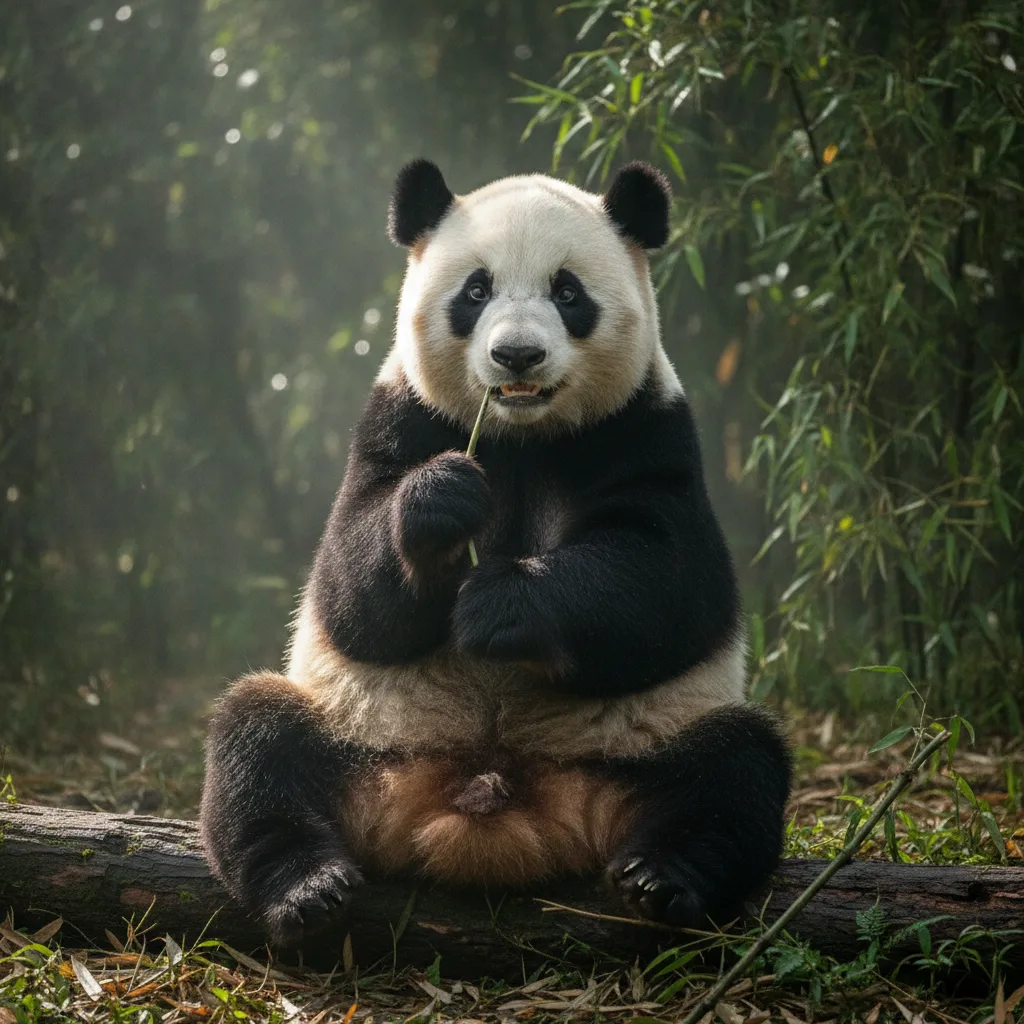
The giant panda lives only in the bamboo forests of mountainous central China, where an adult may spend 12 hours a day eating 12–38 kilograms of bamboo. It belongs to the bear family yet has an enlarged wrist bone that works like a thumb for gripping stems. Decades of reserve creation moved the panda from Endangered to Vulnerable in 2016, with roughly 1,800 left in the wild.
Five things to know
- Giant pandas are unique among bears for their almost exclusively bamboo-based diet.
- They possess a modified wrist bone, the 'pseudothumb,' to grasp bamboo stems.
- Pandas have the largest molars among bears, adapted for crushing bamboo.
- Giant pandas are classified as 'Vulnerable' rather than 'Endangered' due to population recovery.
- Pandas can spend up to 14 hours a day eating bamboo.
Homeschool unit: Animals homeschool guide — Habitats, adaptations and food chains as a graded unit, with the panda as one of its worked examples.