Hands Down Animals · Printable fact sheet
Saola
Pseudoryx nghetinhensis
Quick facts
| Scientific name | Pseudoryx nghetinhensis |
|---|---|
| Size | 150–180 cm in length, 85–100 cm at the shoulder |
| Weight | 80–100 kg |
| Lifespan | 10–15 years (estimated in the wild) |
| Diet | Saolas are herbivorous, feeding mainly on leafy plants, young foliage, and shrubs found in the forest… |
| Habitat | Evergreen forest, Moist deciduous forest, Mountain river valleys |
| Where it lives | Northern Vietnam, Central Vietnam, Eastern Laos, Annamite Mountains |
| IUCN status | Critically Endangered |
| Population | Less than 100 |
| Family | Bovidae |
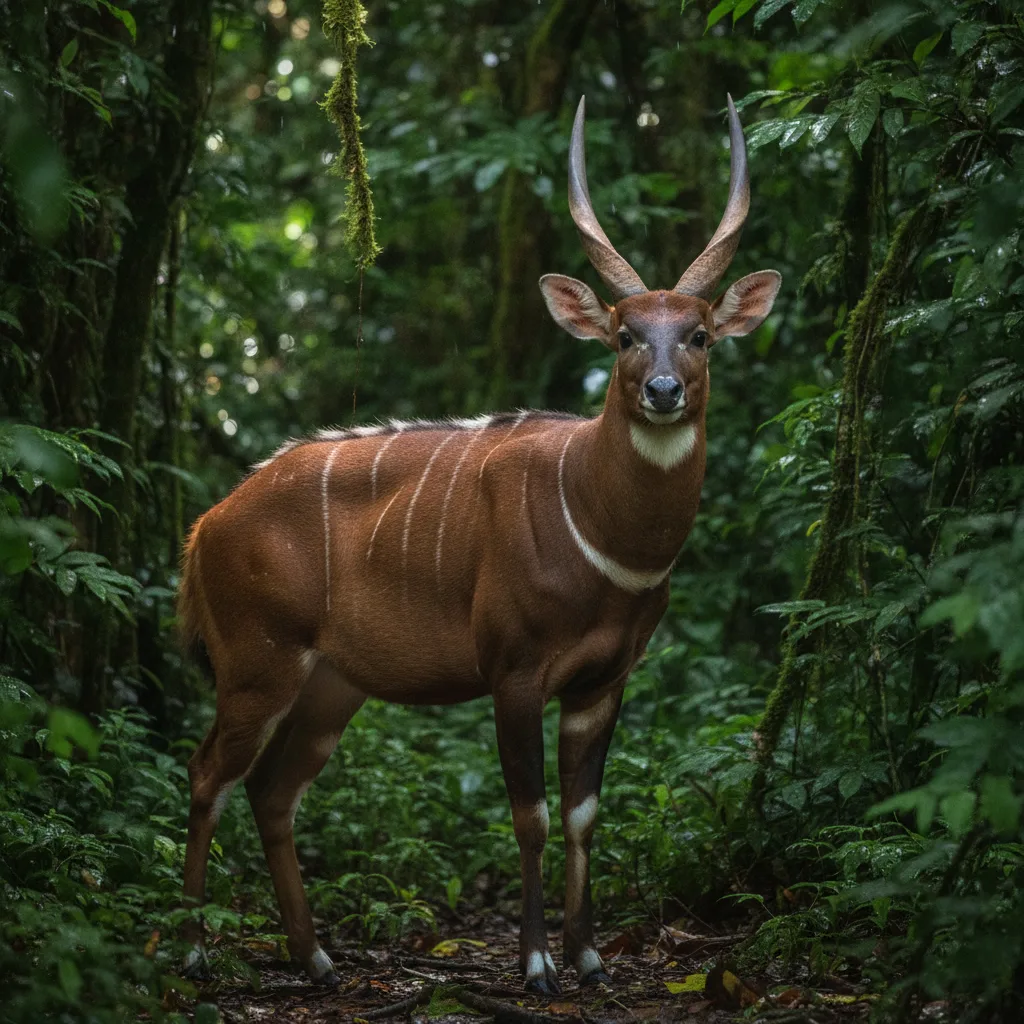
About the saola
The saola lives in the wet evergreen forests of the Annamite Mountains along the Laos–Vietnam border and was unknown to science until 1992, when its horns were found in a hunter's house. It is a forest bovid with two straight, parallel horns up to 50 cm long and white facial markings, and no biologist has ever seen one in the wild. Snaring has reduced it to an unknown handful; it is Critically Endangered and was last photographed by camera trap in 2013.
Five things to know
- The Saola is one of the world's rarest large mammals and was only discovered by Western science in 1992.
- Saolas are sometimes called the 'Asian unicorn' due to their rarity and long, parallel horns.
- They are endemic to the Annamite mountain range along the Laos-Vietnam border.
- No Saola is known to exist in captivity; all known individuals live in the wild.
- Their horns are present in both males and females and can reach up to 50 cm in length.
Homeschool unit: Animals homeschool guide — Habitats, adaptations and food chains as a graded unit, with the saola as one of its worked examples.