Saola
Pseudoryx nghetinhensis
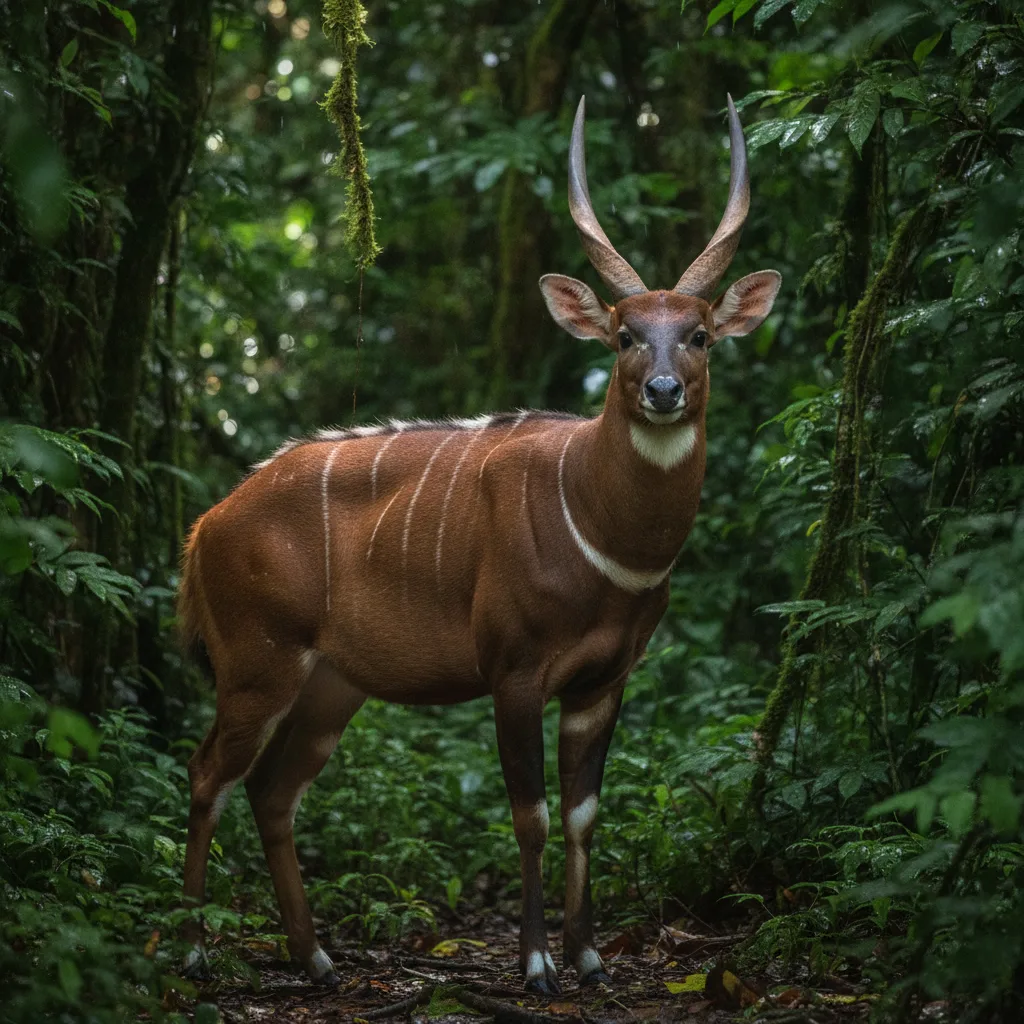
The saola lives in the wet evergreen forests of the Annamite Mountains along the Laos–Vietnam border and was unknown to science until 1992, when its horns were found in a hunter's house. It is a forest bovid with two straight, parallel horns up to 50 cm long and white facial markings, and no biologist has ever seen one in the wild. Snaring has reduced it to an unknown handful; it is Critically Endangered and was last photographed by camera trap in 2013.
Quick facts: Size 150–180 cm in length, 85–100 cm at the shoulder · Lifespan 10–15 years (estimated in the wild) · IUCN status Critically Endangered
Print the fact sheet — a free one-page PDF for homeschool and classroom use
Saola at a glance
| Scientific name | Pseudoryx nghetinhensis |
|---|---|
| IUCN status | Critically Endangered |
| Population | Less than 100 |
| Population trend | decreasing |
| Weight | 90–100 kg |
| Length | 150–180 cm |
| Lifespan | 10–15 years |
| Class | Mammalia |
| Order | Artiodactyla |
| Family | Bovidae |
Need to know
- The Saola is one of the world's rarest large mammals and was only discovered by Western science in 1992.
- Saolas are sometimes called the 'Asian unicorn' due to their rarity and long, parallel horns.
- They are endemic to the Annamite mountain range along the Laos-Vietnam border.
- No Saola is known to exist in captivity; all known individuals live in the wild.
- Their horns are present in both males and females and can reach up to 50 cm in length.
- Little is known about Saola's behavior due to its elusive nature and remote habitat.
About the Saola
The Saola (Pseudoryx nghetinhensis), also known as the 'Asian unicorn,' is one of the world's rarest and most enigmatic large mammals. It was only discovered by scientists in 1992 in the remote Annamite Mountains on the border of Vietnam and Laos. The Saola is a medium-sized bovid, most closely related to cattle, but with unique physical features and evolutionary lineage.
Saolas are so elusive that fewer than a handful of scientists have ever seen one in the wild, and none live in captivity. They inhabit dense, wet evergreen and deciduous forests, largely along river valleys at low to moderate elevations. Their populations have suffered precipitous declines due to hunting and habitat fragmentation, and they are now classified as Critically Endangered by the IUCN.
Physical characteristics
Size: 150–180 cm in length, 85–100 cm at the shoulder. Weight: 80–100 kg. Lifespan: 10–15 years (estimated in the wild).
- Long, nearly straight parallel horns in both sexes
- Striking white facial and throat markings
- Glossy dark brown coat
- Large, elongated preorbital glands (scent glands on the snout)
- Stocky body and short tail
Notable species
- Saola (Pseudoryx nghetinhensis) — Critically Endangered. Evergreen and moist deciduous forests along mountain river valleys Regions: Annamite Mountains, Northern Vietnam, Central Vietnam, Laos, Eastern Indochina.
Habitat and range
Original range: Annamite Mountains of Vietnam and Laos
Current distribution: Remnant populations only in the Annamite mountain forests of Vietnam and Laos; no populations exist outside this region.
Preferred environments: Evergreen forest, Moist deciduous forest, Mountain river valleys, Remote, undisturbed forest areas
Regions: Northern Vietnam, Central Vietnam, Eastern Laos, Annamite Mountains
Where to see Saola
- Vu Quang Nature Reserve, Vietnam — Rainy season (May–September). Extremely rare; sightings are almost nonexistent despite regular surveys.
- Nakai-Nam Theun National Protected Area, Laos — Wet season (June–September). Dense forest cover makes observations nearly impossible without camera traps.
Behavior and diet
Diet: Saolas are herbivorous, feeding mainly on leafy plants, young foliage, and shrubs found in the forest understory.
Social structure: They are believed to be solitary or to form small family groups, such as pairs or mothers and young; large groupings are not reported.
Communication: Saolas likely communicate through scent marking using their large preorbital glands and possibly through vocalizations, though these are not well documented.
- Uses enlarged preorbital glands to mark territory with scent.
- Extremely elusive and avoids human contact.
- Prefers dense forest cover, remaining hidden even when disturbed.
- May migrate seasonally to higher elevations during wet season.
Interactions with other animals
- Dhole (Cuon alpinus) (predator): Potential predator of young Saola, though direct observations are lacking.
- Leopard (Panthera pardus) (predator): May prey on Saola, but few confirmed interactions exist due to rarity of both species in the region.
- Humans (threat): Main threat through poaching and setting snares, which frequently harm Saolas even when targeting other species.
Conservation
IUCN Red List status: Critically Endangered
Threats
- Widespread snaring and poaching for bushmeat and illegal wildlife trade
- Habitat loss and fragmentation from logging and agriculture
- Low genetic diversity due to small, fragmented populations
- Lack of knowledge about basic biology and distribution
Conservation efforts
- Strengthening anti-poaching patrolling and removal of snares in protected areas
- Establishment of Saola Working Group (IUCN SSC) dedicated to conservation
- Plans for ex-situ conservation and potential captive breeding centers
- Education and awareness programs for local communities
How to help
- Support reputable conservation organizations working in Vietnam and Laos
- Raise awareness about the plight of the Saola and the dangers of wildlife trade
- Promote sustainable livelihoods and alternative protein sources for local communities
- Advocate for stricter enforcement of wildlife protection laws
Saola facts for kids
Saolas are super-rare animals that look like a mix between a cow and an antelope, living deep in the forests of Vietnam and Laos. Because they hide so well and are very shy, almost nobody has ever seen one! Scientists are working hard to protect these 'forest unicorns' and their home.
- Saolas have long, straight horns like unicorns!
- They were only discovered in 1992.
- Saolas live in thick, rainy forests in the mountains.
- No one has ever kept a Saola in a zoo.
- Their white face markings make them look very special.
Did you know? Did you know the Saola is so rare that scientists call it the 'Asian unicorn'?
Watch & learn
- The Mysterious Saola: Asia’s Unicorn – Endangered Species Documentary — National Geographic Wild. A focused documentary segment examining the elusive Saola, its rainforest habitat in Vietnam and Laos, and conservation efforts. National Geographic brings expert commentary and rare footage of this critically endangered mammal.
- Saola – The Asian Unicorn | Nature’s Rarest Mammals — BBC Earth. BBC Earth explores the discovery, biological features, and conservation status of the Saola, featuring expert interviews and rare archival footage of this extremely rare artiodactyl.
- Saola: The World’s Rarest Large Mammal | The Vanishing Unicorn — Smithsonian Channel. Smithsonian Channel presents a moving profile of the Saola, its fragile ecosystem, and the international efforts underway to prevent its extinction. Includes insights from field researchers working in remote Southeast Asian forests.
- Searching for the Saola: Southeast Asia’s Ghostly Bovidae — PBS Nature. This detailed segment highlights the Saola's elusive nature with interviews from scientists, updates on camera trap programs, and footage of conservation projects in the Annamite Mountains.
- Guardians of the Saola: Race to Save Asia’s Hidden Mammal — WWF International. WWF International documents urgent field conservation work to protect the Saola, with first-hand accounts from patrolling rangers and researchers dedicated to saving this critically endangered uncaptured species.
Sources
Facts on this page are checked against these references. Follow them for the primary data.
- IUCN Red List — Conservation status, population trend and range assessment for Pseudoryx nghetinhensis
- Encyclopaedia Britannica — Reviewed encyclopaedia entry on the saola
- National Geographic — Articles, photographs and field reporting on the saola