Hands Down Animals · Printable fact sheet
Sea Turtle
Cheloniidae and Dermochelyidae
Quick facts
| Scientific name | Cheloniidae and Dermochelyidae |
|---|---|
| Size | From 60 cm (Kemp’s/Olive ridley) to 2.9 m (leatherback) in shell length |
| Weight | From 35 kg to 900 kg |
| Lifespan | Typically 50 years, with some reaching 80-100 years |
| Diet | Varies by species; can include seagrasses, algae, jellyfish, sponges, crustaceans, and mollusks. |
| Habitat | Open ocean, Neritic zone (shallow coastal waters), Coral reefs |
| Where it lives | Atlantic Ocean, Pacific Ocean, Indian Ocean, Mediterranean Sea |
| IUCN status | Most species are Endangered or Critically Endangered (IUCN Red List) |
| Population | Approximately 1,600,000 nesting females (all species… |
| Top speed | 35 km/h |
| Family | Cheloniidae (all except leatherback); Dermochelyidae (leatherback) |
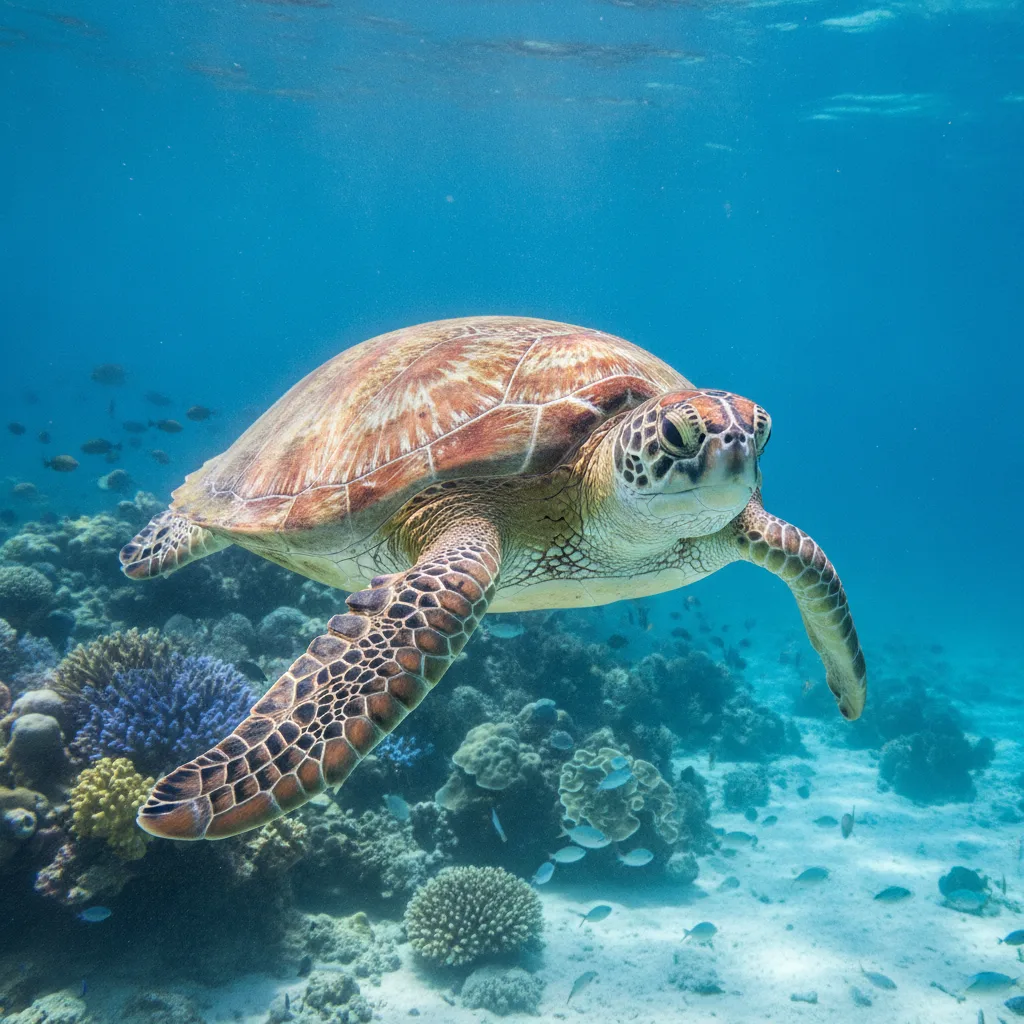
About the sea turtle
Sea turtles have swum the oceans for over 100 million years, and the seven living species nest on tropical and subtropical beaches while ranging across whole ocean basins. Females return to lay eggs near the beach where they hatched, navigating by Earth's magnetic field, and leatherbacks dive deeper than 1,000 metres. Six of the seven species are listed as threatened, with the hawksbill and Kemp's ridley Critically Endangered.
Five things to know
- Sea turtles have been on Earth for over 100 million years.
- All species migrate long distances between feeding grounds and nesting beaches.
- Female sea turtles return to nest on the same beach where they were born.
- Leatherback turtles are the largest and can dive deeper than 1,200 meters.
- Hawksbill turtles help maintain healthy coral reefs by eating sponges.
Homeschool unit: Ocean homeschool guide — An ocean unit on marine food webs, tides and conservation, with the sea turtle as a case study.