Sea Turtle
Cheloniidae and Dermochelyidae
Sea turtles have swum the oceans for over 100 million years, and the seven living species nest on tropical and subtropical beaches while ranging across whole ocean basins. Females return to lay eggs near the beach where they hatched, navigating by Earth's magnetic field, and leatherbacks dive deeper than 1,000 metres. Six of the seven species are listed as threatened, with the hawksbill and Kemp's ridley Critically Endangered.
Quick facts: Size From 60 cm (Kemp’s/Olive ridley) to 2.9 m (leatherback) in shell length · Lifespan Typically 50 years, with some reaching 80-100 years · IUCN status Most species are Endangered or Critically Endangered (IUCN Red List)
Print the fact sheet — a free one-page PDF for homeschool and classroom use
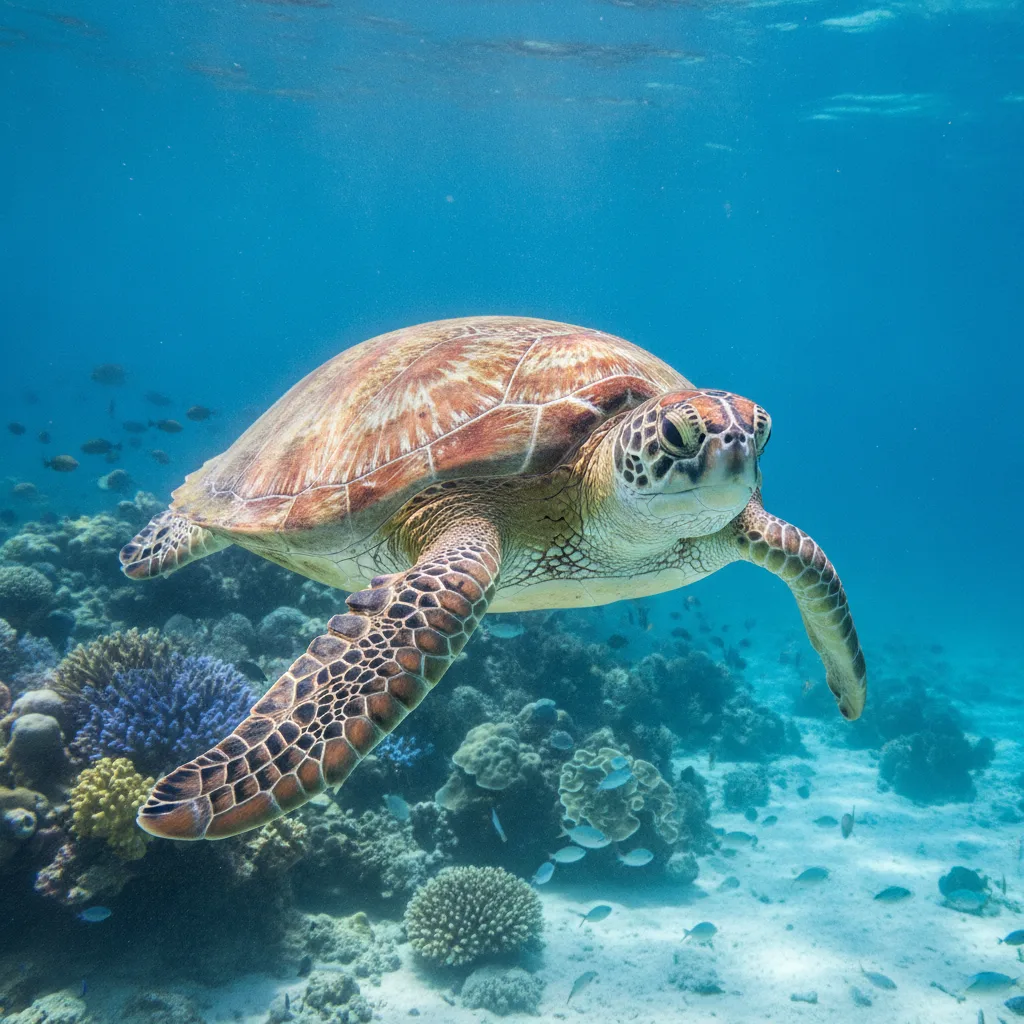
Sea Turtles at a glance
| Scientific name | Cheloniidae and Dermochelyidae |
|---|---|
| IUCN status | Most species are Endangered or Critically Endangered (IUCN Red List) |
| Population | Approximately 1,600,000 nesting females (all species combined) |
| Population trend | decreasing |
| Weight | 140–900 kg |
| Length | 1–2.91 m |
| Lifespan | 50–100 years |
| Top speed | 35 km/h |
| Class | Reptilia |
| Order | Testudines |
| Family | Cheloniidae (all except leatherback); Dermochelyidae (leatherback) |
| Known species | 7 |
Need to know
- Sea turtles have been on Earth for over 100 million years.
- All species migrate long distances between feeding grounds and nesting beaches.
- Female sea turtles return to nest on the same beach where they were born.
- Leatherback turtles are the largest and can dive deeper than 1,200 meters.
- Hawksbill turtles help maintain healthy coral reefs by eating sponges.
- Many sea turtles are threatened by plastic pollution, fishing nets, and habitat loss.
About the Sea Turtles
Sea turtles are ancient marine reptiles whose earliest ancestors date back to the age of the dinosaurs. These reptiles are perfectly adapted for life at sea, with streamlined bodies, powerful flippers, and remarkable navigational skills that enable them to traverse entire ocean basins. Every generation embarks on extraordinary journeys—hundreds or even thousands of kilometers—to nest on sandy beaches, often the very stretch where they began life as hatchlings.
Ranging from the gigantic leatherback to the small Kemp’s ridley, sea turtles play crucial ecological roles: maintaining healthy seagrass beds and coral reefs, ensuring food web balance, and supporting other marine life. However, they are now among the most endangered large vertebrates on the planet due to human activity. Conservation efforts, scientific research, and international collaboration are critical to their future survival.
Physical characteristics
Size: From 60 cm (Kemp’s/Olive ridley) to 2.9 m (leatherback) in shell length. Weight: From 35 kg to 900 kg. Lifespan: Typically 50 years, with some reaching 80-100 years.
- Streamlined body for fast swimming
- Paddle-like flippers with no claws or with reduced claws
- Carapace shape varies by species—range from domed to flat, hard to leathery
- Large, dark eyes adapted for underwater vision
- Prominent beak or jaw shape specific to diet
Notable species
- Leatherback Sea Turtle (Dermochelys coriacea) — Vulnerable. Open ocean; nests on tropical and subtropical sandy beaches Regions: Atlantic Ocean, Pacific Ocean, Indian Ocean, Southern Ocean, Caribbean Sea, waters off South Africa.
- Green Sea Turtle (Chelonia mydas) — Endangered. Coastal areas, seagrass beds, and open ocean; nests on tropical beaches Regions: Pacific Ocean, Atlantic Ocean, Indian Ocean, Caribbean Sea, Mediterranean Sea, Coral Sea.
- Loggerhead Sea Turtle (Caretta caretta) — Vulnerable. Coastal bays, estuaries, open ocean; nests on subtropical and temperate beaches Regions: Atlantic Ocean, Indian Ocean, Pacific Ocean, Mediterranean Sea, South China Sea, Bering Sea.
- Hawksbill Sea Turtle (Eretmochelys imbricata) — Critically Endangered. Coral reefs, rocky outcrops; nests in tropical beaches Regions: Caribbean Sea, Indian Ocean, Pacific Ocean, Coral Triangle, South Atlantic Ocean, Red Sea.
- Olive Ridley Sea Turtle (Lepidochelys olivacea) — Vulnerable. Warm coastal waters; nests on tropical beaches Regions: Indian Ocean, Pacific Ocean, South Atlantic Ocean, Bay of Bengal, Arabian Sea, Gulf of California.
- Kemp's Ridley Sea Turtle (Lepidochelys kempii) — Critically Endangered. Shallow coastal areas; nests almost exclusively at Rancho Nuevo, Mexico Regions: Gulf of Mexico, Western Atlantic Ocean, Caribbean Sea, waters off the southeastern United States.
Habitat and range
Original range: Sea turtles evolved in ancient tropical and subtropical seas around 110 million years ago.
Current distribution: Modern sea turtles inhabit nearly all tropical and subtropical oceans and many temperate seas worldwide.
Preferred environments: Open ocean, Neritic zone (shallow coastal waters), Coral reefs, Seagrass beds, Sandy nesting beaches
Regions: Atlantic Ocean, Pacific Ocean, Indian Ocean, Mediterranean Sea, Red Sea, Coral Sea, Gulf of Mexico, Caribbean Sea, Bering Sea, South China Sea, Southern Ocean, Bay of Bengal, Arabian Sea
Where to see Sea Turtles
- Tortuguero National Park, Costa Rica — June–October (Green turtles), March–May (Leatherbacks). Nighttime guided nesting walks offer the safest and least intrusive viewing.
- Great Barrier Reef, Australia — November–March. Observe green, loggerhead, and hawksbill turtles feeding and nesting along key beaches.
- Ras Al Jinz, Oman — Year-round. Famous nesting site for green turtles, with visitor programs for responsible observation.
Behavior and diet
Diet: Varies by species; can include seagrasses, algae, jellyfish, sponges, crustaceans, and mollusks.
Social structure: Primarily solitary except for mass gatherings at breeding and feeding sites.
Communication: Primarily silent; some researchers believe they use physical cues, vibrations, and possible low-frequency sounds for navigation and orientation.
- Long-distance seasonal migrations between feeding and nesting sites
- Females return to natal beaches to lay eggs using geomagnetic cues
- Synchronised nesting called 'arribadas' in olive ridley and Kemp’s ridley turtles
- Deep diving abilities—leatherbacks can dive over 1,200 meters
Interactions with other animals
- Jellyfish (prey): Leatherbacks and other species feed extensively on jellyfish, helping control jellyfish populations.
- Tiger sharks (predator): Tiger sharks prey on adult and juvenile sea turtles in coastal waters.
- Cleaner fish (remoras) (symbiotic): Remoras eat parasites off sea turtles’ shells and skin.
- Seabirds (predator): Seabirds often prey on hatchlings as they cross the beach to the sea.
Conservation
IUCN Red List status: Most species are Endangered or Critically Endangered (IUCN Red List)
Threats
- Entanglement in fishing gear (bycatch)
- Habitat loss and coastal development
- Egg/hatchling predation by animals and humans
- Illegal trade and poaching
- Marine pollution (especially plastics)
- Climate change affecting eggs and beaches
Conservation efforts
- International treaties like CITES and CMS
- Protection of nesting sites and beaches
- Regulation and modification of fishing gear
- Community and ecotourism initiatives
- Habitat restoration and marine protected areas
How to help
- Reduce plastic use and participate in beach cleanups
- Support organizations protecting turtles and habitats
- Follow responsible tourism guidelines near nesting sites
- Inform and educate others about threats to sea turtles
- Support sustainable seafood choices
Sea Turtles facts for kids
Sea turtles are amazing reptiles that spend almost their whole lives swimming the world’s oceans. Every few years, female turtles crawl onto sandy beaches at night to lay their eggs before returning to sea. Sadly, these gentle giants need our help to keep their nests and ocean home safe.
- Sea turtle babies hatch at night and race to the ocean to avoid predators.
- A leatherback turtle can grow longer than a grown-up person!
- Some turtles travel thousands of kilometers between their home and the beach where they hatch.
- Sea turtles don’t have teeth—they have sharp beaks instead.
- Most sea turtles can hold their breath for longer than you can swim across a pool.
Did you know? Did you know? Some baby turtles can use the Earth’s magnetic field like a built-in GPS to find their way in the vast ocean!
Watch & learn
- Sea Turtles: The Ancient Mariners - Full Documentary — National Geographic. This feature explores the remarkable life cycle and ancient lineage of all sea turtle species (Cheloniidae and Dermochelyidae), including migration, nesting, and survival challenges. National Geographic combines stunning underwater footage with expert storytelling to reveal the lives of these endangered reptiles.
- Return of the Sea Turtle: A PBS Nature Special — PBS Nature. PBS Nature follows scientists and conservationists as they track, protect, and document the nesting habits and perilous journeys of sea turtles. The program features both Cheloniidae and Dermochelyidae families and covers global conservation efforts.
- Incredible Sea Turtle Journeys | BBC Earth — BBC Earth. With captivating visuals, BBC Earth presents the impressive migratory journeys of sea turtles, focusing on both Cheloniidae and the leatherback turtle (Dermochelyidae). Highlights include feeding behavior, navigation, and unique reproductive rituals.
- Sea Turtles - Ancient Ocean Survivors | Smithsonian Channel — Smithsonian Channel. Smithsonian Channel provides an in-depth look at the evolutionary history, anatomy, and threats faced by sea turtles, including the only living member of Dermochelyidae, the leatherback. Includes interviews with marine biologists and conservation footage.
- The Secret Lives of Sea Turtles | Nat Geo WILD — Nat Geo WILD. This special reveals seldom-seen behaviors of sea turtles, from foraging on coral reefs to mass nesting events, using advanced filming techniques. Focuses on multiple species across both Cheloniidae and Dermochelyidae.
Sources
Facts on this page are checked against these references. Follow them for the primary data.
- IUCN Red List — Conservation status, population trend and range assessment for Cheloniidae and Dermochelyidae
- Encyclopaedia Britannica — Reviewed encyclopaedia entry on the sea turtles
- National Geographic — Articles, photographs and field reporting on the sea turtles