Hands Down Animals · Printable fact sheet
White Rhino
Ceratotherium
Quick facts
| Scientific name | Ceratotherium |
|---|---|
| Size | 3.7–4.0 meters in length, 1.7–1.9 meters at the shoulder |
| Weight | 1,800–2,700 kg; occasionally up to 3,600 kg |
| Lifespan | 40 years in the wild, up to 50 years in captivity |
| Diet | Strictly grazers—primarily feed on short grasses. |
| Habitat | Open grassland, Savanna, Light woodland with access to water |
| Where it lives | South Africa, Namibia, Zimbabwe, Botswana |
| IUCN status | Near Threatened (Southern white rhino); Critically Endangered (Northern white rhino) |
| Population | 16,000-18,000 |
| Top speed | 40 km/h |
| Family | Rhinocerotidae |
About the white rhino
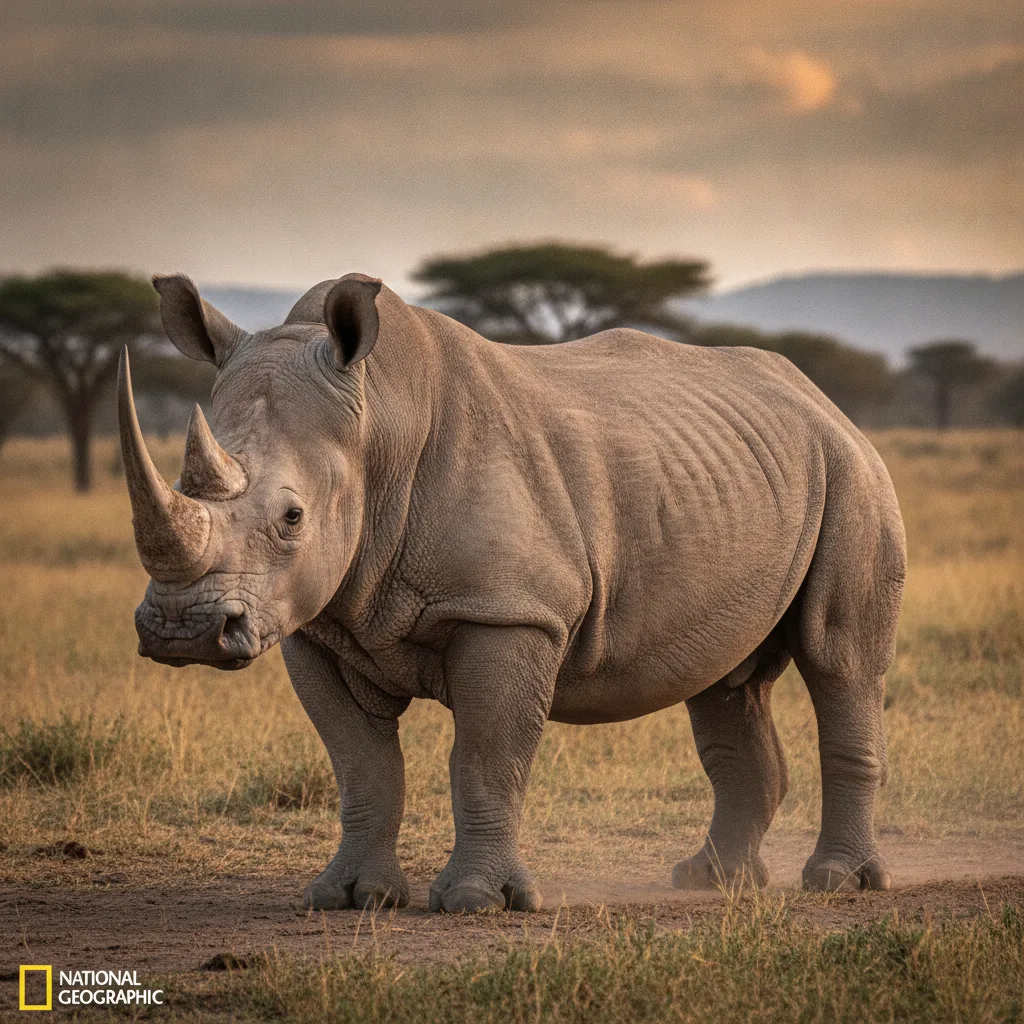
White rhinos are the largest rhino species, with bulls weighing over 2 tonnes, and they graze the open grasslands of southern Africa with a wide, square lip built for cropping short grass. The name probably comes from the Afrikaans 'wyd', meaning wide, not from any colour. The southern subspecies recovered from fewer than 100 animals a century ago to around 16,000 and is Near Threatened; the northern subspecies is down to two females and is functionally extinct.
Five things to know
- The white rhino is the largest extant species of rhinoceros.
- Its name derives from the Afrikaans word 'wyd' meaning 'wide', referring to its broad mouth.
- The northern white rhino is functionally extinct with only two females remaining.
- White rhinos can run at speeds up to 40 km/h.
- They are one of the few non-territorial rhinos and form loose social groups.
Homeschool unit: Animals homeschool guide — Habitats, adaptations and food chains as a graded unit, with the white rhino as one of its worked examples.