White Rhino
Ceratotherium
White rhinos are the largest rhino species, with bulls weighing over 2 tonnes, and they graze the open grasslands of southern Africa with a wide, square lip built for cropping short grass. The name probably comes from the Afrikaans 'wyd', meaning wide, not from any colour. The southern subspecies recovered from fewer than 100 animals a century ago to around 16,000 and is Near Threatened; the northern subspecies is down to two females and is functionally extinct.
Quick facts: Size 3.7–4.0 meters in length, 1.7–1.9 meters at the shoulder · Lifespan 40 years in the wild, up to 50 years in captivity · IUCN status Near Threatened (Southern white rhino); Critically Endangered (Northern white rhino)
Print the fact sheet — a free one-page PDF for homeschool and classroom use
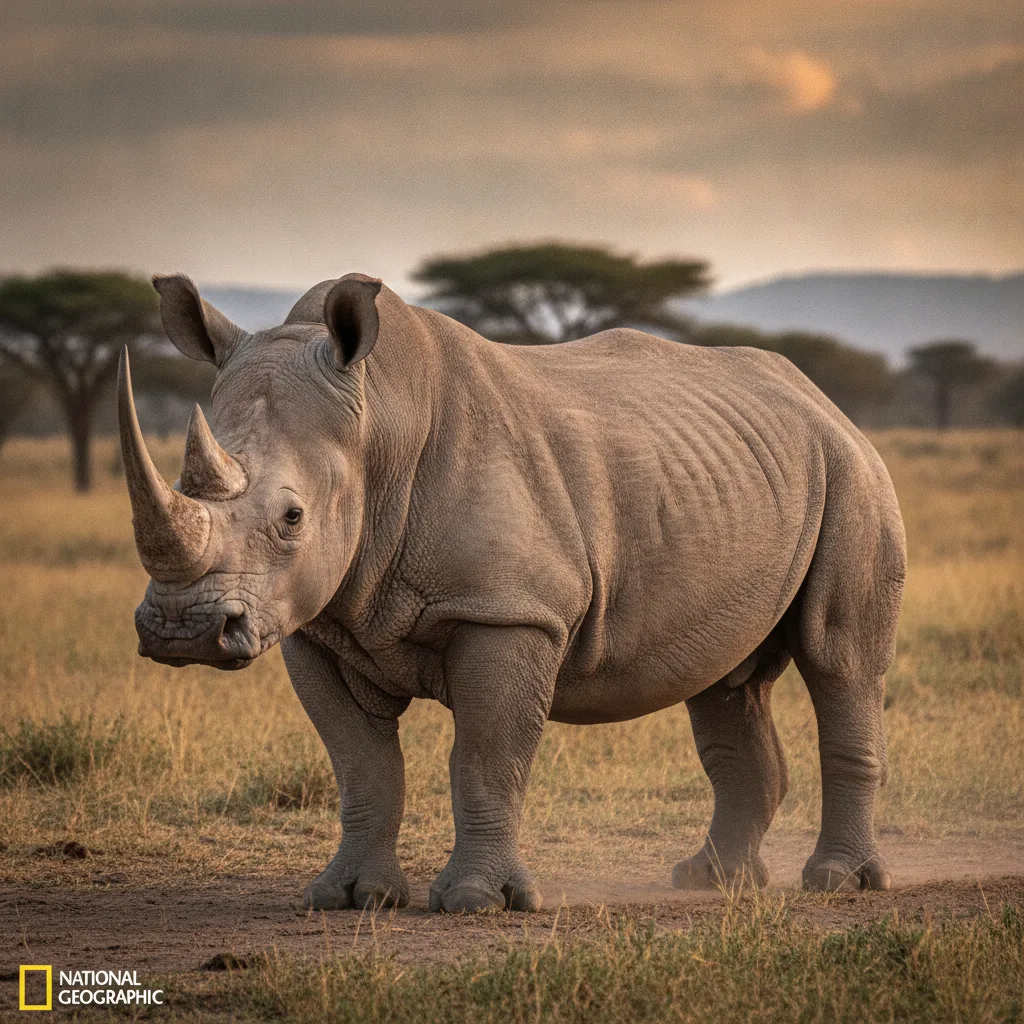
White Rhino at a glance
| Scientific name | Ceratotherium |
|---|---|
| IUCN status | Near Threatened (Southern white rhino); Critically Endangered (Northern white rhino) |
| Population | 16,000-18,000 |
| Population trend | stable |
| Weight | 2300–3600 kg |
| Length | 4–4.6 m |
| Lifespan | 40–50 years |
| Top speed | 40 km/h |
| Class | Mammalia |
| Order | Perissodactyla |
| Family | Rhinocerotidae |
| Known species | 2 |
Need to know
- The white rhino is the largest extant species of rhinoceros.
- Its name derives from the Afrikaans word 'wyd' meaning 'wide', referring to its broad mouth.
- The northern white rhino is functionally extinct with only two females remaining.
- White rhinos can run at speeds up to 40 km/h.
- They are one of the few non-territorial rhinos and form loose social groups.
- Most white rhinos live in Southern Africa, with South Africa home to the majority.
About the White Rhino
The white rhinoceros is not just the largest living rhino, but also the second largest land mammal after the elephant. Characterized by its massive head and distinctive squared mouth, the white rhino thrives on the open savannas and grasslands of Southern Africa. Unlike their black rhino cousins, white rhinos are major grazers, spending much of their day feeding on grasses.
There are two subspecies: the Southern white rhinoceros, which has recovered from near extinction to become the most populous rhino, and the Northern white rhinoceros, which is now considered functionally extinct, with only two females surviving under armed guard. Their size, social behaviors, and ecological importance make them one of the most iconic animals of Africa.
Physical characteristics
Size: 3.7–4.0 meters in length, 1.7–1.9 meters at the shoulder. Weight: 1,800–2,700 kg; occasionally up to 3,600 kg. Lifespan: 40 years in the wild, up to 50 years in captivity.
- Broad, square-shaped mouth for grazing
- Two facial horns, front horn usually larger
- Massive muscular body
- Thick, grayish skin with sparse hair
- Large, humped neck with pronounced shoulder hump
Notable species
- Southern White Rhinoceros (Ceratotherium simum simum) — Near Threatened. Open grasslands and savannas Regions: South Africa, Namibia, Zimbabwe, Botswana, Eswatini.
- Northern White Rhinoceros (Ceratotherium simum cottoni) — Critically Endangered (Possibly Extinct in the Wild). Formerly grassy plains and savanna woodlands Regions: Formerly Central Africa, Democratic Republic of the Congo, South Sudan, Uganda, Currently only in captivity in Kenya.
Habitat and range
Original range: Once widespread across sub-Saharan Africa from South Africa to the north of the Democratic Republic of the Congo.
Current distribution: Now mostly restricted to Southern Africa, mainly South Africa, with small populations in neighboring countries; Northern white rhino is virtualy extinct except for two individuals under protection in Kenya.
Preferred environments: Open grassland, Savanna, Light woodland with access to water
Regions: South Africa, Namibia, Zimbabwe, Botswana, Eswatini, (formerly Central African Republic), Kenya (in managed care)
Where to see White Rhino
- Kruger National Park, South Africa — May–September (dry season). Look around waterholes and in open savanna grasslands.
- Hluhluwe–Imfolozi Park, South Africa — June–September. This park was crucial for the white rhino's survival and remains a stronghold.
- Ol Pejeta Conservancy, Kenya — Year-round. Home to the last two northern white rhinos.
Behavior and diet
Diet: Strictly grazers—primarily feed on short grasses.
Social structure: More social than other rhinos; females and young often form groups (crashes) of up to 14 individuals, while males are territorial.
Communication: Use vocalizations (snorts, bellows, grunts), scent marking, and body language; scent marking with dung piles is a key behavior.
- Use communal dung heaps to mark territories and communicate
- Wallowing in mud to cool off and protect skin from parasites
- Form 'crashes'—temporary groups, especially females with calves
- Adult males mark and defend territories aggressively
Interactions with other animals
- Lion (predator): Lions may prey on very young or weak calves, but this is rare due to the white rhino's size and protective mothers.
- Oxpecker (bird) (symbiotic): Oxpeckers feed on parasites on the rhino's skin and alert them to danger.
- African Elephant (competitive): Occasionally compete for water sources during extreme droughts.
Conservation
IUCN Red List status: Near Threatened (Southern white rhino); Critically Endangered (Northern white rhino)
Threats
- Poaching for horns
- Habitat loss and fragmentation
- Political instability in former northern range
- Low population numbers (Northern subspecies)
- Limited genetic diversity
Conservation efforts
- Anti-poaching patrols and strict law enforcement in reserves
- Rhino relocation to safer areas
- Dehorning in highly targeted populations
- Community-based conservation programs
- Assisted reproductive technology for northern white rhino
How to help
- Support organizations committed to rhino protection and habitat conservation
- Refuse to buy or trade items containing rhino horn
- Promote public awareness about rhino conservation
- Support wildlife-friendly tourism in rhino habitats
- Contribute to anti-poaching and ranger support funds
White Rhino facts for kids
White rhinos are huge plant-eating animals with two horns on their heads. Most live in grassy areas in Southern Africa. Sadly, they are in danger because people hunt them for their horns.
- White rhinos aren't white—their name means 'wide' because of their big mouths.
- They can weigh more than a small truck.
- A white rhino's horn is made of the same stuff as your fingernails.
- Despite their size, they can run faster than a human!
- White rhinos love to roll in the mud to keep cool.
Did you know? Did you know that the rarest white rhinos—called northern white rhinos—all live with 24-hour bodyguards to protect them from poachers?
Watch & learn
- White Rhinos: Giants of the African Plains — BBC Earth. This documentary provides an in-depth look at the life and behavior of Ceratotherium simum, capturing the daily struggles and triumphs of the white rhino. It features expert commentary and iconic high-definition wildlife footage that BBC Earth is known for.
- White Rhino Rescue: Conservation in Action — National Geographic Wild. National Geographic Wild follows teams on the ground in Africa as they work to protect and save the critically endangered white rhino. The video spotlights conservation tactics and the real challenges of fighting rhino poaching.
- Tracking the White Rhino – Secrets in the Grasslands — Smithsonian Channel. Go behind the scenes with Smithsonian Channel wildlife experts as they study the movements and ecology of white rhinos, using GPS and field research to reveal new insights about these gentle giants.
- The Last White Rhinos – Race Against Extinction — PBS Nature. PBS Nature tells the dramatic story of the survival struggle faced by the world's last northern white rhinos, focusing on conservation, genetics, and the urgent fight against extinction.
- White Rhino Families: Life and Legacy — BBC Earth. This feature observes the social structures and parenting behaviors within white rhino groups, capturing intimate moments of births, bonding, and the day-to-day lives of these massive mammals.
Sources
Facts on this page are checked against these references. Follow them for the primary data.
- IUCN Red List — Conservation status, population trend and range assessment for Ceratotherium
- Encyclopaedia Britannica — Reviewed encyclopaedia entry on the white rhino
- National Geographic — Articles, photographs and field reporting on the white rhino