Peregrine Falcon
Falco peregrinus
The peregrine falcon is the fastest animal on Earth, folding its wings into a hunting dive that has been clocked at over 300 km/h. It nests on cliffs on every continent except Antarctica and has taken readily to city skyscrapers, where pigeons provide easy prey. Pesticide-thinned eggshells nearly wiped it out in North America and Europe by the 1970s; after DDT bans and reintroductions it is now Least Concern.
Quick facts: Size 34-58 cm in length, 80-120 cm wingspan · Lifespan 13 years on average, up to 20 years in the wild · IUCN status Least Concern
Print the fact sheet — a free one-page PDF for homeschool and classroom use
Peregrine Falcon at a glance
| Scientific name | Falco peregrinus |
|---|---|
| IUCN status | Least Concern |
| Population | 140,000 mature individuals |
| Population trend | increasing |
| Weight | 0.85–1.5 kg |
| Length | 40–58 cm |
| Lifespan | 13–20 years |
| Top speed | 320 km/h |
| Class | Aves |
| Order | Falconiformes |
| Family | Falconidae |
Need to know
- Peregrine Falcons are the fastest animals on Earth, reaching dive speeds over 320 km/h (200 mph).
- They have made a remarkable recovery after 20th-century population crashes due to DDT.
- Peregrines are found on every continent except Antarctica.
- They often nest on tall urban buildings, adapting well to city life.
- The species name 'peregrinus' means 'wanderer,' reflecting their immense migratory range.
- Peregrine Falcons use a distinctive hunting stoop, or dive, to catch prey mid-air.
About the Peregrine Falcon
The Peregrine Falcon (Falco peregrinus) is one of the world's best-known birds of prey, famed for its athletic prowess and astonishing speed. This cosmopolitan raptor is found nearly everywhere on Earth, from Arctic tundra to bustling urban skylines. Historically revered by falconers and naturalists alike, the Peregrine's beauty, skill, and dramatic conservation story have made it an emblem for wildlife recovery and environmental stewardship.
With 17 recognized subspecies varying in appearance and migratory habits, this single species displays an impressive adaptability. Once brought to the brink of extinction by pesticide poisoning in the mid-20th century, the Peregrine's global population has rebounded due to intensive conservation efforts. They are now thriving on cliffs, in wild wildernesses, and atop some of the world's tallest skyscrapers.
Physical characteristics
Size: 34-58 cm in length, 80-120 cm wingspan. Weight: 0.6 - 1.5 kg. Lifespan: 13 years on average, up to 20 years in the wild.
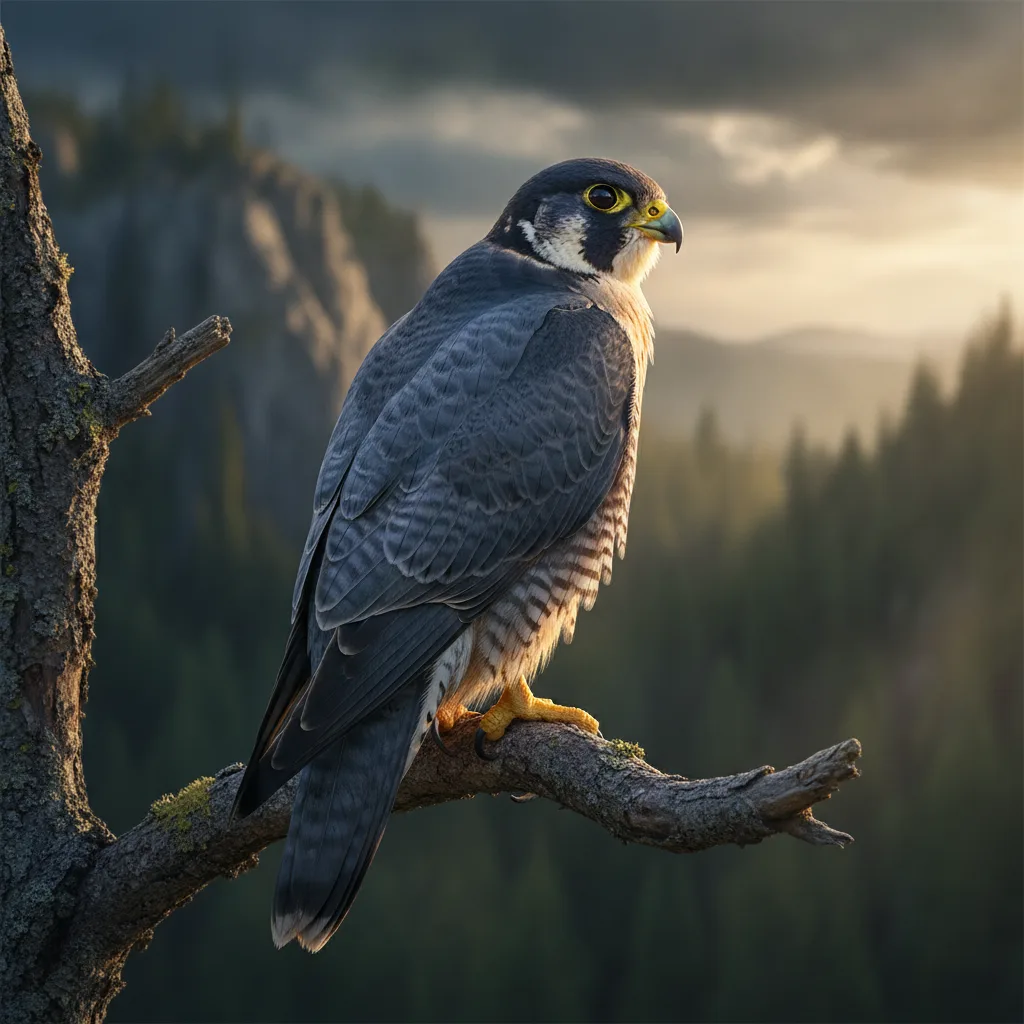
- Slate-blue to gray back
- Barred white underparts
- Distinct dark 'moustache' facial markings
- Sharp, hooked beak
- Long pointed wings
Notable species
- Peregrine Falcon (Nominate subspecies) (Falco peregrinus peregrinus) — Least Concern. Cliffs, urban buildings, wide open countryside Regions: Europe, North Africa, Western Asia, Scandinavia.
- Falco peregrinus tundrius (Falco peregrinus tundrius) — Least Concern. Tundra cliffs and open spaces Regions: Arctic tundra, Northern Canada, Alaska, Migrates to South America.
- Falco peregrinus anatum (Falco peregrinus anatum) — Least Concern. Mountains, riversides, skyscrapers in cities Regions: North America, Rocky Mountains, Eastern US, Western US.
- Falco peregrinus calidus (Falco peregrinus calidus) — Least Concern. Arctic and subarctic river valleys, cliffs Regions: Northern Asia, Siberia, Migrates to Sub-Saharan Africa, Indian Subcontinent.
- Falco peregrinus brookei (Falco peregrinus brookei) — Least Concern. Rocky cliffs, canyons, Mediterranean scrub Regions: Southern Europe, Northwest Africa, Mediterranean region, Balkans.
Habitat and range
Original range: Evolved across temperate and subarctic regions of Europe, Asia, and North America
Current distribution: Nearly worldwide: present on all continents except Antarctica and many oceanic islands
Preferred environments: Cliffs and rocky outcrops, Open grasslands, Mountain regions, Coastal seashores, Urban skyscrapers and tall buildings
Regions: North America, South America, Europe, Asia, Africa, Australia, Arctic tundra, Mediterranean region
Where to see Peregrine Falcon
- Grand Canyon National Park, Arizona, USA — Spring to early summer. Best observed nesting on cliffs and hunting over canyons.
- London, United Kingdom (urban rooftops) — Year-round. Look for them nesting on skyscrapers and historic buildings.
- Arctic tundra, Alaska — June to August. Migratory subspecies nest on exposed ledges during the Arctic summer.
Behavior and diet
Diet: Primarily medium-sized birds (such as pigeons, doves, songbirds, and ducks), occasionally small mammals and bats.
Social structure: Solitary or in pairs, territorial during breeding season. Juveniles disperse widely after leaving the nest.
Communication: Use vocalizations (kee-yak, kakking calls) for territory defense and mate communication; visual displays and courtship flights are important during breeding.
- High-velocity hunting dive (stoop) from great heights
- Courtship 'sky dance' flights involving steep dives and aerial exchanges
- Adaptation to nesting on urban high-rise buildings
- Regular migration over thousands of kilometers for certain subspecies
Interactions with other animals
- Rock Pigeon (prey): Peregrines commonly hunt and feed on city-dwelling pigeons.
- Ravens (competitive): Ravens sometimes compete for cliff nesting sites and will harass or mob Peregrines.
- Gyrfalcon (competitive): In the far north, Gyrfalcons may compete with Peregrines for prey and breeding territories.
Conservation
IUCN Red List status: Least Concern
Threats
- Pesticide contamination (notably DDT, now banned in most countries)
- Habitat loss and disturbance
- Illegal shooting and egg collection
- Collision with buildings and vehicles
Conservation efforts
- Reintroduction programs using captive-bred birds
- Banning of harmful pesticides like DDT
- Protection of nesting sites (cliffs, urban areas)
- Long-term population monitoring
How to help
- Support organizations engaged in raptor research and rehabilitation
- Promote urban wildlife-friendly policies
- Report disturbed or threatened nests to conservation authorities
- Educate others about the importance of raptors
Peregrine Falcon facts for kids
The Peregrine Falcon is the fastest animal in the world! It lives on every continent except Antarctica and can be found in wild mountains or on city skyscrapers. Peregrines hunt other birds in mid-air using amazing speed and skill.
- Peregrine Falcons can fly faster than a race car!
- Baby falcons are called chicks and hatch in nest scrapes on high ledges.
- Peregrines use their sharp beaks to help catch birds for lunch.
- They often live on skyscrapers in big cities, just like superheroes.
Did you know? Did you know Peregrine Falcons can spot a pigeon from over two miles away and then swoop down at over 200 miles per hour to catch it?
Watch & learn
- Peregrine Falcon – The World's Fastest Animal | BBC Earth — BBC Earth. Explore the remarkable speed and hunting techniques of the peregrine falcon—Falco peregrinus—in stunning detail with cinematic wildlife footage from BBC Earth’s acclaimed series.
- Peregrine Falcon – High-Speed Hunters | National Geographic Wild — National Geographic Wild. Witness the aerial mastery and precision of peregrine falcons as they hunt and thrive in urban and wild landscapes, presented by National Geographic’s expert wildlife filmmakers.
- Raptor Force – Peregrine Falcon’s Flight Secrets | Smithsonian Channel — Smithsonian Channel. Discover the science behind the peregrine falcon’s legendary stoop and its unique adaptations with insight from Smithsonian Channel’s deep-dive raptor specials.
- Urban Falcons – Peregrine Falcons in the City | PBS Nature — PBS Nature. Follow the story of peregrine falcons adapting to life in urban environments, raising young among skyscrapers, and drawing new research insights, as featured on PBS Nature.
- Peregrine Falcon Nest Cameras – Up Close with the World’s Fastest Bird | Explore.org — Explore.org. Experience live and recorded peregrine falcon nest cams provided by Explore.org, offering a rare glimpse into their nesting, feeding, and chick-rearing behaviors.
Sources
Facts on this page are checked against these references. Follow them for the primary data.
- IUCN Red List — Conservation status, population trend and range assessment for Falco peregrinus
- Encyclopaedia Britannica — Reviewed encyclopaedia entry on the peregrine falcon
- National Geographic — Articles, photographs and field reporting on the peregrine falcon