Arctic Fox
Vulpes lagopus
Arctic foxes live on the tundra and sea ice of the circumpolar north, where a dense winter coat lets them stay active at temperatures below −40 °C. Their fur changes from white in winter to brown or grey in summer, and in lean years they follow polar bears to scavenge seal kills. The species is Least Concern overall, though the Scandinavian population remains small after fur trapping and competition from spreading red foxes.
Quick facts: Size body length 45–68 cm; tail length 30–35 cm; height 25–30 cm at shoulder · Lifespan 3–6 years in the wild (up to 11 years recorded) · IUCN status Least Concern
Print the fact sheet — a free one-page PDF for homeschool and classroom use
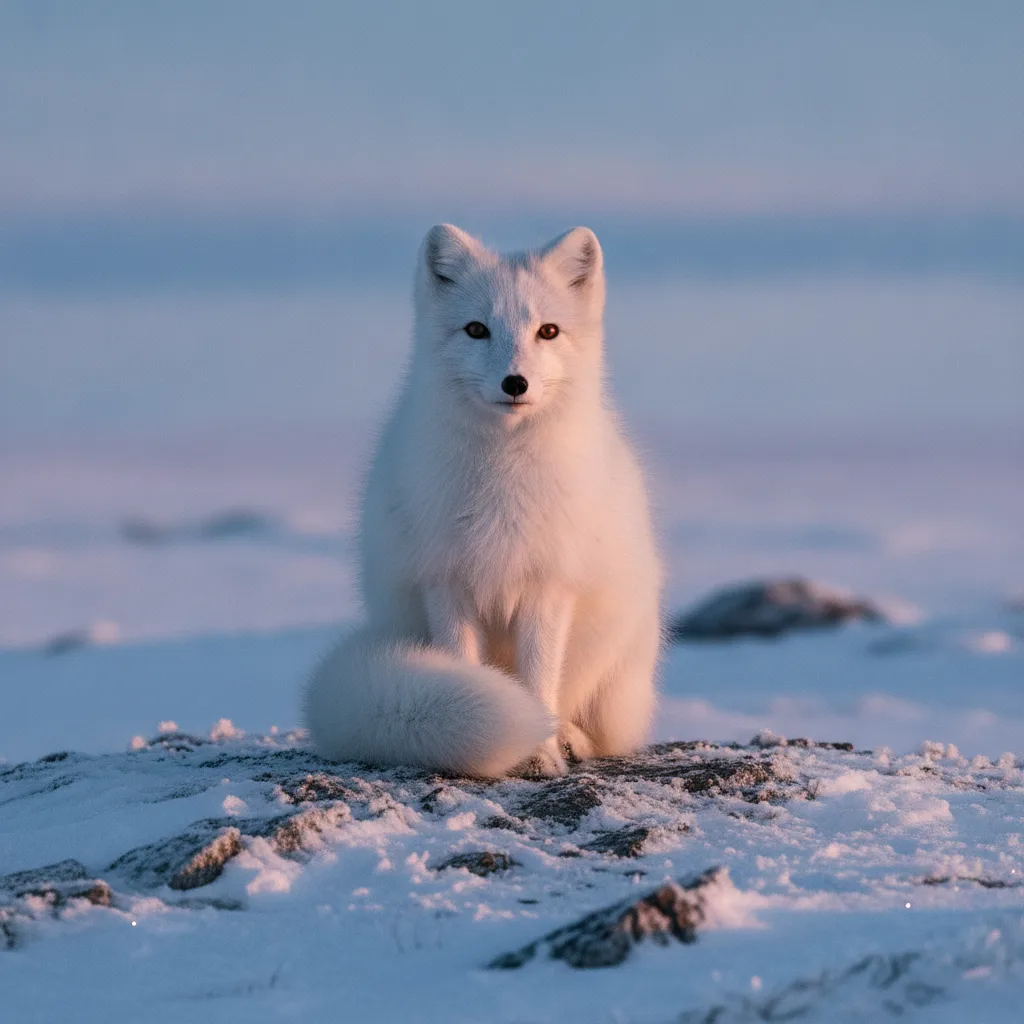
Arctic Fox at a glance
| Scientific name | Vulpes lagopus |
|---|---|
| IUCN status | Least Concern |
| Population | several hundred thousand |
| Population trend | stable |
| Weight | 3.5–9 kg |
| Length | 55–68 cm |
| Lifespan | 3–11 years |
| Top speed | 50 km/h |
| Class | Mammalia |
| Order | Carnivora |
| Family | Canidae |
Need to know
- The Arctic fox is supremely adapted to survive Arctic temperatures as low as -50°C with its dense, insulating fur.
- Its fur changes color with the seasons: white in winter and brown or gray in summer for camouflage.
- Arctic foxes can smell and locate prey beneath up to 1 meter of snow.
- This species is known for following polar bears to scavenge on leftovers after a big kill.
- In Iceland, the Arctic fox is the only native land mammal.
- Some populations, particularly in Fennoscandia, are endangered—despite global stability.
About the Arctic Fox
The Arctic fox (Vulpes lagopus) roams the circumpolar regions of the Northern Hemisphere, thriving in some of the most extreme cold climates on Earth. Its compact body, thick winter fur, and behavioral adaptations have evolved to survive freezing temperatures, sparse food, and vast, treeless tundra expanses. While most Arctic fox populations remain stable, some local populations are threatened due to habitat changes, disease, and increased competition.
These foxes are mostly solitary outside the breeding season, but during summer, they become highly visible as they raise pups in large dens. Their remarkable camouflage and resourcefulness—such as caching surplus food and switching diets seasonally—highlight how wildlife thrives in the harsh Arctic.
Physical characteristics
Size: body length 45–68 cm; tail length 30–35 cm; height 25–30 cm at shoulder. Weight: 2.5–9 kg, typically 3–5.5 kg. Lifespan: 3–6 years in the wild (up to 11 years recorded).
- Extremely thick winter fur, white or blue-gray coloring
- Short, rounded ears and nose to minimize heat loss
- Large, bushy tail (up to 35 cm), often used as a wrap for warmth
- Short legs and compact body shape
- Color-changing pelage: white in winter, brown/gray in summer
Notable species
- Arctic Fox (Vulpes lagopus) — Least Concern. Open Arctic tundra, coastal shorelines, pack ice edges, rocky and snowy terrain Regions: Arctic tundra, Northern Alaska, Canadian Arctic Archipelago, Greenland, Iceland, Svalbard, Northern Russia, Lapland.
Habitat and range
Original range: Circumpolar Arctic tundra regions of North America, Europe, and Asia
Current distribution: Arctic foxes still occupy most of their historical range across circumpolar tundra, with local declines in some Nordic regions
Preferred environments: Coastal tundra, Inland tundra, Rocky slopes, Permafrost plains, Pack ice and sea ice edges
Regions: Northern Alaska, Canadian Arctic Archipelago, Greenland, Iceland, Svalbard, Lapland, Chukotka, Siberian Arctic, Kanin Peninsula, Baffin Island
Where to see Arctic Fox
- Svalbard, Norway — June–August. Most visible during the Arctic summer when pups are raised around dens.
- Icelandic Westfjords — Year-round. Best spotted in remote coastal and tundra regions, especially in Hornstrandir Nature Reserve.
- Churchill, Manitoba (Canada) — November–March. Watch along the tundra for foxes scavenging after polar bear hunts.
Behavior and diet
Diet: Lemmings and voles (mainly), birds, eggs, berries, fish, carrion (including polar bear leftovers)
Social structure: Mainly solitary except for breeding pairs and families during denning season
Communication: Barks, high-pitched yaps, growls, and body language (posture, tail position); scent marking
- Seasonal color morphing for camouflage
- Food caching for winter survival
- Long-distance wandering over sea ice during food shortages
- Use of complex, multi-entrance dens for shelter
Interactions with other animals
- Lemmings (prey): Arctic foxes heavily rely on lemmings as their main summer food source.
- Polar bears (competitive/scavenger): Foxes follow polar bears and scavenge carcasses left behind after a kill.
- Red fox (competitive): Red foxes sometimes displace Arctic foxes from habitats as climate warms and their range expands north.
Conservation
IUCN Red List status: Least Concern
Threats
- Climate change reducing sea ice and tundra habitats
- Competition with expanding red fox populations
- Disease outbreaks (distemper, rabies)
- Fluctuations in lemming populations
- Fur trapping (localized impact in the past)
Conservation efforts
- Protection and management of critical den areas
- Reintroduction programs in Fennoscandia
- Regulation and monitoring of trapping
- Research and monitoring of subpopulations
How to help
- Support organizations that protect Arctic habitats and wildlife
- Reduce carbon footprint to mitigate climate change
- Spread awareness about impacts of invasive species
- Promote sustainable tourism in Arctic regions
Arctic Fox facts for kids
The Arctic fox lives way up north where it’s freezing cold. It has fluffy fur that keeps it warm and changes color from white in winter to brown in summer. It eats lemmings and follows polar bears to find food!
- Arctic foxes’ paws are furry like snow boots!
- Their tails are as long as their bodies and help keep them cozy at night.
- They can survive in places colder than your freezer!
- In winter, they turn totally white to hide in the snow.
- They sometimes travel across icy sea to find food.
Did you know? An Arctic fox can hear and dig through thick snow to catch tiny animals moving below!
Watch & learn
- Arctic Foxes: Masters of Survival in the Frozen North — BBC Earth. This BBC Earth documentary covers the incredible adaptations and survival strategies of Vulpes lagopus in the harsh Arctic environment, featuring beautiful cinematography and natural behavior footage.
- The Secret Life of Arctic Foxes — National Geographic Wild. Explore the daily life, hunting skills, and family bonds of Arctic foxes with National Geographic Wild. The video provides rare insights into how these mammals endure the brutal Arctic winters.
- Winter Warriors: Arctic Fox Family Drama — Smithsonian Channel. Delve into the fascinating world of an Arctic fox family as they raise their young and face predators, filmed by Smithsonian Channel with expert narration and close-up wildlife interactions.
- Nature: Arctic Ghost — The Enigmatic Arctic Fox — PBS Nature. PBS Nature explores the life cycle, remarkable camouflaging abilities, and ecological role of the Arctic fox, combining expert commentary with breathtaking remote-filmed wildlife scenes.
- Extreme Survival: Arctic Fox vs. the Frozen Tundra — BBC Studios. Witness the Arctic fox's relentless quest for food and warmth during the polar night, with BBC Studios providing firsthand footage of this canid’s unique adaptations.
Sources
Facts on this page are checked against these references. Follow them for the primary data.
- IUCN Red List — Conservation status, population trend and range assessment for Vulpes lagopus
- Encyclopaedia Britannica — Reviewed encyclopaedia entry on the arctic fox
- National Geographic — Articles, photographs and field reporting on the arctic fox