Wolf
Canis
Grey wolves once ranged across most of the Northern Hemisphere and still occupy tundra, forest and mountain country from Alaska to Mongolia. A pack is usually a family — a breeding pair and their offspring from the past few years — that cooperates to bring down prey many times a single wolf's weight, from deer to bison. Globally the species is Least Concern, though populations in Western Europe and the lower 48 US states are only recently recovering from near-extermination.
Quick facts: Size 1–1.6 m body length, 38–85 cm shoulder height · Lifespan 6–8 years in the wild (up to 16 in captivity) · IUCN status Varies by species (Gray Wolf: Least Concern; Red Wolf: Critically Endangered; Ethiopian Wolf: Endangered)
Print the fact sheet — a free one-page PDF for homeschool and classroom use
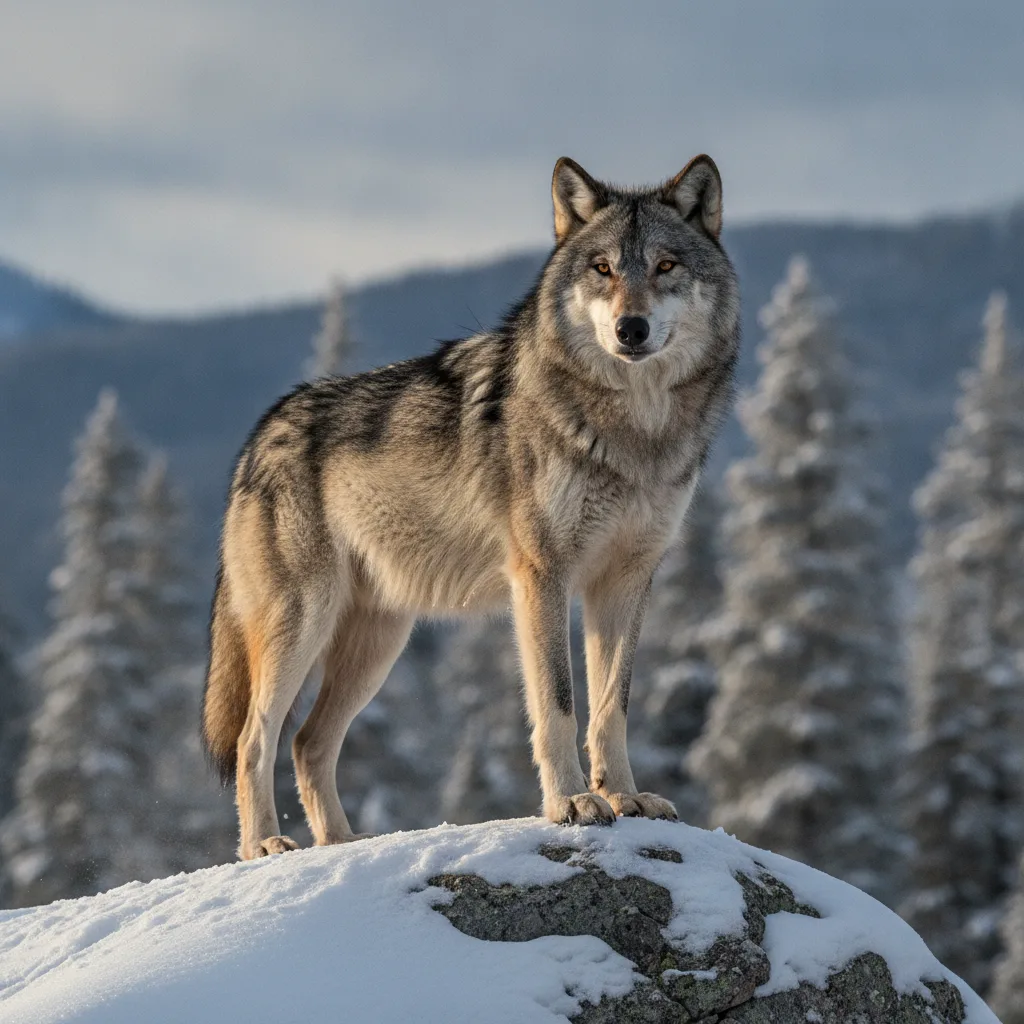
Wolves at a glance
| Scientific name | Canis |
|---|---|
| IUCN status | Varies by species (Gray Wolf: Least Concern; Red Wolf: Critically Endangered; Ethiopian Wolf: Endangered) |
| Population | 200,000 - 250,000 |
| Population trend | stable |
| Weight | 40–80 kg |
| Length | 1.3–1.8 m |
| Lifespan | 6–16 years |
| Top speed | 60 km/h |
| Class | Mammalia |
| Order | Carnivora |
| Family | Canidae |
| Known species | 6 |
Need to know
- Wolves are the largest members of the Canidae family.
- A wolf pack is a highly organized family group led by an alpha pair.
- Gray wolves can travel up to 30–40 km per day and reach speeds of 60 km/h.
- Wolves communicate through howls, body language, and scent marking.
- Red wolves are among the most endangered canids worldwide.
- Ethiopian wolves are the world's rarest and most specialized African canid.
About the Wolves
Wolves are iconic, highly adaptable canids that play a crucial ecological role across the Northern Hemisphere and parts of Africa. They are known for their intelligence, complex social structure, and unique adaptations to various environments, from Arctic tundra to deserts. The gray wolf alone includes numerous subspecies, but other distinct wolf species such as the Ethiopian wolf and the critically endangered red wolf are also of significant scientific interest.
Wolves exhibit a range of colors from gray, black, and white to reddish and golden depending on the species and habitat. They hunt cooperatively in packs and are apex predators that help regulate populations of prey animals such as deer and rodents. Human persecution, habitat loss, and hybridization threaten some wolf species, leading to dramatic declines in their numbers during the 20th century, followed by conservation-driven recoveries in recent decades.
Physical characteristics
Size: 1–1.6 m body length, 38–85 cm shoulder height. Weight: 25–45 kg (can reach 80 kg for some large males). Lifespan: 6–8 years in the wild (up to 16 in captivity).
- Large triangular ears
- Long bushy tail with black tip
- Dense double fur coat
- Powerful jaws and canines
- Yellow or amber eyes
Notable species
- Gray Wolf (Canis lupus) — Least Concern. Forests, tundra, mountains, grasslands Regions: North America, Europe, Russia, Central Asia, Middle East, Arctic tundra, Himalayas.
- Red Wolf (Canis rufus) — Critically Endangered. Wetlands, coastal prairie, pine forests Regions: Southeastern United States, Coastal North Carolina.
- Ethiopian Wolf (Canis simensis) — Endangered. Afro-alpine grasslands Regions: Ethiopian Highlands, Bale Mountains, Simien Mountains.
- Indian Wolf (Canis lupus pallipes) — Least Concern. Grasslands, semi-deserts Regions: India, Pakistan, Iran, Afghanistan, Nepal.
- Himalayan Wolf (Canis lupus chanco) — Data Deficient. Alpine meadows, mountain scrub Regions: Himalayas, Tibet Plateau, Qinghai, Western China, Nepal.
- African Golden Wolf (Canis lupaster) — Least Concern. Savannah, semi-arid regions, open woodland Regions: North Africa, East Africa, Horn of Africa, Sahel, Egypt.
Habitat and range
Original range: Primarily North America, Eurasia, and Africa—though wolves once roamed most of the Northern Hemisphere.
Current distribution: Now found in selected regions of North America, Eurasia, and Africa, usually where wilderness habitats are preserved.
Preferred environments: Boreal and temperate forests, Mountains, Tundra, Grasslands, Deserts, Alpine meadows
Regions: Alaska, Canada, Northern Rocky Mountains, Eurasian Steppe, Russia, Scandinavia, Central Asia, Ethiopian Highlands, India, North Africa, Nepal
Where to see Wolves
- Yellowstone National Park, USA — Winter and Early Spring. Look for packs tracking elk in Lamar Valley.
- Bale Mountains National Park, Ethiopia — October–March (dry season). Chance to spot rare Ethiopian wolves at high altitude.
- Scandinavia (Sweden, Finland, Norway) — Late winter. Remote forest expeditions for European gray wolves.
Behavior and diet
Diet: Carnivorous: mainly large ungulates (deer, elk, moose), sometimes smaller mammals, birds, and carrion; Ethiopian wolves primarily eat rodents.
Social structure: Lives in family-based packs led by dominant alpha male and female. Packs typically 5–10 individuals but can reach 20+.
Communication: Highly vocal—uses howls, barks, whimpers, and growls; also communicates through scent-marking, body postures, and facial expressions.
- Cooperative hunting strategies targeting prey larger than themselves
- Regurgitation of food by adults to feed pups
- Seasonal territory marking and howling as pack boundary warning
- Strong pup-rearing cooperation among all pack members
Interactions with other animals
- Elk (predator): Wolves hunt elk as primary prey in North America; impacts elk herd behavior and population.
- Bear (Brown/Grizzly) (competitive): Wolves and bears compete for similar prey; occasional confrontations at carcasses.
- Raven (symbiotic): Ravens follow wolves to scavenged kills; wolves appear to tolerate them, possibly benefiting from their alarm calls.
Conservation
IUCN Red List status: Varies by species (Gray Wolf: Least Concern; Red Wolf: Critically Endangered; Ethiopian Wolf: Endangered)
Threats
- Habitat loss and fragmentation
- Human persecution and illegal killing
- Hybridization with domestic dogs
- Disease (canine distemper, rabies)
- Decline in prey populations
Conservation efforts
- Reintroduction and recovery programs
- Legal protection (national/international law)
- Captive breeding (especially for red and Ethiopian wolves)
- Community conservation and education
- Ongoing ecological and behavioral monitoring
How to help
- Support wolf conservation organizations
- Promote coexistence measures to reduce livestock conflict
- Report illegal poaching or harassment
- Participate in education and advocacy initiatives
- Respect protected areas and follow responsible ecotourism guidelines
Wolves facts for kids
Wolves are smart, social animals that live in packs, hunt together, and howl to communicate. They're found in forests, mountains, and grasslands all around the world and are important for keeping nature in balance.
- Wolves can travel up to 50 miles in one day.
- Wolf pups are born deaf and blind.
- Each wolf’s howl is unique, just like a fingerprint.
- A wolf pack is like a family – they hunt, eat, and play together.
- Despite their scary reputation, wolves are shy and usually avoid people.
Did you know? Did you know? Wolves can hear other wolves howling as far as 10 kilometers (6 miles) away!
Watch & learn
- Wolves: The Great Predators of Yellowstone — National Geographic. Explore the reintroduction and impact of Canis lupus in Yellowstone National Park, revealing their essential ecological role and complex social lives with stunning cinematography.
- The Secret Life of Wolves — PBS Nature. A deep dive into wolf packs, their family bonds, hunting strategies, and conservation stories across North America, offering scientific insights and incredible wild encounters.
- The Wolf Pack: Social Structure and Survival — BBC Earth. Witness the intricate hierarchy, hunting techniques, and cooperative behaviors of wolf packs in remote wildernesses, narrated with BBC's trademark excellence.
- Wolves Unleashed: Return of the Predators — Smithsonian Channel. Follow biologists as they study the rewilding of wolves in North America and Europe, highlighting their role as top carnivores and the challenges they face from humans.
- How Wolves Change Rivers — BBC Earth. Discover how the presence of Canis lupus transforms entire ecosystems, including the remarkable trophic cascade seen in Yellowstone, in this concise but impactful segment.
Sources
Facts on this page are checked against these references. Follow them for the primary data.
- IUCN Red List — Conservation status, population trend and range assessment for Canis
- Encyclopaedia Britannica — Reviewed encyclopaedia entry on the wolves
- National Geographic — Articles, photographs and field reporting on the wolves