Shark
Selachimorpha
Sharks have patrolled the oceans for more than 400 million years, predating both trees and dinosaurs, and the roughly 500 living species range from the hand-sized dwarf lanternshark to the 18-metre whale shark. Their skeletons are cartilage rather than bone, and pores on the snout detect the faint electrical fields given off by hidden prey. More than a third of shark and ray species are now threatened with extinction, mainly through overfishing.
Quick facts: Size Ranges from 15 cm (dwarf lanternshark) to 12 m (whale shark), most species 1–3 m. · Lifespan Typical lifespan is 20–30 years, some species over 70, Greenland shark up to 400 years. · IUCN status Threatened (Several species: Vulnerable, Endangered, Critically Endangered)
Print the fact sheet — a free one-page PDF for homeschool and classroom use
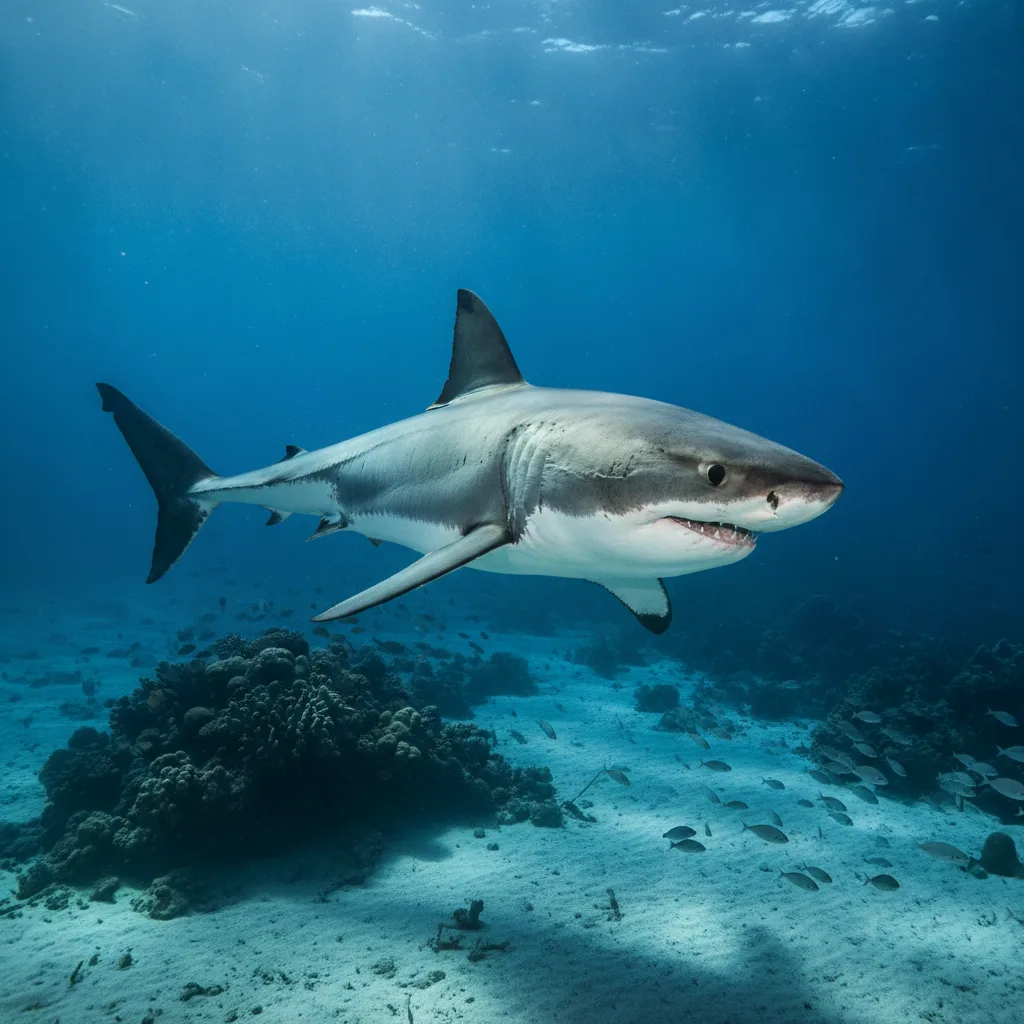
Sharks at a glance
| Scientific name | Selachimorpha |
|---|---|
| IUCN status | Threatened (Several species: Vulnerable, Endangered, Critically Endangered) |
| Population | Unknown; estimated tens of millions, but rapidly declining |
| Population trend | decreasing |
| Weight | 150–19000 kg |
| Length | 2–12 m |
| Lifespan | 25–100 years |
| Top speed | 56 km/h |
| Class | Chondrichthyes |
| Order | Selachimorpha |
| Family | Various (e.g., Carcharhinidae, Lamnidae, Sphyrnidae, Rhincodontidae) |
| Known species | 536 |
Need to know
- Sharks have survived more than 400 million years—older than dinosaurs.
- Some shark species can live more than 100 years; the Greenland shark may live over 400 years.
- The whale shark is the largest fish alive, reaching up to 18 meters in length.
- Sharks are critical apex predators, shaping marine ecosystems.
- Humans kill an estimated 100 million sharks per year, mainly for fins and meat.
- Some sharks, like the great white, detect electrical impulses with specialized organs called ampullae of Lorenzini.
About the Sharks
Sharks are a diverse and ancient group of cartilaginous fishes that are vital to healthy marine ecosystems. With more than 500 species ranging from the tiny dwarf lanternshark to the gigantic whale shark, they occupy virtually every type of marine habitat around the globe – from deep ocean trenches to colorful coral reefs.
Sharks have evolved an impressive variety of adaptations: some are fast and powerful hunters, while others are slow-moving or even filter feeders. Despite their reputation as fearsome predators, the vast majority of sharks pose little or no threat to humans. Sadly, many species now face critical threats due to overfishing, habitat loss, and the global shark fin trade.
Physical characteristics
Size: Ranges from 15 cm (dwarf lanternshark) to 12 m (whale shark), most species 1–3 m.. Weight: Ranges from less than 1 kg to over 19,000 kg (whale shark).. Lifespan: Typical lifespan is 20–30 years, some species over 70, Greenland shark up to 400 years..
- Cartilaginous skeleton (no bones)
- Multiple rows of replaceable teeth
- Streamlined, fusiform body shape
- Prominent dorsal fin(s)
- Gill slits (usually five, up to seven) on the sides of the head
Notable species
- Great White Shark (Carcharodon carcharias) — Vulnerable. Coastal and offshore temperate waters Regions: Pacific Ocean, Atlantic Ocean, Indian Ocean, waters off South Africa, waters off Australia, Mediterranean Sea.
- Whale Shark (Rhincodon typus) — Endangered. Warm tropical and subtropical open waters Regions: Indian Ocean, Pacific Ocean, Atlantic Ocean, Red Sea, waters off the Philippines, Gulf of Mexico.
- Hammerhead Shark (Scalloped) (Sphyrna lewini) — Critically Endangered. Coastal warm temperate and tropical seas, often near continental shelves Regions: Pacific Ocean, Atlantic Ocean, Indian Ocean, Caribbean Sea, waters off West Africa, Central Pacific.
- Greenland Shark (Somniosus microcephalus) — Near Threatened. Deep, cold Arctic and sub-Arctic waters Regions: North Atlantic Ocean, Arctic Ocean, waters off Greenland, waters off Canada, Norwegian Sea, Baffin Bay.
- Tiger Shark (Galeocerdo cuvier) — Near Threatened. Coastal tropical and subtropical seas, often near river mouths and reefs Regions: Tropical regions of Atlantic Ocean, Pacific Ocean, Indian Ocean, waters off Central America, Caribbean Sea, waters off Southeast Asia.
- Goblin Shark (Mitsukurina owstoni) — Least Concern. Deep-sea continental slopes and seamounts Regions: Deep waters of Pacific Ocean, Atlantic Ocean, Indian Ocean, waters off Japan, Gulf of Mexico.
Habitat and range
Original range: Sharks evolved in the early Devonian and originally inhabited ancient oceans worldwide.
Current distribution: Today, sharks inhabit every ocean as well as some brackish and rare freshwater environments.
Preferred environments: Open ocean (pelagic), Coastal shallows, Coral reefs, Deep sea, Continental and insular shelves, Mangrove estuaries
Regions: Pacific Ocean, Atlantic Ocean, Indian Ocean, Southern Ocean, Arctic Ocean, Mediterranean Sea, Red Sea, Caribbean Sea, Gulf of Mexico, Coral Sea, Baffin Bay
Where to see Sharks
- Ningaloo Reef, Australia — March–July. Famous for whale shark aggregations; snorkeling and diving tours available.
- Isla Guadalupe, Mexico — August–October. Best place to cage dive with great white sharks.
- Bahamas, Caribbean Sea — Year-round. Shallow, clear waters for observing reef sharks and tiger sharks.
- Gansbaai, waters off South Africa — May–September. Prime spot for great white shark viewing.
Behavior and diet
Diet: Sharks are mostly carnivores; diets range from plankton (filter-feeding whale sharks and basking sharks) to fish, marine mammals, crustaceans, and even other sharks.
Social structure: Most species are solitary; some form schools or loose aggregations, especially during feeding or breeding.
Communication: Sharks communicate using body language, postures, and sometimes by electroreception and vibrational cues.
- Great white sharks breach (leap from the water) when hunting seals.
- Hammerhead sharks form massive daytime schools, dispersing to hunt at night.
- Some sharks undertake epic transoceanic migrations for feeding and breeding.
- Nurse sharks can pump water over their gills, allowing them to rest motionless on the sea floor.
Interactions with other animals
- Seals and Sea Lions (prey): Great white sharks are apex predators that hunt seals and sea lions, especially near rookeries.
- Remora fish (symbiotic): Remoras attach to sharks, cleaning parasites and feeding on scraps without harming the shark.
- Other sharks (competitive): Multiple shark species may compete for the same prey in regions where they overlap.
- Humans (predator/prey): Humans threaten sharks through overfishing, but shark attacks on humans are rare and mostly accidental.
Conservation
IUCN Red List status: Threatened (Several species: Vulnerable, Endangered, Critically Endangered)
Threats
- Overfishing for fins, meat, and liver oil
- Bycatch in commercial fisheries
- Habitat destruction (e.g., coral reef damage)
- Slow reproductive rates
- Climate change and ocean acidification
- Pollution, including heavy metals and plastics
Conservation efforts
- International shark fishing bans and finning bans
- Marine protected areas
- Listing of species under CITES and CMS treaties
- Shark tagging and tracking for population research
- Consumer awareness campaigns to reduce shark fin demand
How to help
- Choose sustainably caught seafood and avoid shark products.
- Support ocean conservation groups and citizen science programs.
- Advocate for shark finning bans and marine protected areas.
- Reduce single-use plastic to help keep ocean habitats healthy.
- Raise awareness about the importance of sharks in healthy ecosystems.
Sharks facts for kids
Sharks are amazing fish that live in every ocean. Some are tiny and some are huge, but most sharks are not dangerous to people. Sharks help keep the ocean healthy by being top predators.
- Some sharks have up to 10 rows of teeth!
- The whale shark is as long as a school bus.
- Sharks can smell just one drop of blood in a million drops of water.
- Sharks’ skeletons are made from cartilage, like your nose.
- Not all sharks have to keep moving to breathe—some can rest still!
Did you know? Did you know the Greenland shark can live longer than any other vertebrate animal—possibly over 400 years?
Watch & learn
- Sharks: The Ultimate Predators – Full Nature Documentary — PBS Nature. This in-depth documentary explores the biology, behavior, and conservation of sharks (Selachimorpha), featuring stunning cinematography and insightful narration.
- World’s Deadliest Sharks: Attacks, Adaptations, and Myths — National Geographic Wild. A thrilling look at the most notorious shark species, debunking myths and showcasing their unique adaptations as apex predators of the marine world.
- Blue Planet II: Incredible Shark Footage and Hunting Strategies — BBC Earth. Follow the awe-inspiring underwater hunt and social behaviors of different shark species in some of the world’s most pristine oceans, narrated by Sir David Attenborough.
- Shark Superpowers: Secrets of the Ocean’s Top Predators — Smithsonian Channel. Discover how sharks’ extraordinary senses and evolutionary adaptations have made them the ocean’s most successful predators over millions of years.
- Rise of the Sharks: Evolution and Survival Stories — Nat Geo WILD. Investigate the evolutionary history and astonishing diversity of the order Selachimorpha, featuring families like Carcharhinidae and Lamnidae, and why sharks are vital to marine ecosystems.
Sources
Facts on this page are checked against these references. Follow them for the primary data.
- IUCN Red List — Conservation status, population trend and range assessment for Selachimorpha
- Encyclopaedia Britannica — Reviewed encyclopaedia entry on the sharks
- National Geographic — Articles, photographs and field reporting on the sharks