Dolphin
Delphinidae
Dolphins are toothed whales, and the roughly 40 species range from the familiar bottlenose to the river dolphins of the Amazon and Ganges. They find fish in murky water by echolocation, sending out clicks and reading the returning echoes, and bottlenose dolphins address one another with individual signature whistles. Most ocean species are widespread, but several river dolphins are Endangered and the Yangtze's baiji is thought to be extinct.
Quick facts: Size 1.5–4 m for most species (orca can reach 9.5 m) · Lifespan 20–40 years for most, over 60 years for orca · IUCN status Most species Least Concern, but several are Endangered or Data Deficient
Print the fact sheet — a free one-page PDF for homeschool and classroom use
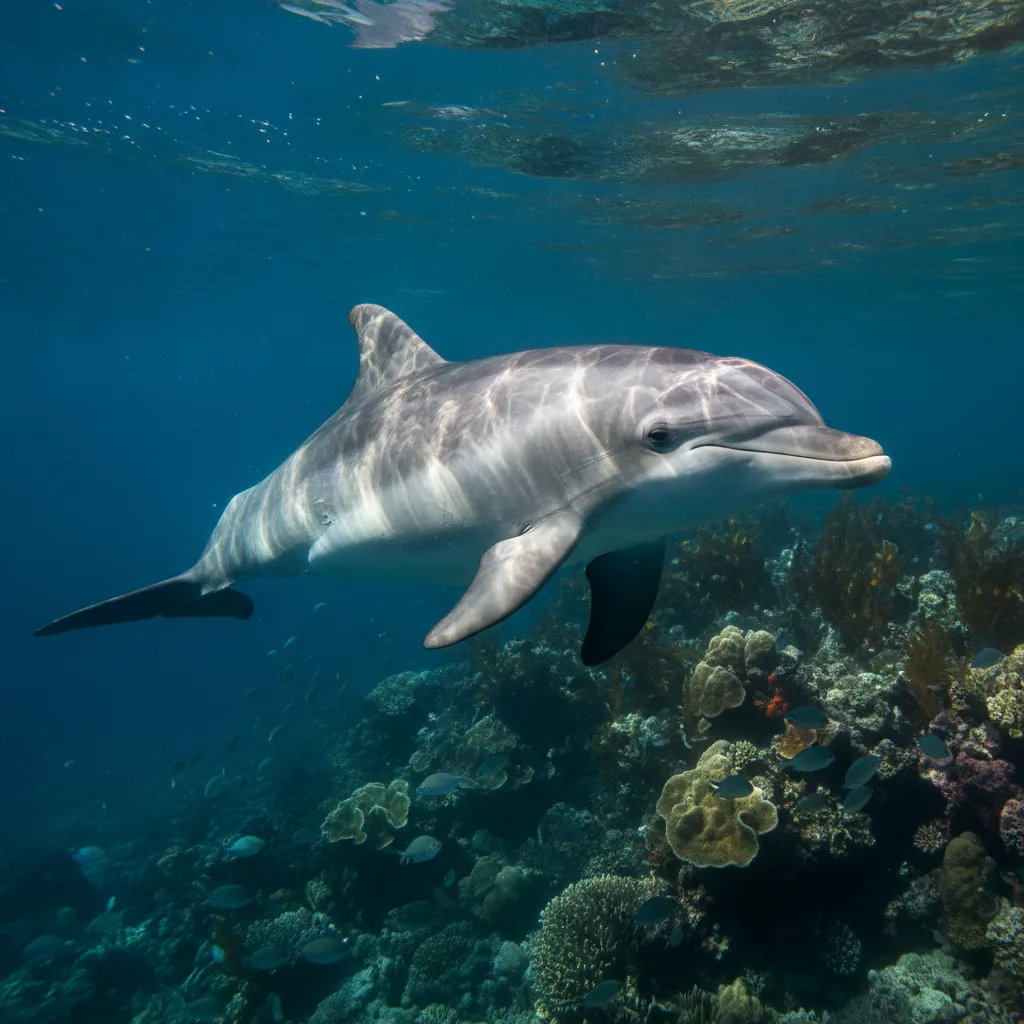
Dolphins at a glance
| Scientific name | Delphinidae |
|---|---|
| IUCN status | Most species Least Concern, but several are Endangered or Data Deficient |
| Population | Several million (global, all species combined), but highly variable by species |
| Population trend | decreasing |
| Weight | 135–9000 kg |
| Length | 2.5–9.5 m |
| Lifespan | 25–60 years |
| Top speed | 37 km/h |
| Class | Mammalia |
| Order | Cetacea |
| Family | Delphinidae |
| Known species | 36 |
Need to know
- Dolphins are highly intelligent—capable of self-recognition, tool use, and complex communication.
- They use echolocation to hunt and navigate, emitting clicks and listening for echoes.
- Killer whales (orcas) are the largest dolphin species, not a whale!
- Some dolphin pods can include thousands of individuals, known as superpods.
- Dolphins sleep with one half of their brain at a time, allowing them to surface to breathe.
- Certain species, like the Irrawaddy dolphin, can live in both fresh and saltwater habitats.
About the Dolphins
Dolphins are a diverse and highly intelligent group of aquatic mammals belonging to the family Delphinidae. Known for their agility, playful behavior, and complex societies, dolphins inhabit nearly every ocean and some river systems around the world. Their charismatic appearance and frequent surface behaviors, such as leaping and bow-riding, make them beloved by humans and prominent in marine research.
Ranging in size from the small Maui dolphin to the mighty orca (killer whale), dolphins display extraordinary adaptations to marine life. They use echolocation for hunting and orientation, communicate through a range of whistles, clicks, and body language, and show advanced problem-solving skills. Human activity poses significant threats, but conservation efforts are ongoing worldwide to ensure their future.
Physical characteristics
Size: 1.5–4 m for most species (orca can reach 9.5 m). Weight: 50–300 kg for most species; up to 9,000 kg for orca. Lifespan: 20–40 years for most, over 60 years for orca.
- Streamlined, torpedo-shaped body
- Falcate (curved) dorsal fin (except some riverine species)
- Blowhole on top of head for breathing
- Complex coloration—various patterns of gray, black, white, or even yellow/tan
- Prominent, often elongated beak/snout, except for species like orca and Risso's dolphin
Notable species
- Common Bottlenose Dolphin (Tursiops truncatus) — Least Concern. Coastal and offshore marine environments, estuaries Regions: Atlantic Ocean, Pacific Ocean, Indian Ocean, Mediterranean Sea, Gulf of Mexico, Caribbean Sea, coastal waters off Australia, coastal waters off South Africa.
- Orca (Killer Whale) (Orcinus orca) — Data Deficient / Some populations Endangered. All oceans, both coastal and open sea, from polar to tropical regions Regions: Arctic Ocean, North Atlantic Ocean, North Pacific Ocean, Southern Ocean, South Atlantic Ocean, Bering Sea, waters off Norway, waters off Antarctica.
- Spinner Dolphin (Stenella longirostris) — Least Concern. Tropical and subtropical offshore waters, near islands and atolls Regions: Indian Ocean, Pacific Ocean, Atlantic Ocean, Red Sea, Gulf of Aden, coastal waters of Southeast Asia, Central Pacific islands.
- Short-beaked Common Dolphin (Delphinus delphis) — Least Concern. Warm-temperate and tropical marine environments Regions: Atlantic Ocean, Pacific Ocean, Indian Ocean, Mediterranean Sea, Black Sea, waters off California, coastal Peru, coastal South Africa.
- Irrawaddy Dolphin (Orcaella brevirostris) — Endangered. Estuaries, freshwater rivers, coastal lagoons Regions: coastal waters of Southeast Asia, freshwater sections of Mekong River, Ayeyarwady River, Mahakam River, Bay of Bengal, Ganges Delta.
- Risso's Dolphin (Grampus griseus) — Least Concern. Deep offshore waters, continental slopes, seamounts Regions: Atlantic Ocean, Indian Ocean, Pacific Ocean, Mediterranean Sea, Benguela Current, waters off Japan, coastal California.
Habitat and range
Original range: Dolphins evolved from land-dwelling ancestors around 50 million years ago, first adapting to marine and, in a few cases, freshwater environments.
Current distribution: Today, dolphins are present in all oceans, many coastal seas, and some major river systems, with species adapted to a wide range of aquatic habitats.
Preferred environments: Shallow coastal waters, Open pelagic zones, Estuaries and bays, Continental shelf areas, Deep oceanic trenches (some species), Tropical and subtropical rivers (Irrawaddy dolphin)
Regions: Atlantic Ocean, Pacific Ocean, Indian Ocean, Southern Ocean, Arctic Ocean, Mediterranean Sea, Black Sea, Caribbean Sea, Red Sea, Gulf of Mexico, Bering Sea, Ganges River, Mekong River, Ayeyarwady River, Mahakam River
Where to see Dolphins
- Red Sea coast, Egypt — Late spring and summer. Bottlenose and spinner dolphins are commonly seen on boat tours.
- Kaikoura, New Zealand — Year-round. World-famous for superpods of dusky dolphins and occasional orca sightings.
- Moray Firth, Scotland — June–August. One of the best places to watch bottlenose dolphins in Europe.
- Bay of Islands, New Zealand — Summer months (Dec–Feb). Chance to swim with wild dolphins in open water.
Behavior and diet
Diet: Varies by species but commonly includes a range of fish, squid, cephalopods, and sometimes crustaceans; orcas hunt larger prey including seals and other whales.
Social structure: Highly social; typically live in pods of 2–30, but superpods may have over 1,000; orcas have complex family-based societies.
Communication: Use clicks (echolocation), whistles (identification and social calls), pulsed calls, and body language including leaping and tail-slapping.
- Cooperative hunting (corralling and herding fish)
- Echolocation for detailed perception of surroundings
- Leaping, bow-riding, and surfing waves
- Alloparenting (helping care for others' young)
Interactions with other animals
- Sharks (competitive): Compete for similar prey in overlapping ranges; dolphins can mob or chase off sharks.
- Fish (various species) (prey): Main food source, herded or driven together during feeding.
- Seals and sea lions (prey (for orca)): Orcas are apex predators, preying on seals in polar regions.
- Humans (varied): Positive (ecotourism, research, cooperative fishing) and negative (bycatch, habitat loss, pollution) interactions.
Conservation
IUCN Red List status: Most species Least Concern, but several are Endangered or Data Deficient
Threats
- Incidental bycatch in fisheries
- Habitat degradation and pollution (including heavy metals, plastics, PCBs)
- Noise pollution disrupting communication and echolocation
- Deliberate hunting in some regions
- Climate change affecting prey distributions
Conservation efforts
- International agreements (e.g., Marine Mammal Protection Act, CITES, IWC)
- Creation of marine protected areas
- Stranding response and rescue networks
- Community-based conservation in critical habitats
How to help
- Support ocean conservation organizations
- Choose sustainably-caught seafood
- Participate in beach and river clean-ups
- Report stranded or injured dolphins to authorities
- Educate others about dolphin-friendly tourism
Dolphins facts for kids
Dolphins are smart, playful animals that live in oceans and some rivers around the world. They love to swim in groups with friends and talk to each other with special clicks and whistles. Some dolphins can even jump out of the water and do high flips!
- Dolphins talk with lots of different sounds and clicks!
- Some dolphins, like orcas, eat big animals such as seals.
- Baby dolphins are called calves.
- Each dolphin can have its own unique whistle, like a name.
- Dolphins love to surf and race alongside boats.
Did you know? Did you know dolphins can sleep with one eye open and half their brain awake so they can still breathe and watch for danger?
Watch & learn
- Dolphins: Spy in the Pod - The Secret Lives of Dolphins — BBC Earth. This series uses spy cameras to reveal the intelligence, playfulness, and social life of dolphins (family: Delphinidae) in breathtaking detail. Insider footage explores their communication and hunting tactics.
- Dolphins: Deep Thinkers of the Ocean — PBS Nature. Explore the fascinating world of dolphin intelligence and social behavior, focusing on how these mammals communicate, hunt, and bond in their families. Features immersive underwater cinematography.
- Amazing Dolphin Superpod: Family, Hunting and Play — Smithsonian Channel. Follow a massive dolphin superpod as they navigate the ocean, displaying synchronized hunting and intricate social interactions within the Delphinidae family. Captures rare, large-scale group behavior.
- The Secret Language of Dolphins — National Geographic. A scientific look at how Delphinidae dolphins use complex vocalizations to communicate, bond, and solve problems. Excellent for science-minded viewers interested in dolphin cognition.
- Dolphin Mothers and Calves: Nurturing the Next Generation — BBC Earth. Observe intimate scenes of dolphin maternal care, including nursing, teaching, and protecting calves in the wild. Perfect for those interested in mammalian behavior within the Delphinidae family.
Sources
Facts on this page are checked against these references. Follow them for the primary data.
- IUCN Red List — Conservation status, population trend and range assessment for Delphinidae
- Encyclopaedia Britannica — Reviewed encyclopaedia entry on the dolphins
- National Geographic — Articles, photographs and field reporting on the dolphins