Capybara
Hydrochoerus
The capybara is the world's largest rodent, weighing up to 65 kilograms, and it lives in groups beside rivers, lakes and marshes across much of South America. Its eyes, ears and nostrils sit high on the head so it can watch for jaguars and caimans while almost fully submerged, and it can stay underwater for several minutes. The species is Least Concern and increasingly common in Brazilian cities and parks.
Quick facts: Size 1.0–1.35 m (length), up to 60 cm tall at the shoulder · Lifespan 6–12 years (wild up to 8–10 years, captivity up to 12 years) · IUCN status Least Concern
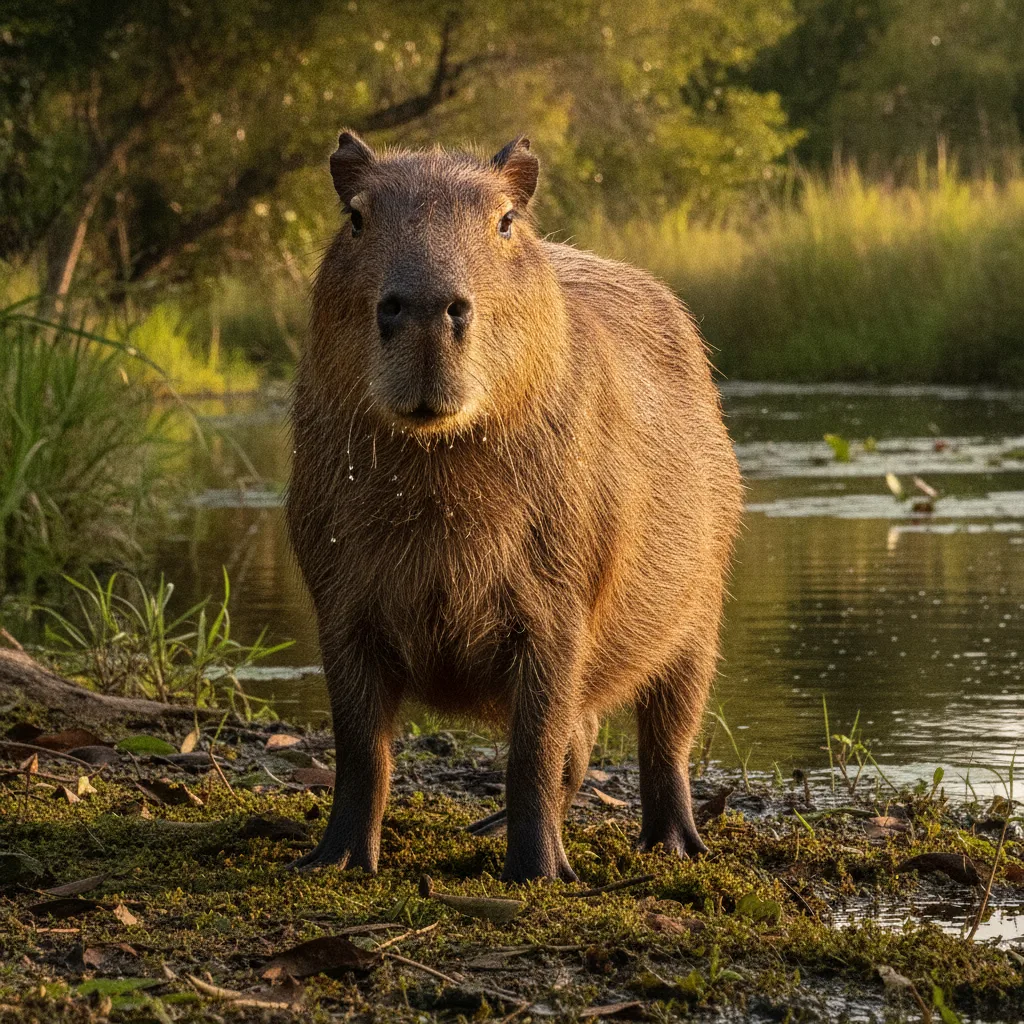
Capybara at a glance
| Scientific name | Hydrochoerus |
|---|---|
| IUCN status | Least Concern |
| Population | Several million |
| Population trend | stable |
| Weight | 50–79 kg |
| Length | 1.2–1.5 m |
| Lifespan | 6–12 years |
| Top speed | 35 km/h |
| Class | Mammalia |
| Order | Rodentia |
| Family | Caviidae |
| Known species | 2 |
Need to know
- Capybaras are the world’s largest rodents.
- They are excellent swimmers, capable of holding their breath for up to 5 minutes.
- Capybaras have partially webbed feet to aid in swimming.
- They live in highly social groups and can sometimes form herds of 50 or more.
- Their teeth continuously grow and require steady gnawing on vegetation.
- Capybaras have a unique vocal repertoire that includes purrs, barks, and whistles.
About the Capybara
Capybaras (genus Hydrochoerus) are the largest rodents on Earth, widely distributed throughout the wetlands and riverbanks of South America. Adapted for a semi-aquatic lifestyle, these gentle herbivores are instantly recognizable by their barrel-shaped bodies, square snouts, and docile nature. Social by necessity and by inclination, capybaras are rarely found alone, typically gathering in groups ranging from small family units to large herds during the dry season.
Thanks to their calm temperament, capybaras have become cultural icons, often coexisting peacefully with other wildlife and even, in some regions, with humans. Their population is generally considered stable, supported by their large range and adaptability, though habitat alteration can pose regional threats.
Physical characteristics
Size: 1.0–1.35 m (length), up to 60 cm tall at the shoulder. Weight: 35–66 kg (can reach up to 79 kg). Lifespan: 6–12 years (wild up to 8–10 years, captivity up to 12 years).
- Large, barrel-shaped body
- Short, rudder-like tail nearly absent
- Blunt, broad snout
- Coarse, sparse brown fur
- Partially webbed feet
Notable species
- Capybara (Hydrochoerus hydrochaeris) — Least Concern. Dense vegetation near rivers, lakes, marshes, and flooded savannas Regions: Amazon Basin, Orinoco Basin, Pantanal, Llanos of Venezuela, east of the Andes, Gran Chaco, Guiana Shield.
- Lesser Capybara (Hydrochoerus isthmius) — Least Concern. Near rivers, swamps, and flooded grasslands in lowland tropical forests Regions: Panama, Colombia (northern), Venezuela (northwestern), Magdalena River basin.
Habitat and range
Original range: Central and South American riverine and wetland environments
Current distribution: South American wetlands and river systems; introduced populations in Florida, USA; minor presence in select Trinidad & Tobago wetlands
Preferred environments: Riverbanks, Marshes, Flooded grasslands, Lakes and ponds with dense shoreline vegetation, Swamps
Regions: Amazon Basin, Pantanal, Orinoco Basin, Llanos of Venezuela, Gran Chaco, Guiana Shield, Magdalena River basin, Panama, Northern Colombia, Florida Wetlands
Where to see Capybara
- Pantanal, Brazil — May to September (dry season). Capybaras frequently gather in large herds along exposed riverbanks and ponds during the dry months.
- Llanos, Venezuela — December to April (dry season). Often visible in the morning and evening near water sources.
- Iberá Wetlands, Argentina — All year, peak visibility in local dry season. Easily observed from eco-lodges and boat tours.
- Magdalena River Basin, Colombia — December to February. Sightings are possible in protected wetland reserves.
- Everglades, Florida (introduced) — Winter and spring. Small feral populations exist; sightings are rare.
Behavior and diet
Diet: Mainly grasses and aquatic plants; will also eat fruit, bark, and reeds.
Social structure: Highly social, living in groups averaging 10-20 individuals, sometimes up to 50+ in the dry season. Groups usually consist of a dominant male, several females, subordinate males, and young.
Communication: Capybaras use a variety of vocalizations including barks, whistles, purrs, and clicks to communicate alarm, greetings, and group cohesion. Scent glands are used for marking territory.
- Frequently wallow and swim to regulate body temperature and flee predators
- Practice coprophagy (re-eating their own fecal pellets) for digestive efficiency
- Form mixed-species groups, allowing birds and smaller animals to perch on them
- Utilize communal latrines for scent marking and social information exchange
Interactions with other animals
- Caiman (predator): Juvenile and unwary adult capybaras may be preyed upon by caimans in aquatic habitats.
- Jaguar (predator): Jaguars are top land predators of capybaras, ambushing them near waterbanks.
- Wattled Jacana (bird) (commensal): Birds often perch on capybaras to feed on insects stirred up in the grass or from their fur.
- Piranha (danger/occasional predation): Capybaras crossing rivers may occasionally be bitten by piranhas.
Conservation
IUCN Red List status: Least Concern
Threats
- Habitat loss and wetland drainage
- Overhunting for meat, hide, and grease in some areas
- Predation by natural predators (jaguars, pumas, caimans)
- Occasional persecution as agricultural pests
Conservation efforts
- Wetland preservation initiatives
- Sustainable capybara management and legal hunting quotas
- Community-based wildlife education
- Protected areas enforcement
How to help
- Support wetland conservation NGOs
- Promote sustainable agricultural practices
- Respect wildlife in capybara habitats
- Assist with local ecotourism initiatives that provide habitat protection incentives
Capybara facts for kids
Capybaras are the world's biggest rodents and love to live near water in groups. They are gentle giants who spend lots of time swimming and munching grass.
- Capybaras can sleep in water and only poke their noses out to breathe!
- They can run as fast as a small dog.
- Capybaras' teeth never stop growing.
- They make funny sounds like barks and whistles to talk to friends.
- Many other animals like to hang out with capybaras because they are so calm.
Did you know? Did you know? A capybara can hold its breath underwater for up to five minutes—making it a true swimming champion!
Watch & learn
- Capybara: The World's Largest Rodent | BBC Earth — BBC Earth. Experience stunning footage of capybaras in their natural wetland habitat and learn about their social behavior, diet, and interactions with other animals. BBC Earth's documentaries combine captivating visuals with in-depth scientific explanation.
- Giant Rodents of South America: Capybara Family Life | Smithsonian Channel — Smithsonian Channel. Follow a capybara family in the wild as they navigate seasonal changes and predators in South America. The Smithsonian Channel showcases intimate scenes of daily life and survival strategies of Hydrochoerus hydrochaeris.
- Nature’s Unlikely Friendships: Capybaras and Animal Allies | National Geographic Wild — National Geographic Wild. Discover the fascinating relationships capybaras form with other wildlife, including birds and reptiles. National Geographic Wild explores how their gentle nature and social skills help capybaras thrive.
- South America's Giant: Capybara Secrets Revealed | PBS Nature — PBS Nature. Learn about the biology, ecological role, and conservation status of capybaras in detailed segments presented by PBS Nature, known for its scientific depth and beautiful wildlife cinematography.
- Living with Capybaras: Adaptation and Survival | BBC Earth Unplugged — BBC Earth Unplugged. Gain insight into the remarkable adaptations that allow capybaras to flourish in challenging wetland environments. BBC Earth Unplugged features field researchers explaining survival tactics of these mammals.
Sources
Facts on this page are checked against these references. Follow them for the primary data.
- IUCN Red List — Conservation status, population trend and range assessment for Hydrochoerus
- Encyclopaedia Britannica — Reviewed encyclopaedia entry on the capybara
- National Geographic — Articles, photographs and field reporting on the capybara