Amur Leopard
Panthera pardus orientalis
The Amur leopard survives in a narrow strip of temperate forest along the Russia–China border in the Russian Far East, farther north than any other leopard. A thick, pale winter coat with widely spaced rosettes and hair up to 7 cm long suits winters that drop below −30 °C. It is the rarest big cat on Earth, Critically Endangered, with numbers having climbed from around 30 in 2007 to roughly 100 today.
Quick facts: Size Body length 107-136 cm, shoulder height ~64-78 cm · Lifespan Typically around 10-15 years in the wild · IUCN status Critically Endangered
Print the fact sheet — a free one-page PDF for homeschool and classroom use
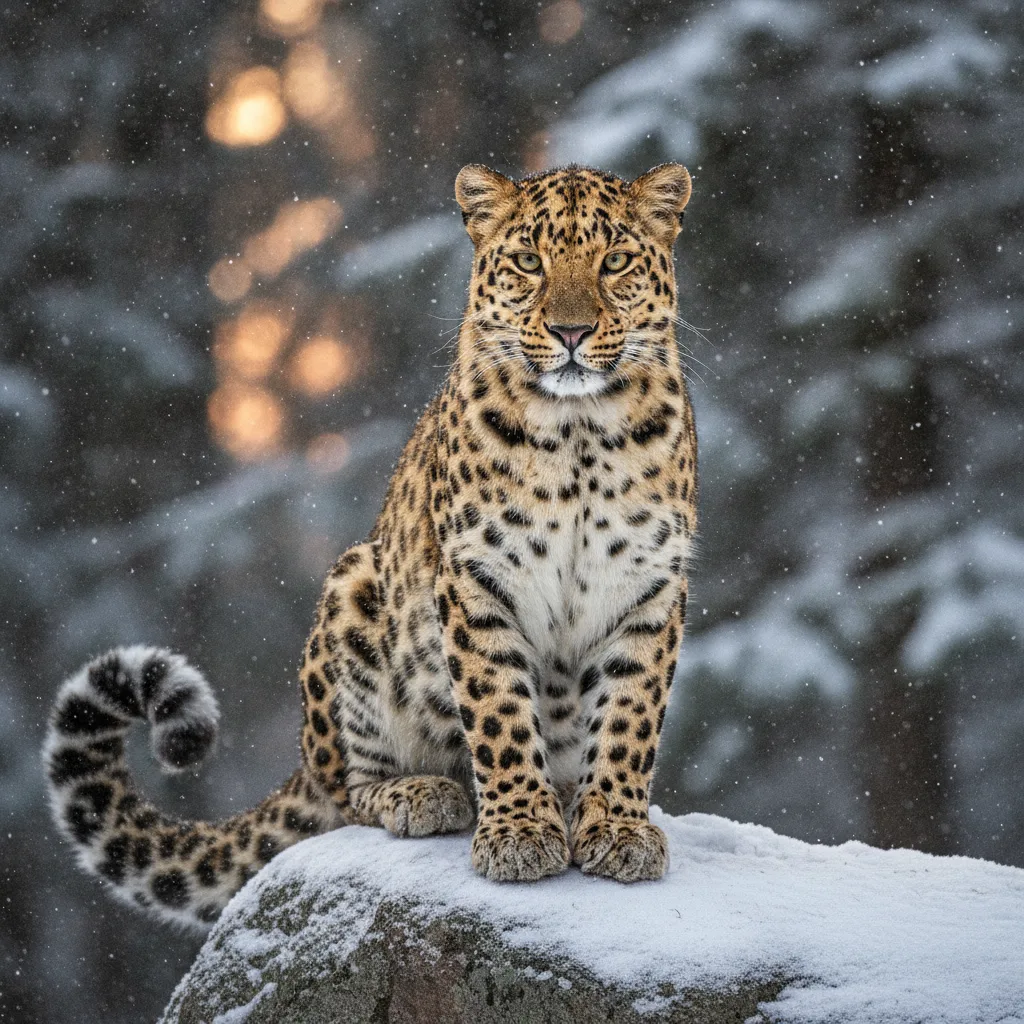
Amur Leopard at a glance
| Scientific name | Panthera pardus orientalis |
|---|---|
| IUCN status | Critically Endangered |
| Population | 110 |
| Population trend | increasing |
| Weight | 35–48 kg |
| Length | 1.1–1.36 m |
| Lifespan | 10–15 years |
| Top speed | 60 km/h |
| Class | Mammalia |
| Order | Carnivora |
| Family | Felidae |
Need to know
- Amur leopards are the world's rarest big cats, with around 110 individuals remaining in the wild.
- They have longer, paler fur than other leopards, suited for life in snowy forests.
- These leopards can leap over 6 meters (20 feet) horizontally in a single bound.
- The Amur leopard is the only leopard subspecies adapted to temperate and cold climates.
- Conservation programs in Russia have helped the population rise from just 30 individuals in the 1970s.
About the Amur Leopard
The Amur leopard (Panthera pardus orientalis) is a critically endangered leopard subspecies native to the temperate forests of the Russian Far East and northeast China. Known for its beautiful, thick, pale golden coat and distinctive rosettes, the Amur leopard is perfectly camouflaged for snowy winters. Its long legs and powerful muscles allow it to move easily through rugged, mountainous landscapes, making it an agile hunter.
Due to poaching, habitat destruction, and prey depletion, the Amur leopard's numbers plummeted to about 30 individuals during the late 20th century. Thanks to strict protection in Russia and China, the wild population is now showing a slow but encouraging increase. The Amur leopard remains an iconic symbol for wildlife conservation, showcasing the impact of international efforts and the delicate balance needed to protect Earth's most threatened big cats.
Physical characteristics
Size: Body length 107-136 cm, shoulder height ~64-78 cm. Weight: Females 25-42 kg, males 32-48 kg. Lifespan: Typically around 10-15 years in the wild.
- Exceptionally long, dense winter coat (up to 7 cm on the back)
- Pale golden to cream background color with clearly defined dark rosettes
- Very long, thick, bushy tail
- Long limbs for traversing deep snow
- Relatively small head with strong jaws
Notable species
- Amur Leopard (Panthera pardus orientalis) — Critically Endangered. Temperate forests, with a mix of broadleaf, mixed, and conifer trees; rugged mountainous terrain Regions: Primorye region (Russian Far East), Jilin Province (northeast China), Sikhote-Alin Mountains, border areas along Amur River.
Habitat and range
Original range: Historically ranged across the Amur River basin, including the Russian Far East, Korean Peninsula, and northeastern China.
Current distribution: Now restricted to a small region in the Russian Primorye and parts of northeast China.
Preferred environments: Temperate forests, Mixed deciduous-coniferous woodland, Rugged mountainous terrain, River valleys with dense understory
Regions: Primorye region (Russian Far East), Sikhote-Alin Mountains, Jilin Province (northeast China), border areas along Amur River
Where to see Amur Leopard
- Land of the Leopard National Park (Russia) — December to March. Early mornings in winter increase chances, but sightings are extremely rare due to their elusive nature.
- Hunchun Nature Reserve (Jilin, China) — Winter months. Occasional camera-trap sightings; guided eco-tours available.
Behavior and diet
Diet: Primarily roe deer, sika deer, hares, badgers, and small mammals; will scavenge if food is scarce.
Social structure: Solitary, with males holding territories that may overlap with several females; only mothers and cubs are regularly seen together.
Communication: Communicate via scent marking, scrapes, vocalizations (rasps, growls), and visual signals (scratching trees).
- Buries unfinished prey or drags it into trees or dense vegetation for later consumption.
- Uses snow cover both for camouflage and to cover scent from other predators.
- Can travel over 10 km nightly while patrolling territory.
- Will establish scent-marked trails along ridges and game paths.
Interactions with other animals
- Siberian tiger (competitive): Occasionally compete for prey and habitat, but direct confrontations are rare.
- Grey wolf (competitive): May compete for similar prey and compete for territory during scarcity.
- Roe deer (prey): Primary wild prey of the Amur leopard.
Conservation
IUCN Red List status: Critically Endangered
Threats
- Poaching for fur and traditional medicine
- Habitat loss due to logging and development
- Prey depletion from hunting
- Human-wildlife conflict
- Inbreeding and genetic isolation
Conservation efforts
- Strict anti-poaching patrols and surveillance (Russia & China)
- Establishment of transboundary nature reserves and cross-border corridors
- Prey reintroduction and habitat restoration
- Community education programs and compensation for livestock losses
- Captive breeding programs and genetic monitoring
How to help
- Support reputable conservation organizations working to protect Amur leopards
- Avoid buying illegal wildlife products or fur
- Promote and share information about the importance of big cat conservation
- Donate to or volunteer with habitat restoration or research projects
- Advocate for stronger wildlife protection laws and anti-poaching measures
Amur Leopard facts for kids
The Amur leopard is one of the most endangered big cats in the world. It has beautiful spotted fur and lives in cold, snowy forests in Russia and China. With fewer than 110 left, we must work together to help save them!
- Each Amur leopard's spots are unique like your fingerprints!
- They love to hide in thick forests and sneak up on their food.
- Their long tail helps them balance when running and jumping in snow.
- A leopard's loud growl can scare off bigger animals.
- Baby Amur leopards are called cubs and stay with their mom for about two years.
Did you know? Did you know the Amur leopard can jump farther than most cars are long—over 6 meters in a single leap?
Watch & learn
- Amur Leopard: The Rarest Big Cat in the World — BBC Earth. This feature spotlights the elusive Amur Leopard (Panthera pardus orientalis), capturing rare footage in its natural habitat and chronicling conservation efforts to save this critically endangered feline.
- Surviving in the Russian Far East: Amur Leopard Conservation — National Geographic Wild. National Geographic Wild explores the unique challenges faced by Amur Leopards living in the Russian Far East, highlighting their hunting techniques and the threats from habitat loss and poaching.
- Vanishing Shadows: Protecting the Amur Leopard — Smithsonian Channel. This episode delves into the urgent race to protect the last wild Amur Leopards, offering breathtaking visuals and interviews with field biologists fighting on the front lines.
- Amur Leopard: Ghost of the Forest — PBS Nature. PBS Nature provides an in-depth look at the solitary and rare Amur Leopard, following camera trap research and tracking its elusive movements through the forests of eastern Russia.
- The Last Wildcats: Saving the Amur Leopard — WWF International. WWF International documents critical efforts to protect the dwindling Amur Leopard population, raising awareness about conservation challenges and restoration programs.
Sources
Facts on this page are checked against these references. Follow them for the primary data.
- IUCN Red List — Conservation status, population trend and range assessment for Panthera pardus orientalis
- Encyclopaedia Britannica — Reviewed encyclopaedia entry on the amur leopard
- National Geographic — Articles, photographs and field reporting on the amur leopard