Tiger
Panthera tigris
The tiger is the largest of the wild cats, with Amur males reaching over 3 metres from nose to tail, and it lives and hunts alone in forests, mangroves and grasslands from India to the Russian Far East. Each animal's stripe pattern is unique, and unlike most cats tigers are strong, willing swimmers that readily cross rivers. Around 4,500–5,500 remain in the wild, and the species is classified as Endangered.
Quick facts: Size 2.4–3.3 meters in length, tail adds 60–110 cm · Lifespan 8–12 years in wild, up to 20–26 years in captivity · IUCN status Endangered
Print the fact sheet — a free one-page PDF for homeschool and classroom use
Tiger at a glance
| Scientific name | Panthera tigris |
|---|---|
| IUCN status | Endangered |
| Population | 3,726 - 5,578 |
| Population trend | decreasing |
| Weight | 220–320 kg |
| Length | 2.8–3.7 m |
| Lifespan | 10–26 years |
| Top speed | 65 km/h |
| Class | Mammalia |
| Order | Carnivora |
| Family | Felidae |
| Known species | 6 |
Need to know
- Tigers are the largest members of the cat family (Felidae).
- Each tiger's stripe pattern is unique, like a human fingerprint.
- Tigers can swim for kilometers and often enjoy bathing.
- Wild tiger numbers have dropped by over 95% since 1900.
- Only about 4,500 tigers are believed to remain in the wild.
- Some tiger subspecies, like the South China tiger, are functionally extinct in the wild.
About the Tiger
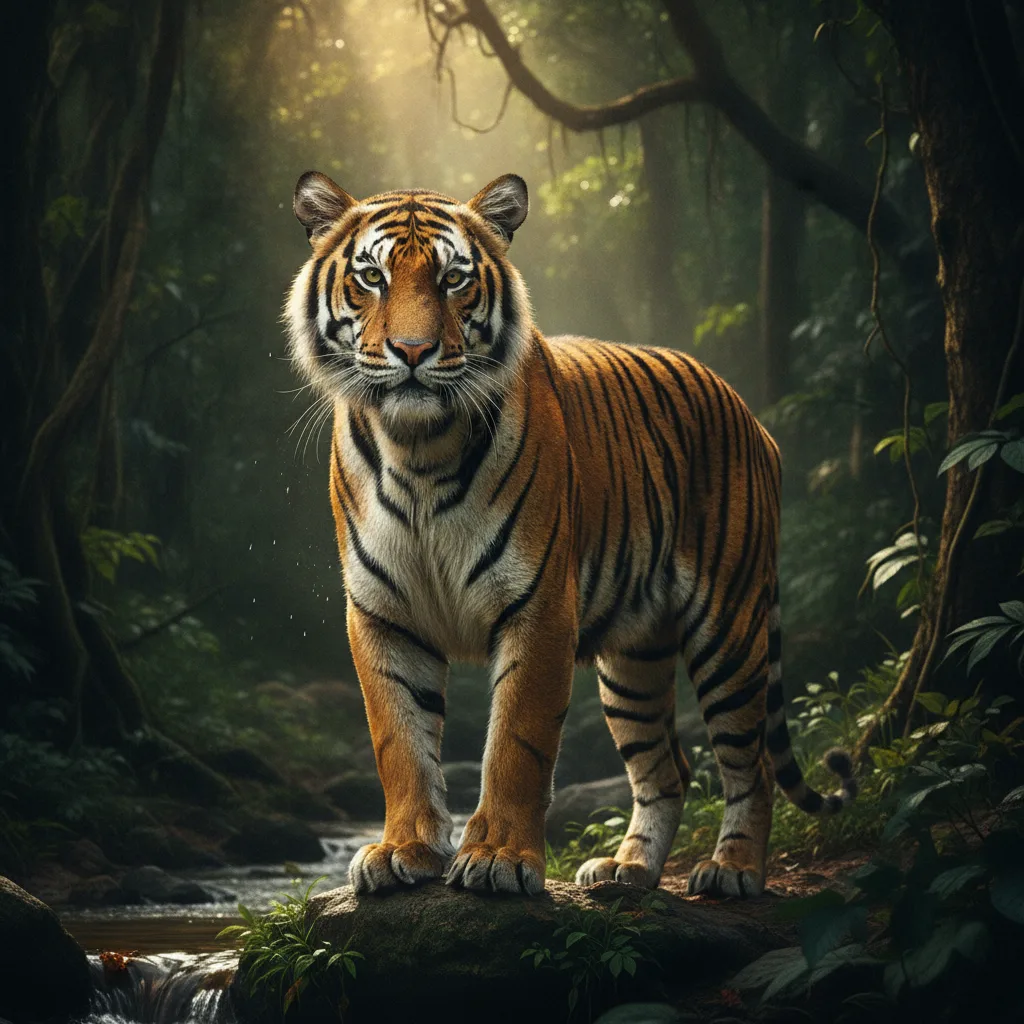
The tiger (Panthera tigris) is a formidable apex predator and the largest living cat species, instantly recognizable by its orange fur and black stripes. Tigers once roamed throughout much of Asia, from Turkey and the Caspian region all the way to the eastern coast of Russia, as well as large parts of Southeast Asia and the Indonesian islands. Today, however, their range has been drastically reduced due to habitat loss, hunting, and poaching.
Tigers stand out not only for their size and strength, but also for their solitary, mysterious nature. They mostly hunt alone at night, relying on stealth, patience, and power to bring down prey sometimes twice their own size. Despite their reputation for aggression, tigers are threatened primarily by humans, and every subspecies is now considered endangered to critically endangered.
Conservation efforts are intense and ongoing, focusing on habitat protection, anti-poaching measures, and international cooperation. The tiger is a flagship species for global conservation and a symbol of wild Asia.
Physical characteristics
Size: 2.4–3.3 meters in length, tail adds 60–110 cm. Weight: 100–307 kg, with Siberian tigers on the upper end. Lifespan: 8–12 years in wild, up to 20–26 years in captivity.
- Orange fur with black vertical stripes
- Powerful, stocky body and large head
- Long tail with black rings
- White underbelly, cheeks, and inner limbs
- Large canines and retractable claws
Notable species
- Bengal Tiger (Panthera tigris tigris) — Endangered. Tropical and subtropical forests, grasslands, mangroves Regions: India, Bangladesh, Nepal, Bhutan, Western Myanmar.
- Siberian Tiger (Panthera tigris altaica) — Endangered. Temperate forests, taiga, mountainous terrain Regions: Russian Far East, Northeast China, Eastern Russia, Occasionally North Korea.
- Sumatran Tiger (Panthera tigris sumatrae) — Critically Endangered. Tropical rainforest, swamps, lowland forests Regions: Sumatra (Indonesia).
- Indochinese Tiger (Panthera tigris corbetti) — Endangered. Remote forests, hills, tropical and subtropical moist broadleaf forests Regions: Thailand, Laos, Vietnam, Cambodia, Western Myanmar.
- Malayan Tiger (Panthera tigris jacksoni) — Critically Endangered. Tropical lowland and hill forests Regions: Peninsular Malaysia.
- South China Tiger (Panthera tigris amoyensis) — Critically Endangered (Possibly Extinct in the Wild). Forest and grassland (historically, now only found in reserves and zoos) Regions: South China (historical), Currently extinct in the wild.
Habitat and range
Original range: Tigers historically ranged from the eastern Anatolia region in Turkey, through much of South and Southeast Asia, to the Russian Far East and North Korea, and across the Indonesian islands of Sumatra, Java, and Bali.
Current distribution: Now fragmented into isolated populations across India, Southeast Asia, Sumatra, the Russian Far East, and small pockets in China and the Malay Peninsula.
Preferred environments: Tropical rainforests, Mangrove swamps, Temperate forests, Grasslands, Taiga (boreal forest), Monsoon forests
Regions: India, Bangladesh, Nepal, Bhutan, Sumatra, Russian Far East, Northeast China, Peninsular Malaysia, Southeast Asia
Where to see Tiger
- Bandhavgarh National Park, India — March–June. Most reliable wild tiger sightings are in central Indian reserves.
- Sundarbans Mangrove Forest, Bangladesh/India — November–March. Chance to see swimming tigers among the mangroves.
- Primorsky Krai, Russian Far East — Winter and early spring. Best to see Siberian tigers on camera traps or guided eco-tours.
- Gunung Leuser National Park, Sumatra — April–October (dry season). Elusive but Sumatran tigers may be spotted via guided treks.
Behavior and diet
Diet: Large and medium mammals such as deer, wild boar, buffalo, antelope; occasionally birds, fish, or small mammals.
Social structure: Mostly solitary except for mothers with cubs; each adult occupies a large, defended territory.
Communication: Tigers use roaring, growling, chuffing, scent marking, and scrape marks to communicate territory and reproductive state.
- Exceptional swimmers and often rest or travel in water
- Mothers fiercely defend cubs and teach them to hunt
- Tigers can mimic sounds of prey animals to aid in hunting
- Nocturnal and crepuscular hunters, using stealth and ambush
Interactions with other animals
- Leopard (competitive): Tigers compete with leopards for prey and space, occasionally driving them away from shared habitats.
- Sloth Bear (competitive): Tigers may occasionally prey on or displace sloth bears in India.
- Humans (competitive/predator): Humans are both a threat and a competitor, causing habitat loss and sometimes falling victim to predatory tigers.
- Wild boar (prey): Wild boar are a primary food source for many wild tigers.
Conservation
IUCN Red List status: Endangered
Threats
- Poaching for skins, bones, and body parts used in traditional medicine
- Loss and fragmentation of habitat
- Conflict with local people
- Disappearance of prey species
- Climate change impacts in some regions
Conservation efforts
- Strict anti-poaching patrols and law enforcement
- Protected area expansion and management
- Community engagement programs reducing human-tiger conflict
- International cooperation via the Global Tiger Initiative
- Wildlife corridor establishment
How to help
- Support conservation groups dedicated to tiger protection
- Never buy products made with tiger parts
- Promote responsible tourism and avoid disturbing wild tigers
- Raise awareness through education and advocacy
- Support sustainable land use practices in tiger regions
Tiger facts for kids
Tigers are the biggest wild cats in the world. They have beautiful orange fur with black stripes and live in forests and grasslands across Asia. Sadly, there are not many left in the wild, so people are working hard to help protect them.
- Each tiger has its own unique set of stripes, like a fingerprint!
- Tigers can swim really well and often play in water to cool off.
- A tiger can jump over 6 meters (20 feet) in one leap.
- Baby tigers are called cubs and stay with their mom for up to 2 years.
- Some tigers are born with white fur because of a rare gene.
Did you know? Did you know that a tiger's roar is so loud, it can be heard over 3 kilometers away?
Watch & learn
- Tiger: Spy in the Jungle (Full Documentary) — BBC Earth. Narrated by Sir David Attenborough, this groundbreaking documentary uses hidden cameras carried by elephants to showcase the secret and intimate lives of Bengal tigers in India’s jungles.
- Tiger: The World’s Most Powerful Predator — National Geographic WILD. Explore the hunting strategies, strength, and majesty of the tiger, with exceptional footage of tigers in the wild showing how they dominate the Asian forests.
- Asia’s Deadly Tigers: Big Cat Country — Smithsonian Channel. Smithsonian Channel follows the day-to-day survival and predatory tactics of wild tigers in Asia, with a focus on their interactions and challenges in dense jungle environments.
- Tigers: Episode Highlight – Spy in the Jungle — PBS Nature. PBS Nature presents exclusive footage of tigers growing up in the wild, including their behavior, family dynamics, and threats they face from humans and other predators.
- Indian Tiger: India’s National Animal — Wildlife Conservation Society / BBC Earth. This co-produced documentary offers expert commentary and rare footage of Indian tigers in their natural habitats, exploring their cultural significance and the urgent conservation efforts under way.
Sources
Facts on this page are checked against these references. Follow them for the primary data.
- IUCN Red List — Conservation status, population trend and range assessment for Panthera tigris
- Encyclopaedia Britannica — Reviewed encyclopaedia entry on the tiger
- National Geographic — Articles, photographs and field reporting on the tiger