Komodo Dragon
Varanus komodoensis
The Komodo dragon is the world's largest lizard, reaching 3 metres and around 70 kilograms, and it lives only on Komodo, Rinca, Flores and a few neighbouring Indonesian islands. It brings down deer and water buffalo with a venomous bite that lowers blood pressure and prevents clotting, then follows the weakening animal by scent. The species was uplisted to Endangered in 2021, with rising sea levels expected to shrink its habitat.
Quick facts: Size Typically 2 - 3 meters in length · Lifespan Average 30 years, maximum 50 years · IUCN status Endangered
Print the fact sheet — a free one-page PDF for homeschool and classroom use
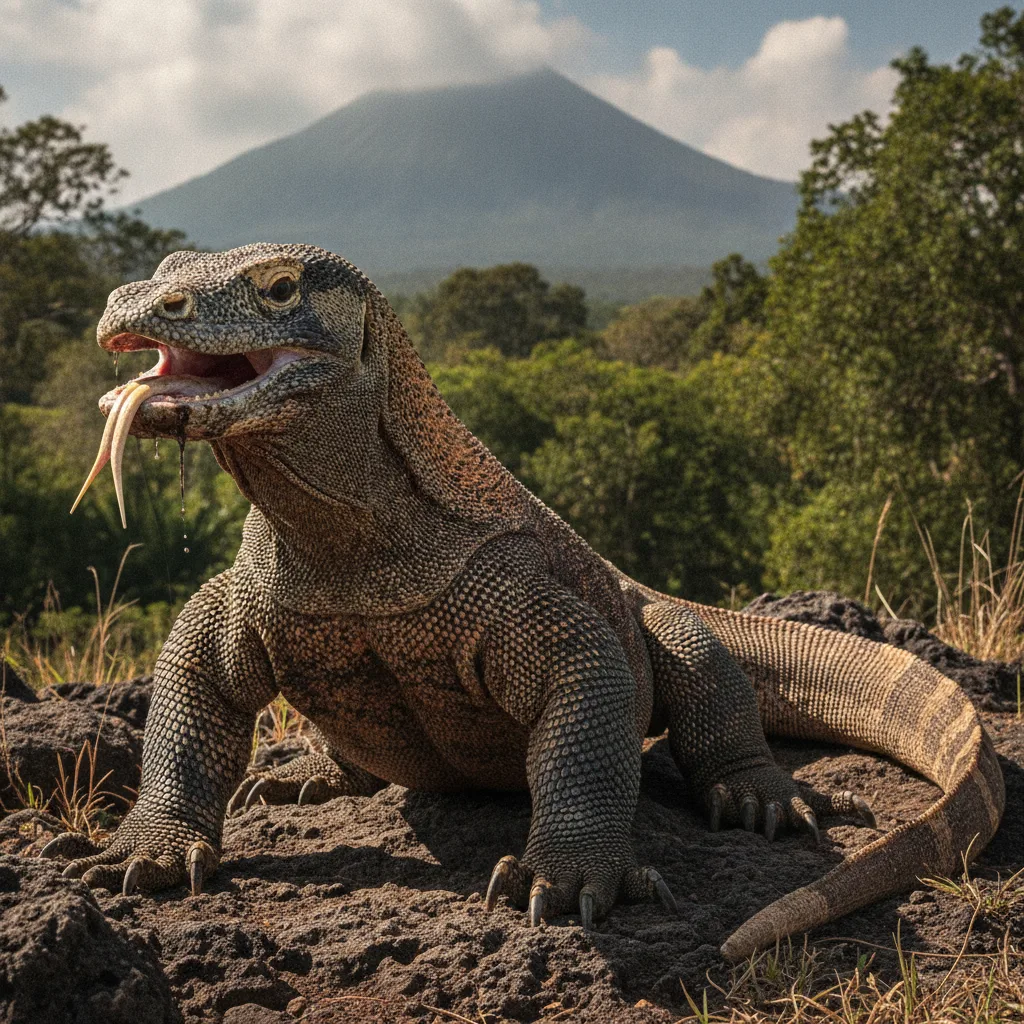
Komodo Dragon at a glance
| Scientific name | Varanus komodoensis |
|---|---|
| IUCN status | Endangered |
| Population | 3,500 - 5,700 |
| Population trend | decreasing |
| Weight | 70–90 kg |
| Length | 2.2–3.1 m |
| Lifespan | 30–50 years |
| Top speed | 20 km/h |
| Class | Reptilia |
| Order | Squamata |
| Family | Varanidae |
Need to know
- The Komodo dragon is the largest living lizard, growing over 3 meters in length.
- It has a mildly venomous bite that helps subdue large prey.
- Komodo dragons can consume up to 80% of their body weight in a single meal.
- They are apex predators on their native Indonesian islands.
- Komodo dragons can run up to 20 km/h in short bursts.
- Females can lay eggs that develop into offspring without mating (parthenogenesis).
About the Komodo Dragon
The Komodo dragon (Varanus komodoensis) is a gigantic monitor lizard and the apex terrestrial predator of several Indonesian islands. Recognized for its massive size and impressive power, it is the largest living lizard in the world, with some individuals exceeding 3 meters in length and 90 kg in weight. Komodo dragons are awe-inspiring ambush hunters, preying on large mammals such as deer, wild boar, and even water buffalo. They possess venom glands that secrete toxic proteins, and their bite is known to introduce anticoagulants and bacteria into wounds, rapidly incapacitating their prey.
Native only to a handful of small islands within Komodo National Park and nearby areas, the Komodo dragon exists in the wild only in a narrow range of southeast Indonesia. These remarkable reptiles have evolved to be masters of their environment, displaying intelligence, social behaviors, and impressive endurance. Despite their formidable nature, Komodo dragons face significant threats from habitat loss, poaching, climate change, and human encroachment.
Physical characteristics
Size: Typically 2 - 3 meters in length. Weight: Average 70 kg, with maximums up to 90 kg. Lifespan: Average 30 years, maximum 50 years.
- Massive, robust body with muscular limbs
- Long, powerful tail roughly equal to body length
- Thick, durable skin reinforced with bony osteoderms
- Long, yellow-forked tongue for chemical sensing
- Rows of sharp, serrated teeth
Notable species
- Komodo Dragon (Varanus komodoensis) — Endangered. Tropical dry forests, savanna, scrubland, and coastal beaches Regions: Komodo Island, Rinca Island, Gili Motang, Gili Dasami, western and northern Flores.
Habitat and range
Original range: Islands of Lesser Sunda (Flores, Komodo, Rinca, Gili Motang, Gili Dasami), Indonesia
Current distribution: Still restricted to few islands in southeastern Indonesia
Preferred environments: Tropical dry forests, Open savanna, Scrubland, Coastal beaches, Lowland deciduous monsoon woodland
Regions: Komodo Island, Rinca Island, Gili Motang, Gili Dasami, western and northern Flores
Where to see Komodo Dragon
- Komodo National Park (Komodo and Rinca Islands) — April to June (dry season, fewer tourists). Guided tours allow safe observation; dragons are most active during morning hours
- Gili Motang and Gili Dasami — May to August. Best for small populations, require special permits
Behavior and diet
Diet: Carnivorous: primarily Timor deer, wild boar, water buffalo, smaller mammals, birds, and carrion. Juveniles eat insects, smaller reptiles, and eggs.
Social structure: Primarily solitary, but may gather in groups around kills; strict dominance hierarchy at food sources.
Communication: Limited vocalization (hissing when threatened); communication via chemical cues (tongue-flicking), body postures, and tail movements.
- Use ambush tactics and rely on acute chemical senses
- Can rapidly consume large prey using strong jaws and flexible throat
- Females capable of facultative parthenogenesis (egg fertilization without a male)
- Juveniles climb trees to avoid predation by adults
Interactions with other animals
- Timor Deer (prey): Main prey species for adult Komodo dragons, often taken by ambush.
- Water Buffalo (prey): Large prey subdued by repeated bites; dragons may follow them until infection from bites causes collapse.
- Other Komodo dragons (competitive/predatory): Cannibalism is common, especially with juveniles, and adults fiercely compete for carrion.
- Humans (competitive/threat): Humans pose threats through habitat encroachment, occasional poaching, and accidental encounters.
Conservation
IUCN Red List status: Endangered
Threats
- Habitat loss and fragmentation due to development
- Decline of prey species such as deer from poaching
- Climate change and rising sea levels
- Illegal hunting and human disturbance
- Natural disasters (especially drought and fire)
Conservation efforts
- Strict protection within Komodo National Park
- Anti-poaching patrols and habitat preservation
- Community education and ecotourism partnerships
- Monitoring populations via tagging and camera traps
- Captive breeding and reintroduction programs
How to help
- Support Komodo dragon conservation through certified ecotourism
- Avoid purchasing souvenirs made from endangered species
- Raise awareness about habitat protection
- Contribute to reputable wildlife charities supporting Indonesian biodiversity
- Advocate for continued protection and anti-poaching laws
Komodo Dragon facts for kids
The Komodo dragon is the world's largest lizard and lives only on a few islands in Indonesia. These giant reptiles are powerful hunters that can even bring down animals much larger than themselves! Because their numbers are shrinking, people are working hard to protect them.
- Komodo dragons can grow longer than a car!
- They can smell food from several miles away using their tongue.
- Young dragons climb trees to stay safe from grown-up dragons.
- Komodo dragons can swallow huge pieces of meat in one gulp.
- They sometimes lay eggs that hatch without a dad (a trick called parthenogenesis)!
Did you know? Did you know? Komodo dragons have armor-like skin with tiny bones inside, making them super tough!
Watch & learn
- Komodo Dragons - The World's Largest Lizard | BBC Earth Documentary — BBC Earth. This documentary segment showcases the hunting tactics, habitat, and fierce dominance of Komodo dragons (Varanus komodoensis) in their Indonesian island environment, with stunning camera work and insight into their biology.
- The Komodo Dragon: Indonesia’s Giant Reptile | National Geographic Wild — National Geographic Wild. Explore in-depth how Komodo dragons survive and thrive in Indonesian islands, including rare footage of their feeding and social behaviors, narrated with classic National Geographic expertise.
- Nature’s Ultimate Predator: Komodo Dragons | Smithsonian Channel — Smithsonian Channel. Smithsonian Channel investigates the predatory skills and natural history of Komodo dragons, illustrating their superiority as apex reptiles with expert narration and real wildlife observation.
- Secrets of the Komodo Dragon | PBS Nature — PBS Nature. This acclaimed PBS Nature episode delivers thorough scientific insight into Komodo dragon biology, ecology, and conservation efforts, making it a must-watch for reptile enthusiasts.
- Komodo Dragons: Giant Killers | Nat Geo Documentary — Nat Geo. A dramatic look at the lives, survival tactics, and deadly reputation of Komodo dragons, with signature Nat Geo close-up footage of their behavior in the wild.
Sources
Facts on this page are checked against these references. Follow them for the primary data.
- IUCN Red List — Conservation status, population trend and range assessment for Varanus komodoensis
- Encyclopaedia Britannica — Reviewed encyclopaedia entry on the komodo dragon
- National Geographic — Articles, photographs and field reporting on the komodo dragon