Vaquita
Phocoenidae
The vaquita is a small porpoise found only in the northern Gulf of California, Mexico — the smallest range of any marine mammal. It is about 1.5 metres long with dark rings around its eyes and is almost never seen alive, surfacing briefly and avoiding boats. Drowning in gillnets set for totoaba fish has left roughly 10 individuals, making it the most endangered marine mammal in the world; it is Critically Endangered.
Quick facts: Size 1.4–1.5 meters · Lifespan Average lifespan about 21 years · IUCN status Critically Endangered
Print the fact sheet — a free one-page PDF for homeschool and classroom use
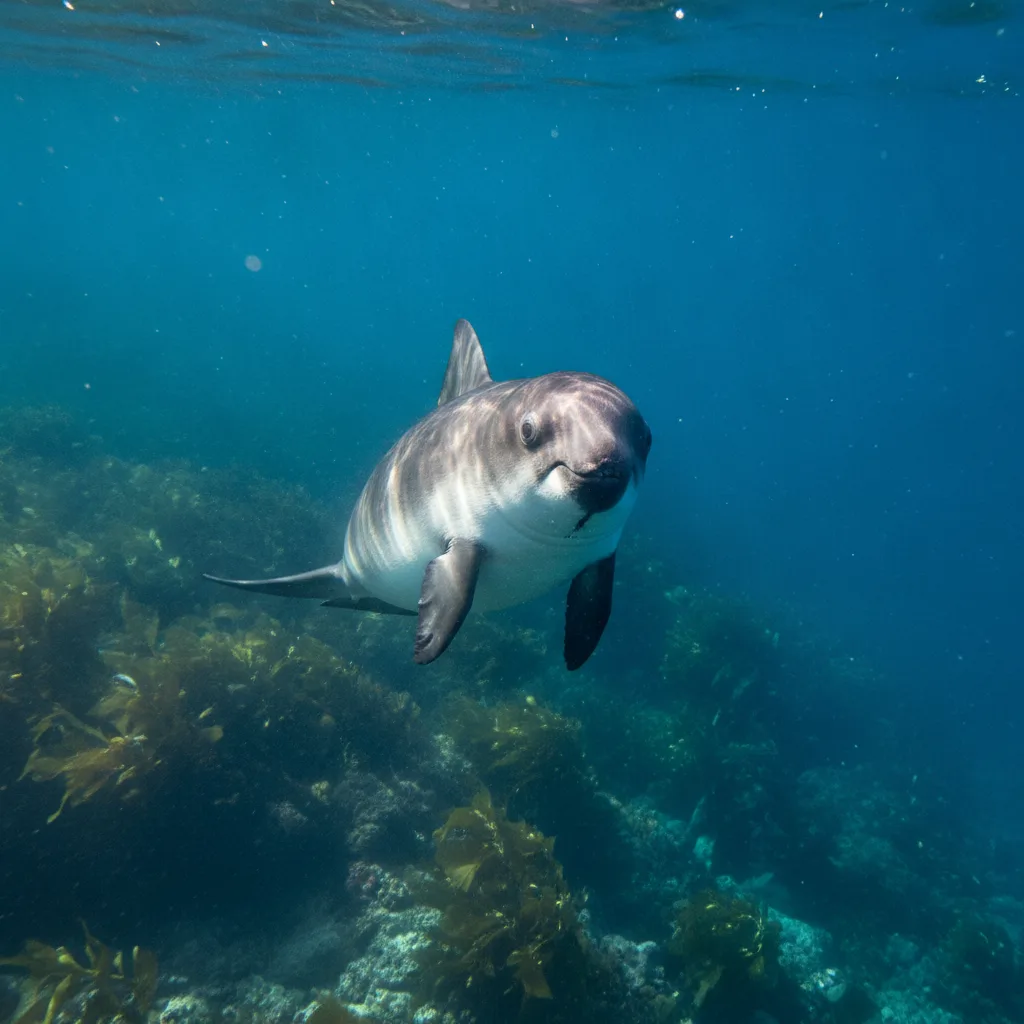
Vaquita at a glance
| Scientific name | Phocoenidae |
|---|---|
| IUCN status | Critically Endangered |
| Population | about 10 left (as of 2023) |
| Population trend | decreasing |
| Weight | 48–54 kg |
| Length | 1.5–1.7 m |
| Lifespan | 21–25 years |
| Class | Mammalia |
| Order | Cetacea |
| Family | Phocoenidae |
Need to know
- Vaquitas are the world's most endangered marine mammal, with fewer than 10 individuals left.
- They have striking dark eye patches and lips, giving them a uniquely expressive face.
- Vaquitas avoid deep water and live only in the shallow, turbid waters of the northern Gulf of California.
- Their main threat is accidental entanglement in illegal gillnets targeting another endangered species, the totoaba fish.
- First described by science only in 1958, vaquitas have always had a very restricted range.
About the Vaquita
The vaquita (Phocoena sinus) is a critically endangered species of porpoise found exclusively in the northern Gulf of California. As the smallest and rarest of all cetaceans, vaquitas are characterized by their diminutive size and distinctive markings. Discovered by science in 1958, their global population has plummeted from several hundred in the late 20th century to around 10 individuals as of 2023, with extinction a real imminent threat.
Vaquitas live in shallow, murky coastal waters where their shy, elusive nature makes them rarely seen. Their population decline is almost entirely due to bycatch in gillnets set for the totoaba, a fish hunted for its swim bladder. Despite numerous international efforts to ban these dangerous nets, illegal fishing continues to endanger every remaining vaquita.
Physical characteristics
Size: 1.4–1.5 meters. Weight: 40–54 kg (adults). Lifespan: Average lifespan about 21 years.
- Very small, compact body
- Tall, triangular dorsal fin
- Striking dark eye patch and trailing lip marks
- Short snout with no beak
- Dorsal surface is gray, with paler sides and a white belly
Notable species
- Vaquita (Phocoena sinus) — Critically Endangered. Shallow, murky coastal waters in the northern Gulf of California Regions: northern Gulf of California.
Habitat and range
Original range: Endemic to the northern part of the Gulf of California (Sea of Cortez), Mexico
Current distribution: Remains restricted to a small zone in the northern Gulf of California; nowhere else in the world.
Preferred environments: Shallow coastal waters, Muddy or turbid estuaries, Warm, subtropical seas
Regions: northern Gulf of California
Where to see Vaquita
- Northern Gulf of California (near San Felipe, Baja California, Mexico) — Spring and early summer (calmest weather, research surveys often occur). Sightings are extremely rare; best chance is from local research vessels with proper permits.
Behavior and diet
Diet: Vaquitas feed mainly on demersal fish (such as croakers), squid, and crustaceans found in shallow waters.
Social structure: Usually solitary or found in pairs; small groups of up to 3 have been observed, but they are not social like dolphins.
Communication: Communicate using high-frequency echolocation clicks, which are rarely audible to humans; low levels of vocalization otherwise.
- Evasive, elusive surfacing behavior (rarely rises far above water)
- Feeds close to bottom in murky conditions
- Uses specialized echolocation to hunt and navigate turbid water
Interactions with other animals
- Totoaba (fish) (indirect competitive): Vaquitas are unintentionally caught and killed in gillnets set illegally for totoaba swim bladders.
- Sharks (predator): Potential natural predators, though predation is a very rare cause of vaquita mortality compared to humans.
Conservation
IUCN Red List status: Critically Endangered
Threats
- Bycatch in illegal gillnets (targeting totoaba)
- Habitat degradation (pollution, disturbance)
- Small population size (inbreeding, demographic risks)
Conservation efforts
- Enforcement of gillnet bans and protected areas in the Gulf of California
- International agreements (CITES, IWC, CMS) prohibiting totoaba trade
- Community-based education initiatives
- Patrol and removal of illegal nets by civil and military forces
How to help
- Support organizations removing illegal fishing nets (donate or volunteer)
- Raise awareness about the plight of vaquitas and totoaba trafficking
- Choose sustainable seafood to reduce demand for illegal fisheries
- Encourage authorities and governments to strictly enforce existing protections
Vaquita facts for kids
Vaquitas are the smallest and rarest porpoises in the world. They live only in a small part of the ocean near Mexico, and there are fewer than 10 left! We need to protect them so they don't disappear forever.
- Vaquitas are about as long as a 7-year-old is tall!
- They have funny 'eye masks' like superheroes.
- Vaquitas swim in the ocean near Mexico and nowhere else.
- They are shy and like to stay away from boats.
- No one has ever seen a vaquita in an aquarium or zoo.
Did you know? Did you know vaquitas were only discovered by scientists about 65 years ago, making them one of the last marine mammals found?
Watch & learn
- The Last Vaquitas – Saving The World’s Most Endangered Porpoise — National Geographic. This documentary explores the ongoing battle to save the vaquita, the world's rarest marine mammal, highlighting urgent conservation efforts and the struggle against illegal fishing in its native Gulf of California habitat.
- Vaquita: The World’s Rarest Marine Mammal — BBC Earth. BBC Earth examines the plight of the vaquita porpoise, delving into why the Phocoenidae family's smallest member is on the brink of extinction and what scientists are doing to try to save it.
- Vanishing: The Vaquita Crisis — PBS Nature. PBS Nature investigates the dramatic decline of the vaquita population and provides insight into how environmental changes and human activity have pushed this unique species to near extinction.
- Vaquita Rescue: Inside a High Stakes Mission — Smithsonian Channel. Follow a team of international marine biologists as they attempt a daring rescue operation to save the vaquita from disappearing forever, showcasing rare footage and expert interviews.
- Saving Vaquita: Conservation in the Gulf of California — Wildlife Conservation Society. Learn about the concerted efforts of scientists and activists striving to protect the critically endangered vaquita, with a focus on sustainable fishing and policy reform in Mexico.
Sources
Facts on this page are checked against these references. Follow them for the primary data.
- IUCN Red List — Conservation status, population trend and range assessment for Phocoenidae
- Encyclopaedia Britannica — Reviewed encyclopaedia entry on the vaquita
- National Geographic — Articles, photographs and field reporting on the vaquita