Leopard
Panthera pardus
The leopard has the widest range of any wild cat, from sub-Saharan Africa through the Middle East to Russia and Southeast Asia, occupying rainforest, savanna, desert edge and even city outskirts. It is a powerful climber that habitually hauls kills heavier than itself into trees to keep them from lions and hyenas. The species is listed as Vulnerable, and several Asian subspecies are Critically Endangered.
Quick facts: Size 1.3 to 1.9 m (head and body), 0.5–1.1 m tail · Lifespan 10–15 years in the wild, up to 23 in captivity · IUCN status Vulnerable
Print the fact sheet — a free one-page PDF for homeschool and classroom use
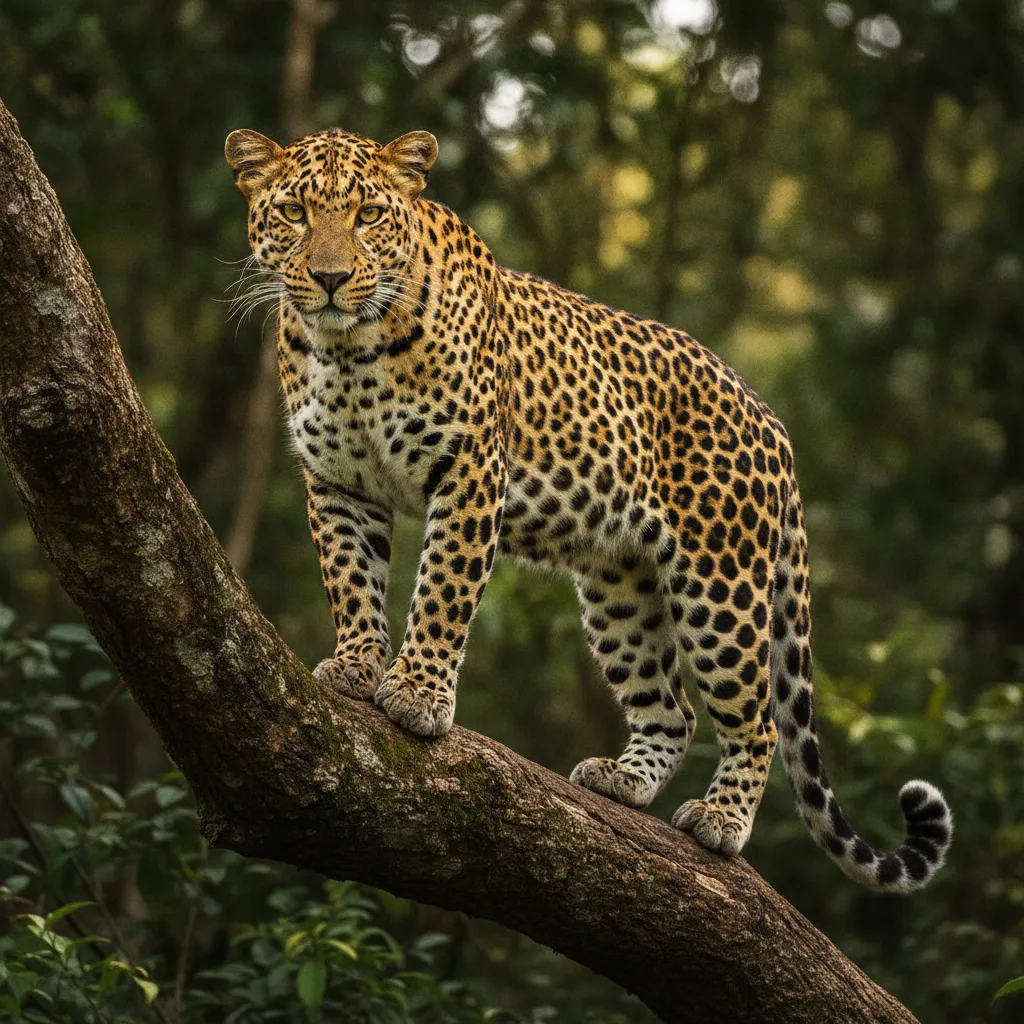
Leopard at a glance
| Scientific name | Panthera pardus |
|---|---|
| IUCN status | Vulnerable |
| Population | 700,000 - 900,000 |
| Population trend | decreasing |
| Weight | 60–90 kg |
| Length | 1.6–2.6 m |
| Lifespan | 12–23 years |
| Top speed | 58 km/h |
| Class | Mammalia |
| Order | Carnivora |
| Family | Felidae |
| Known species | 9 |
Need to know
- Leopards are the most widespread of any wild big cat, living across Africa and Asia.
- They are renowned for being able to adapt to a wide range of habitats, from deserts to rainforests.
- Leopards can drag prey up into trees to avoid losing it to scavengers.
- They are solitary hunters and typically only come together to mate.
- The Amur leopard is the rarest big cat in the world, with fewer than 120 adults left.
- Melanistic (black) leopards, often called 'black panthers', occur mainly in dense forests.
About the Leopard
Leopards (Panthera pardus) are one of the five 'big cats' belonging to the genus Panthera. They are famed for their adaptability and stealth, thriving in a broad array of habitats from the rainforests of Southeast Asia to the savannas of Africa, and the snowy slopes of the Russian Far East. Their distinctive golden-yellow to white fur is marked with dark rosettes and spots, providing perfect camouflage among vegetation and rocks.
Unlike lions and tigers, leopards are solitary and elusive, relying on stealth over strength. Their powerful limbs and keen senses make them formidable ambush predators. Leopards are known for their climbing ability, frequently hauling heavy prey up into trees to guard against theft by hyenas or lions. Their population is decreasing due to habitat loss, poaching, and conflicts with humans, with some subspecies now critically endangered.
Physical characteristics
Size: 1.3 to 1.9 m (head and body), 0.5–1.1 m tail. Weight: 30–90 kg (males larger; size varies by region). Lifespan: 10–15 years in the wild, up to 23 in captivity.
- Golden yellow coat covered with black rosettes and spots
- Long, muscular tail used for balance
- Powerful, stocky build with short legs
- White underbelly and throat
- Greenish or blue-gray eyes in most subspecies
Notable species
- African Leopard (Panthera pardus pardus) — Vulnerable. Savanna woodlands, forests, grasslands, and mountainous regions Regions: West Africa, Central Africa, East Africa, Southern Africa, Sahel.
- Indian Leopard (Panthera pardus fusca) — Vulnerable. Tropical forests, dry deciduous forests, grasslands, hilly regions Regions: Indian subcontinent, Nepal, Bhutan, Bangladesh, Sri Lanka.
- Sri Lankan Leopard (Panthera pardus kotiya) — Endangered. Rainforests, dry forests, mountain forests Regions: Sri Lanka.
- Persian (Caucasian) Leopard (Panthera pardus saxicolor) — Endangered. Mountainous woodlands and foothills Regions: Caucasus, Iran, Turkmenistan, Afghanistan, Eastern Turkey.
- Amur Leopard (Panthera pardus orientalis) — Critically Endangered. Temperate forests, mountainous areas Regions: Russian Far East, Northeastern China.
- Arabian Leopard (Panthera pardus nimr) — Critically Endangered. Mountainous deserts and dry shrublands Regions: Oman, Yemen, Saudi Arabia, United Arab Emirates, Possibly southern Israel.
Habitat and range
Original range: Across sub-Saharan Africa, North Africa, the Middle East, and much of Asia (including India, China, Southeast Asia, and the Russian Far East)
Current distribution: Most of sub-Saharan Africa, patchy populations persisting in North and West Africa, the Middle East, South and Southeast Asia, and the Russian Far East; extinct or very rare in much of North Africa, Arabia, and Central Asia.
Preferred environments: Savannas, Rainforests, Dry shrublands, Mountainous areas, Woodlands, Deserts
Regions: West Africa, East Africa, Central Africa, Southern Africa, Indian subcontinent, Sri Lanka, Russian Far East, Caucasus, Arabian Peninsula, Southeast Asia
Where to see Leopard
- Serengeti National Park, Tanzania — June to October (dry season). Look for leopards resting in acacia trees near waterholes at dawn or dusk.
- Yala National Park, Sri Lanka — February to June. Early mornings or late afternoons increase the chance of sightings in open habitats.
- Leopard National Park, Russia (for Amur leopard) — February to April. Guided winter tracking along forested trails increases the chances of spotting tracks or the cats themselves.
Behavior and diet
Diet: Leopards are obligate carnivores, preying on medium-sized ungulates such as antelope, deer, wild boar, monkeys, rodents, birds, reptiles, and occasionally fish or insects.
Social structure: Leopards are solitary and territorial, typically only interacting for mating or between mothers and cubs.
Communication: They use vocalizations (roaring, growling, rasping coughs), scent marking, facial expressions, and visual signals (body posture and tail movements) to communicate.
- Hoisting prey up into trees to protect it from scavengers
- Adaptable hunting schedules to avoid larger predators or humans
- Swimming and occasionally hunting fish or crustaceans
- Using diverse vocal calls, including a unique 'sawing' rasp
Interactions with other animals
- Hyena (competitive): Hyenas and leopards compete for prey; hyenas often attempt to steal leopard kills.
- Lion (competitive): Lions dominate over leopards, often causing leopards to abandon kills or avoid prime hunting grounds.
- Baboon (prey): Leopards are skilled at preying on monkeys and baboons when the opportunity arises.
- Impala (prey): Impala are a common and preferred food source for African leopards.
Conservation
IUCN Red List status: Vulnerable
Threats
- Habitat loss due to deforestation and expansion of agriculture/human settlement
- Poaching for skins, bones, and body parts
- Depletion of prey species
- Retaliatory killings from livestock farmers
- Road mortality and fragmentation of populations
Conservation efforts
- Establishment and protection of reserves and corridors
- Community-based human-wildlife conflict mitigation programs
- Anti-poaching patrols and law enforcement
- Public awareness and education campaigns
- Reintroduction and captive breeding for critically endangered subspecies like the Amur leopard
How to help
- Support reputable wildlife conservation NGOs and anti-poaching initiatives
- Promote and participate in ecotourism that supports local communities and conservation
- Avoid purchasing products derived from leopards or their prey
- Spread awareness about big cat conservation
- Encourage protection of natural habitats through sustainable land use
Leopard facts for kids
Leopards are big cats with beautiful spotted fur that live in Africa and Asia. They are great climbers and hunters who like to keep to themselves. Some leopards can live in deserts, rainforests, or even cold snowy mountains!
- Leopards can climb trees while carrying prey that's heavier than themselves!
- Their 'spots' are called rosettes because they look like little flowers.
- When leopards snarl or growl, you might hear a harsh 'sawing' sound.
- A black panther in Africa or Asia is just a leopard with very dark fur.
- No two leopards have the same spot pattern—each one is unique!
Did you know? Did you know? Leopards are such strong jumpers, they could leap over the length of a car in a single bound!
Watch & learn
- Leopard: Africa’s Secretive Predator — BBC Earth. Explores the elusive and adaptable leopard, highlighting its hunting skills, mother-offspring relationships, and challenges in the African wild. BBC Earth provides high-quality cinematography of leopards in their native habitat.
- Leopard vs. Crocodile: Survival in the Wild — National Geographic Wild. Shows the powerful hunting tactics of the leopard, including rare interactions with crocodiles and other major predators, with behind-the-scenes information about their remarkable adaptations.
- The Secret Life of the African Leopard — Smithsonian Channel. Documents the daily life of a wild leopard family in Africa, focusing on survival, territory, and competition. The storytelling and visuals offer intimate insight into this secretive feline’s existence.
- Leopards: Masters of Camouflage — PBS Nature. Covers the leopard’s remarkable adaptations for stealth and camouflage, and follows research on how their spotted coats help them avoid detection from both prey and rival predators.
- Leopard Queen: Raising Cubs in the Wild — BBC Earth. Follows a female leopard as she raises her cubs against the odds in the African bush, detailing the risks and lessons in every stage of their development. Exceptional storytelling and wildlife filmmaking.
Sources
Facts on this page are checked against these references. Follow them for the primary data.
- IUCN Red List — Conservation status, population trend and range assessment for Panthera pardus
- Encyclopaedia Britannica — Reviewed encyclopaedia entry on the leopard
- National Geographic — Articles, photographs and field reporting on the leopard