Sumatran Orangutan
Pongo
The Sumatran orangutan lives only in the rainforests of northern Sumatra, Indonesia, chiefly in the Leuser Ecosystem, and spends almost its entire life in the trees. It is more social and eats more fruit than its Bornean relative, and adult males grow wide cheek flanges and a throat sac used for long calls that carry over a kilometre. Around 14,000 remain and the species is Critically Endangered, threatened by logging and oil palm plantations.
Quick facts: Size 1.2–1.4 meters tall · Lifespan 35–40 years in the wild (up to 58 years in captivity) · IUCN status Critically Endangered
Print the fact sheet — a free one-page PDF for homeschool and classroom use
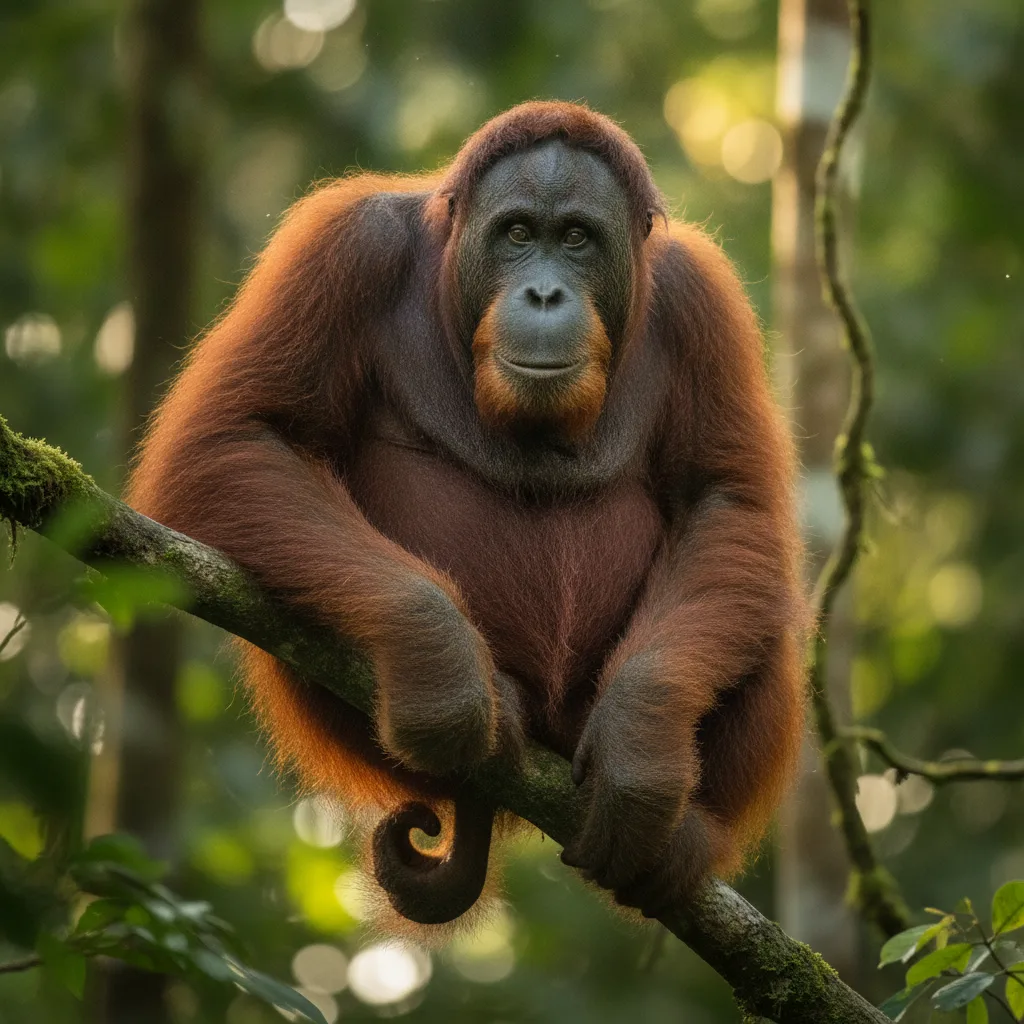
Orangutans at a glance
| Scientific name | Pongo |
|---|---|
| IUCN status | Critically Endangered |
| Population | 13,500 - 14,000 |
| Population trend | decreasing |
| Weight | 45–90 kg |
| Length | 1.3–1.8 m |
| Lifespan | 35–58 years |
| Top speed | 4 km/h |
| Class | Mammalia |
| Order | Primates |
| Family | Hominidae |
| Known species | 3 |
Need to know
- Sumatran orangutans are almost exclusively arboreal, rarely descending to the ground.
- They have the longest arms of any primate, with a span up to 2.2 meters.
- Their nests are woven intricately from branches and leaves and are used for sleeping each night.
- Sumatran orangutans use a wide variety of tools, including sticks to extract insects or honey.
- They share over 97% of their DNA with humans.
About the Orangutans
Sumatran orangutans (Pongo abelii) are one of three recognized orangutan species, native only to the dwindling rainforests of northern Sumatra, Indonesia. Famous for their unique reddish fur and deeply intelligent eyes, these great apes are among the most intelligent non-human primates and are capable of advanced tool use and problem-solving. Sumatran orangutans are the most arboreal of all orangutans, spending nearly all their lives in the tree canopy to avoid large terrestrial predators.
All orangutans play a vital role as seed dispersers, maintaining the ecological health of the forest. Their populations, however, have plummeted due to illegal logging, palm oil plantations, habitat destruction, and poaching. Conservation efforts focus on protecting remaining forest tracts and raising awareness of their critically endangered status.
Physical characteristics
Size: 1.2–1.4 meters tall. Weight: 35–50 kg (females), up to 90 kg (males). Lifespan: 35–40 years in the wild (up to 58 years in captivity).
- long, pale orange fur
- very long arms relative to body size
- high, sloping face with prominent mouth flange in adult males
- bare, grayish-pink face with expressive brown eyes
Notable species
- Sumatran Orangutan (Pongo abelii) — Critically Endangered. Primary and secondary tropical rainforest, peat swamp forests Regions: Northern Sumatra, Leuser Ecosystem, Bukit Tigapuluh National Park, Batang Toru forests.
- Bornean Orangutan (Pongo pygmaeus) — Critically Endangered. Lowland rainforest, peat swamp forests, and disturbed forests Regions: Central Kalimantan, West Kalimantan, Sarawak, Sabah.
- Tapanuli Orangutan (Pongo tapanuliensis) — Critically Endangered. Hill tropical rainforest (350–1,300 m elevation) Regions: Batang Toru region (South Tapanuli, Sumatra).
Habitat and range
Original range: Northern Sumatra, Indonesia, across riparian and lowland forest landscapes
Current distribution: Restricted to fragmented patches in northern Sumatra within the Leuser Ecosystem and a few adjoining forests
Preferred environments: tropical wet lowland forests, hill rainforests, peat swamp forests
Regions: Leuser Ecosystem, Gunung Leuser National Park, Bukit Tigapuluh National Park, Batang Toru forests (Tapanuli range)
Where to see Orangutans
- Gunung Leuser National Park — May–September. Best accessed from Bukit Lawang, guided treks increase chances of seeing wild orangutans
- Bukit Tigapuluh National Park — March–June. Remote, more challenging, but home to reintroduced orangutans
Behavior and diet
Diet: Mainly fruit (figs, durians, lychees), but also leaves, bark, flowers, insects, and occasionally bird eggs.
Social structure: Semi-solitary. Adult females travel with dependent young; adult males solitary, though home ranges may overlap.
Communication: Vocalizations, gestures, leaf rustling, and facial expressions. Males produce long calls that can travel up to 1 km.
- incredible tool use for insect foraging and seed extraction
- builds and abandons new sleeping nests daily
- uses leafy branches for cover and as food tools
Interactions with other animals
- Sumatran Tiger (predator): Rarely preys on young orangutans if caught on the ground.
- Gibbons (competitive): Occasionally competes for fruit resources in the rainforest canopy.
- Asian Elephant (ecological): Shares habitat; elephants may affect forest structure and access to food resources.
Conservation
IUCN Red List status: Critically Endangered
Threats
- habitat loss from illegal logging and oil palm plantations
- habitat fragmentation and degradation
- poaching and illegal pet trade
- human-wildlife conflict
Conservation efforts
- forest protection and anti-logging patrols in Leuser and other reserves
- reintroduction of rescued/reared orangutans into protected forests
- community education and alternative livelihood programs
- international legal protection (CITES Appendix I)
How to help
- Support orangutan conservation NGOs financially or by volunteering
- Avoid buying products with unsustainable palm oil
- Raise awareness about the importance of rainforest preservation
- Promote eco-friendly tourism to protected areas in Sumatra
Orangutans facts for kids
Sumatran orangutans are big orange apes that spend almost all their lives in the trees of Sumatra's rainforests. They love to eat fruit and make nests to sleep in every night. Sadly, there aren’t many left, so people are working hard to help them.
- Orangutans can use sticks like tools to get honey out of trees.
- Each night, they build a fresh leafy nest to sleep in.
- Baby orangutans hold onto their moms for years — sometimes until they're 8 or 9!
- Orangutans have super long arms, even longer than their legs.
Did you know? Did you know? Orangutans are the only great apes that live outside Africa — and they can recognize themselves in a mirror!
Watch & learn
- Spy Orangutan: Primate Intelligence Revealed — BBC Earth. A fascinating look into the lives and clever behaviors of orangutans in the wild, captured using undercover camera technology as part of the 'Spy in the Wild' series. Excellent for learning about their intelligence and social interactions.
- Orangutans of Borneo: Conservation in the Wild — National Geographic Wild. An immersive documentary focusing on the challenges orangutans face in Borneo, detailing efforts to rescue, rehabilitate, and release these endangered primates. Features essential insights into their ecology and conservation.
- Meet the Orangutans: Rainforest Survival and Family Bonds — Smithsonian Channel. This in-depth special follows orangutans in their rainforest habitat, showcasing their strong family connections, problem-solving skills, and the threats they endure. Perfect for viewers interested in natural primate behavior.
- Orangutan Jungle School: Young Primates Learning to Survive — PBS Nature. Following orphaned orangutans at a unique rescue center in Borneo, this documentary captures their playful antics and journey to independence. An inspiring look at animal rehabilitation and survival training.
- Orangutans: The Forest People — BBC Earth. A powerful exploration of orangutan life in Sumatra and Borneo, highlighting their tool use, complex diet, and the impact of habitat loss. Recommended for anyone wanting an in-depth orangutan profile.
Sources
Facts on this page are checked against these references. Follow them for the primary data.
- IUCN Red List — Conservation status, population trend and range assessment for Pongo
- Encyclopaedia Britannica — Reviewed encyclopaedia entry on the orangutans
- National Geographic — Articles, photographs and field reporting on the orangutans