Octopus
Octopodidae
Octopuses are soft-bodied molluscs with eight arms, three hearts and blue, copper-based blood, found in every ocean from tide pools to the deep sea. Two-thirds of their neurons sit in the arms rather than the brain, and specialised skin cells let an octopus change colour and texture in a fraction of a second. Most species live only one to two years, dying soon after breeding once.
Quick facts: Size Average arm span 0.3–3 m depending on species · Lifespan Typically 1–2 years, up to 5 years for large species · IUCN status Mostly 'Least Concern' (varies by species; some Data Deficient)
Print the fact sheet — a free one-page PDF for homeschool and classroom use
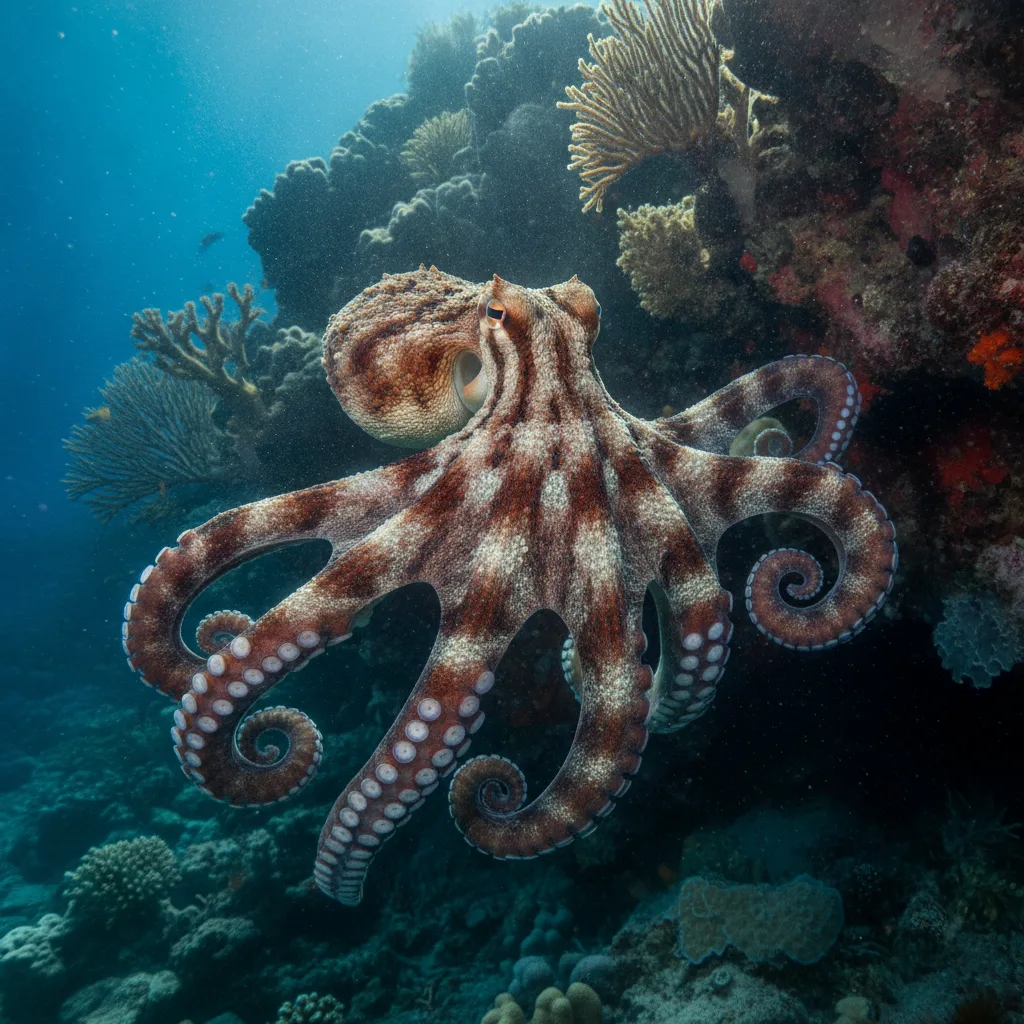
Octopus at a glance
| Scientific name | Octopodidae |
|---|---|
| IUCN status | Mostly 'Least Concern' (varies by species; some Data Deficient) |
| Population | Unknown |
| Population trend | unknown |
| Weight | 10–70 kg |
| Length | 0.9–3 m |
| Lifespan | 2–5 years |
| Top speed | 40 km/h |
| Class | Cephalopoda |
| Order | Octopoda |
| Family | Octopodidae |
| Known species | 300 |
Need to know
- Octopuses have three hearts and blue blood due to a copper-based molecule called hemocyanin.
- They are considered the most intelligent invertebrates, capable of learning and using tools.
- Octopuses can change both color and skin texture instantly for camouflage.
- Many species can squirt ink to deter predators.
- Unlike most animals, octopuses can squeeze through any space larger than their beak.
About the Octopus
Octopuses are remarkable cephalopods recognized for their high intelligence, flexible bodies, and astonishing ability to blend with their surroundings. With more than 300 species distributed across the world’s oceans, they exhibit a wide range of sizes and lifestyles—from the tiny blue-ringed octopus to the massive giant Pacific octopus.
Famous for their soft, boneless bodies and eight dexterous arms lined with suckers, octopuses use sophisticated camouflage, jet propulsion, and problem-solving abilities to survive and thrive in diverse marine environments. Their unique physiology includes three hearts, blue-colored blood, and the ability to regenerate lost limbs.
Physical characteristics
Size: Average arm span 0.3–3 m depending on species. Weight: Most range from 3 kg to over 70 kg for largest species. Lifespan: Typically 1–2 years, up to 5 years for large species.
- Eight arms lined with suckers
- Boneless, highly flexible body
- Color-changing skin with chromatophores
- Wide, bulbous head (mantle)
- Large, complex eyes, usually golden or dark brown
Notable species
- Common Octopus (Octopus vulgaris) — Least Concern. Rocky reefs, seagrass beds, coastal shallows Regions: Atlantic Ocean, Mediterranean Sea, Caribbean Sea, waters off West Africa, Bay of Biscay.
- Giant Pacific Octopus (Enteroctopus dofleini) — Least Concern. Cold temperate coastal waters, rocky crevices, kelp forests Regions: North Pacific Ocean, Bering Sea, Sea of Japan, coastal waters of Alaska, coastal waters of Japan.
- Blue-Ringed Octopus (Hapalochlaena lunulata) — Least Concern. Shallow coral reefs, tide pools, rocky shores Regions: Pacific Ocean, Indian Ocean, Great Barrier Reef, waters off Indonesia, coastal waters of Northern Australia.
- Mimic Octopus (Thaumoctopus mimicus) — Data Deficient. Muddy estuarine sands and shallow coastal waters Regions: Indian Ocean, western Pacific Ocean, waters off Sulawesi, coastal waters of Malaysia, Banda Sea.
- Argonaut (Paper Nautilus) (Argonauta argo) — Not Evaluated. Open ocean, near surface in temperate to tropical waters Regions: Atlantic Ocean, Indian Ocean, Mediterranean Sea, Pacific Ocean, Canary Current.
- Seven-Arm Octopus (Haliphron atlanticus) — Data Deficient. Deep sea, pelagic zones, up to 1,500 m deep Regions: North Atlantic Ocean, South Pacific Ocean, Southern Ocean, Cape Basin, waters off New Zealand.
Habitat and range
Original range: Ancient oceans; cephalopods evolved in the Cambrian period (~500 million years ago)
Current distribution: Virtually all the world's oceans—from shallow reefs to deep-sea trenches, polar to tropical waters.
Preferred environments: Rocky reefs, Seagrass meadows, Coral reefs, Muddy or sandy seafloor, Open ocean (pelagic zone), Deep sea
Regions: Atlantic Ocean, Pacific Ocean, Indian Ocean, Mediterranean Sea, Caribbean Sea, Bering Sea, Coral Sea, Southern Ocean
Where to see Octopus
- Great Barrier Reef — May to November (dry season). Look for octopuses in coral crevices and during night snorkels or dives.
- Monterey Bay, California (Pacific Ocean) — Year-round. Charter a dive to kelp forests for a chance to see the Giant Pacific Octopus.
- Mediterranean Sea coastal regions — Spring and summer. Common octopus species can often be spotted while diving or snorkeling among the rocks.
Behavior and diet
Diet: Carnivorous—primarily feeds on crustaceans, fish, mollusks, and sometimes other cephalopods.
Social structure: Generally solitary, except during mating or in rare cases of high population density.
Communication: Octopuses communicate through changes in skin color, texture, and posture; some species use jetting and arm gestures.
- Problem-solving and tool use (opening jars, using coconut shells or rocks for shelter)
- Camouflage using chromatophores, iridophores, and leucophores in their skin
- Jet propulsion escape mechanism
- Autotomy (shedding arms to escape predators)
Interactions with other animals
- Moray eel (predator): Moray eels hunt octopuses in rocky crevices.
- Crabs (prey): Octopuses prey heavily on crabs, using their beaks to puncture shells.
- Groupers (predator): Large groupers prey on smaller and medium-sized octopuses.
- Cleaner fish (symbiotic): Some fish feed on parasites from octopuses without harming them.
Conservation
IUCN Red List status: Mostly 'Least Concern' (varies by species; some Data Deficient)
Threats
- Bycatch in fisheries
- Habitat destruction (particularly coral reefs and seagrass beds)
- Pollution (plastic, chemical)
- Climate change and ocean acidification
- Overfishing in some regions
Conservation efforts
- Marine protected areas established to safeguard habitats
- Bycatch reduction techniques in fisheries
- Research on sustainable octopus fisheries
How to help
- Support sustainable seafood practices
- Reduce plastic use to decrease ocean pollution
- Advocate for preservation of marine habitats
- Participate in citizen science initiatives on marine life
Octopus facts for kids
Octopuses are clever sea animals with eight bendy arms and soft squishy bodies. They can hide by changing their color and squeeze into tiny spaces. Some even shoot ink to escape from danger!
- Octopuses have three hearts!
- Their blood is blue instead of red.
- They can regrow arms if they lose one.
- Octopuses can fit through holes as small as their beak.
- Some octopuses glow in the dark deep under the ocean.
Did you know? Did you know an octopus can open jars and solve tricky puzzles, just like a smart pet?
Watch & learn
- Octopus: Master of Disguise - BBC Earth Documentary Segment — BBC Earth. This segment showcases the extraordinary camouflage abilities of octopuses, revealing how they use color and texture to evade predators and hunt prey. The signature BBC footage and narration provide stunning underwater visuals and insights.
- The Incredible Intelligence of Octopuses - National Geographic — National Geographic. National Geographic explores the octopus’s unique intelligence, problem-solving abilities, and dexterity, including mesmerizing footage of octopuses opening jars and manipulating objects.
- Octopus: Blue Planet II – BBC Earth — BBC Earth. See remarkable behavioral sequences, including the infamous octopus vs. shark moment, in breathtaking HD from the acclaimed Blue Planet II series.
- Giant Pacific Octopus: The Secret World – Smithsonian Channel — Smithsonian Channel. This documentary dives into the life of the Giant Pacific Octopus, with rare footage unveiling its mating rituals, parenting, and hunting strategies in the Pacific Ocean.
- Octopus: Making Contact – PBS Nature — PBS Nature. Exploring the relationship between humans and octopuses, this full-length PBS Nature special reveals astonishing octopus behaviors, learning skills, and emotional intelligence.
Sources
Facts on this page are checked against these references. Follow them for the primary data.
- IUCN Red List — Conservation status, population trend and range assessment for Octopodidae
- Encyclopaedia Britannica — Reviewed encyclopaedia entry on the octopus
- National Geographic — Articles, photographs and field reporting on the octopus