Snow Leopard
Panthera uncia
Snow leopards live above the treeline in the mountains of Central and South Asia, from the Himalaya to the Altai, at elevations of 3,000 to 5,000 metres or more. A metre-long tail helps them balance on cliffs and doubles as a wrap against the cold, and unlike other big cats they cannot roar. The IUCN lists the species as Vulnerable, with an estimated 4,000–6,500 remaining and few reliable counts.
Quick facts: Size 1.0–1.5 meters body length, 0.8–1.0 meter tail · Lifespan 10–15 years in the wild, up to 22 years in captivity · IUCN status Vulnerable
Print the fact sheet — a free one-page PDF for homeschool and classroom use
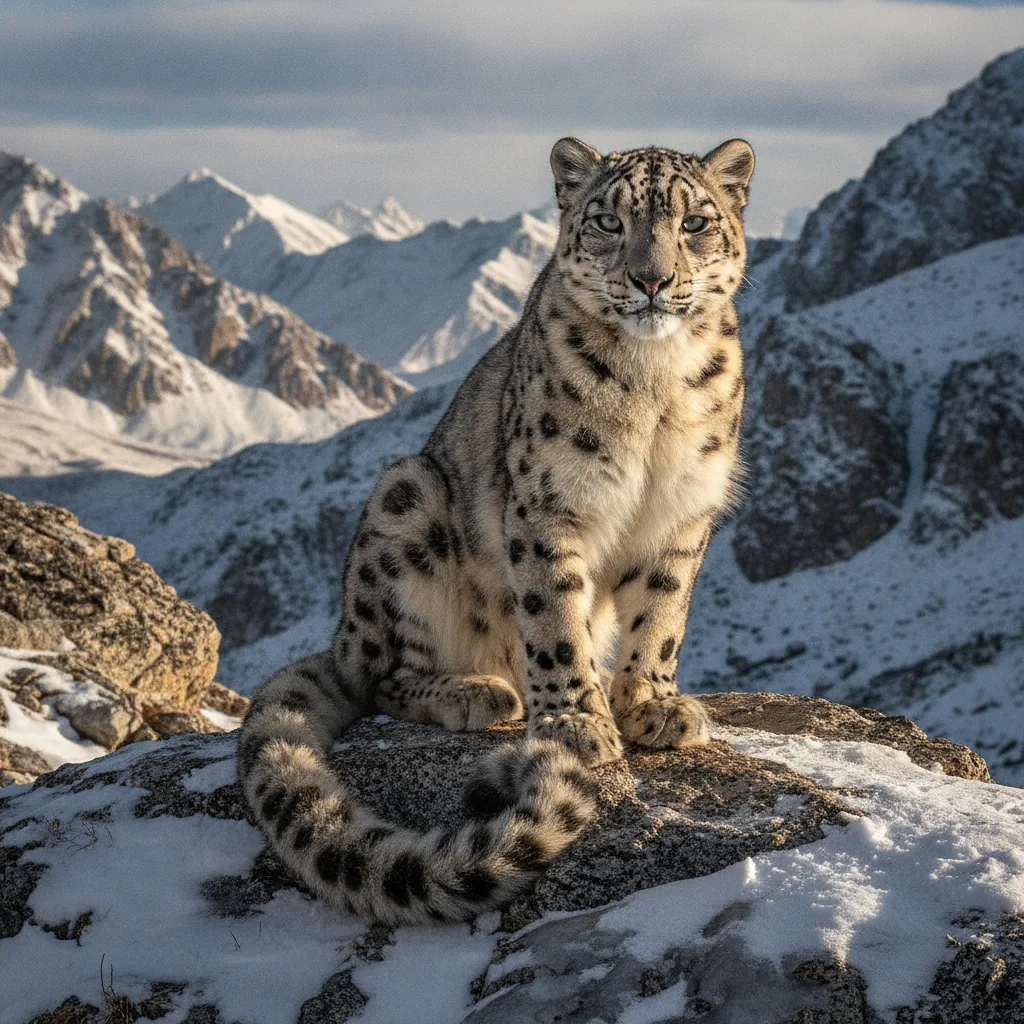
Snow Leopard at a glance
| Scientific name | Panthera uncia |
|---|---|
| IUCN status | Vulnerable |
| Population | 4,000 - 6,500 |
| Population trend | decreasing |
| Weight | 40–55 kg |
| Length | 1.2–1.5 m |
| Lifespan | 12–22 years |
| Top speed | 64 km/h |
| Class | Mammalia |
| Order | Carnivora |
| Family | Felidae |
Need to know
- Snow leopards are master camouflagers, blending perfectly with rocky, snowy terrain.
- Unlike other Panthera species, snow leopards cannot roar due to differences in their larynx structure.
- Their exceptionally long, fluffy tails help with balance and act as warm blankets in the cold.
- They have the largest tail-to-body ratio of any cat, with tails growing up to 1 meter.
- Most snow leopards live in extremely remote, rugged mountains across 12 countries in Central and South Asia.
- They can jump as far as 15 meters (almost 50 feet) in a single leap to ambush prey.
About the Snow Leopard
The snow leopard (Panthera uncia) is a highly elusive, large cat native to the rugged mountain systems of Central and South Asia. Adapted to frigid, high-altitude environments, this solitary prowler is a master of camouflage, able to vanish almost entirely amid snowy rocks and steep cliffs. Beloved as a symbol of wild, untamed mountains, the snow leopard is revered in many local cultures but remains threatened by poaching, habitat loss, and retaliatory killing.
With only one recognized species, the snow leopard boasts unique adaptations for life above the tree line: its extra-thick fur, tremendous leaping power, wide, furry paws that work like natural snowshoes, and famously long, bushy tail. Snow leopards are notoriously difficult to observe in the wild, and new camera-trap and genetic studies continue to reveal exciting insights about their secretive lifestyle.
Physical characteristics
Size: 1.0–1.5 meters body length, 0.8–1.0 meter tail. Weight: 27–55 kg. Lifespan: 10–15 years in the wild, up to 22 years in captivity.
- Thick, pale smoky-gray fur with rosettes and spots
- Long, bushy, ringed tail nearly as long as the body
- Short forelimbs, powerful hind limbs
- Wide, fur-covered paws
- Short, rounded ears
Notable species
- Snow Leopard (Panthera uncia) — Vulnerable. Alpine and subalpine regions above the tree line, rocky mountain slopes and ridges between 2,500–5,500 meters elevation Regions: Himalayas, Tian Shan, Altai Mountains, Pamir Mountains, Hindu Kush, Qilian Mountains, Trans-Himalayas, Plateau of Tibet.
Habitat and range
Original range: Rugged, high-altitude mountain ranges of Central and South Asia, including the Himalayas and surrounding areas.
Current distribution: Currently inhabit isolated high mountain ranges across 12 countries of Central and South Asia.
Preferred environments: Alpine and subalpine slopes, Rocky cliffs and outcrops, Glacial valleys, Steep grassland terraces
Regions: Himalayas, Tian Shan, Altai Mountains, Pamir Mountains, Qilian Mountains, Trans-Himalayas, Plateau of Tibet, Hindu Kush
Where to see Snow Leopard
- Hemis National Park, Ladakh, India — November to March. Snow leopards descend to lower elevations following wild sheep and goats in winter; guided expeditions increase viewing chance.
- Tost Mountains, South Gobi, Mongolia — February to May. Remote trackers and camera traps occasionally reveal snow leopard sightings.
- Kyrgyz Ala-Too Range, Kyrgyzstan — Late winter. Research outposts sometimes support ecotourist tracking.
Behavior and diet
Diet: Primarily wild ungulates such as blue sheep, ibex, Himalayan tahr, argali, and marmots; opportunistically consumes smaller mammals, birds, and occasionally livestock.
Social structure: Solitary except for mating pairs and mothers with cubs; large home ranges often overlap with minimal conflict.
Communication: Communicates mainly with scent-marking, scrapes, and low hissing or mewing calls; cannot roar due to underdeveloped elastic ligament in the larynx.
- Can leap up to 15 meters in a single bound, assisting in ambushing prey on steep cliffs.
- Wraps its long, bushy tail around face and body for warmth during cold mountain nights.
- Scent-marks rocks and trails to denote territory and attract mates.
- Travels and hunts most actively at dawn and dusk (crepuscular activity).
Interactions with other animals
- Blue sheep (bharal) (prey): Blue sheep are the primary diet source for snow leopards in many mountain ranges.
- Wolf (competitive): Wolves compete with snow leopards for prey such as wild sheep and goats.
- Golden eagle (competitive): Golden eagles compete for smaller mammal prey, especially marmots.
- Humans (pastoralists) (competitive): Conflict arises when snow leopards prey on livestock, sometimes resulting in retaliatory killings.
Conservation
IUCN Red List status: Vulnerable
Threats
- Poaching for fur and bones
- Retaliatory or preventive killing by livestock herders
- Loss and fragmentation of natural habitat
- Decline in natural prey populations
- Infrastructure development (roads, mining, grazing pressure)
Conservation efforts
- Anti-poaching patrols and law enforcement in protected areas
- Compensation programs and livestock insurance for herders
- Community-based tourism and conservation incentives
- International Snow Leopard Trust coordination
- Camera-trap and genetic monitoring to improve population estimates
How to help
- Support reputable organizations like the Snow Leopard Trust or WWF
- Choose eco-friendly tourism that benefits local communities
- Educate others about snow leopards and their critical status
- Avoid purchasing or supporting illegal wildlife products
- Advocate for large wilderness areas and wildlife corridors
Snow Leopard facts for kids
Snow leopards are beautiful, rare big cats that live high up in snowy Asian mountains. They have thick spotted fur, long fluffy tails, and are great at leaping and hiding. People are working together to help protect snow leopards so they don’t disappear.
- Snow leopards can jump as far as a school bus is long!
- They use their long tails like a scarf or blanket in the cold.
- Each snow leopard has its own unique spot pattern—like a fingerprint.
- Some people call them the 'ghosts of the mountains' because they're so hard to find.
- They have extra-big paws to walk on snow, a bit like built-in snowshoes.
Did you know? Snow leopards can leap up steep cliffs and rocks in a single jump—sometimes over 15 meters long!
Watch & learn
- BBC Earth: Snow Leopard - Ghost of the Mountain Full Documentary — BBC Earth. An in-depth look at the elusive snow leopard (Panthera uncia) in its natural mountainous habitat, featuring rare footage and expert narration about its survival and hunting techniques.
- National Geographic: Snow Leopard Documentary – Searching for the Phantom Cat — National Geographic Wild. Explore the high Himalayas with National Geographic wildlife teams as they track and reveal the behaviors, struggles, and conservation efforts for the endangered snow leopard.
- PBS Nature: Silent Roar – Searching for the Snow Leopard — PBS Nature. A visually stunning documentary following wildlife cameraman Hugh Miles and naturalist Nisar Malik in their quest to film snow leopards for the first time, exploring their secretive lives.
- Smithsonian Channel: Snow Leopard of Afghanistan – Rare Big Cat in the Wild — Smithsonian Channel. Documenting a conservation program in Afghanistan aimed at tracking and understanding snow leopard populations in hostile and remote terrains, showcasing groundbreaking research footage.
- BBC Studios: Snow Leopards – Attenborough’s Mountain Ghosts — BBC Studios. Sir David Attenborough provides expert narration over incredible footage of snow leopards captured during the making of Planet Earth II, highlighting their elusive behavior and threats.
Sources
Facts on this page are checked against these references. Follow them for the primary data.
- IUCN Red List — Conservation status, population trend and range assessment for Panthera uncia
- Encyclopaedia Britannica — Reviewed encyclopaedia entry on the snow leopard
- National Geographic — Articles, photographs and field reporting on the snow leopard