Chimpanzee
Pan
Chimpanzees, together with bonobos, are our closest living relatives, sharing roughly 98–99% of their DNA with humans, and they live in fluid communities of up to 150 across the forests and woodlands of equatorial Africa. Different populations keep their own tool traditions: some crack nuts with stone hammers, others fish for termites with stripped twigs. The species is Endangered, with numbers falling through poaching, disease and forest clearance.
Quick facts: Size 1.0–1.7 m (head-body length) · Lifespan Average 33 years in the wild, up to 50–60 years in captivity · IUCN status Endangered
Print the fact sheet — a free one-page PDF for homeschool and classroom use
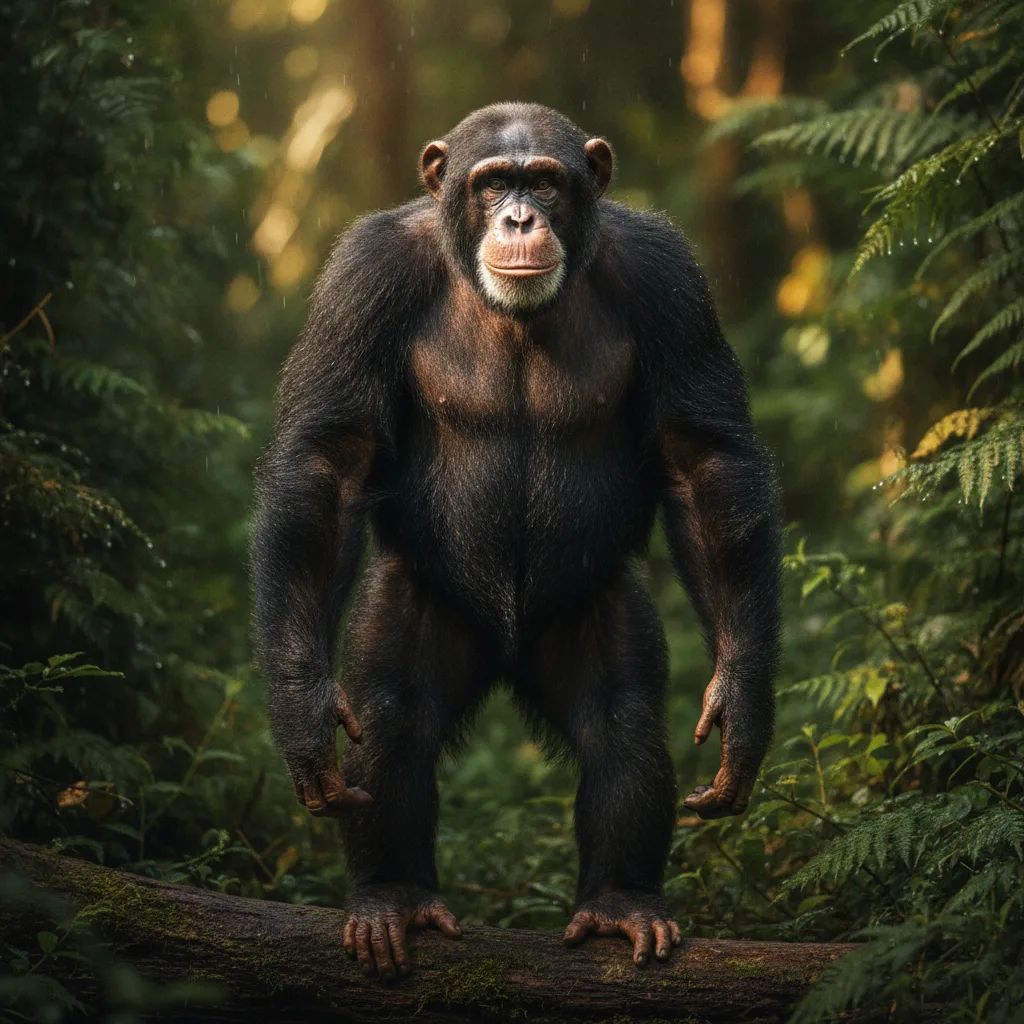
Chimpanzees at a glance
| Scientific name | Pan |
|---|---|
| IUCN status | Endangered |
| Population | 172,700 - 299,700 |
| Population trend | decreasing |
| Weight | 45–70 kg |
| Length | 1–1.7 m |
| Lifespan | 33–63 years |
| Top speed | 40 km/h |
| Class | Mammalia |
| Order | Primates |
| Family | Hominidae |
| Known species | 2 |
Need to know
- Chimpanzees are humans’ closest living relatives, sharing about 98.7% of our DNA.
- They use advanced tools such as sticks for fishing termites and stones to crack nuts.
- Chimpanzee societies are highly complex, featuring politics, alliances, and social hierarchies.
- Bonobos, the other chimpanzee species, are unique for their peaceful matriarchal social structures.
- Chimpanzee numbers have dropped more than 70% in the last 60 years due to habitat loss and hunting.
- They are among the few non-human animals that show self-recognition in mirrors.
About the Chimpanzees
Chimpanzees (genus Pan) are large, highly intelligent African apes, renowned for their advanced cognitive abilities, tool use, and complex social structures. Distributed across the equatorial forests and woodlands of Africa, chimpanzees live in communities governed by intricate relationships, with hierarchies and alliances similar to those found in human society.
The genus consists of two species: the common chimpanzee (Pan troglodytes) and the bonobo (Pan paniscus). While both share a great deal of genetic similarity with humans, they exhibit distinctly different social behaviors: common chimpanzees often form male-dominated, sometimes aggressive societies, while bonobos are known for their more peaceful, female-centered social groups. Chimpanzees are critically important for studies into the evolution of human behavior and cognition.
Unfortunately, populations are rapidly declining due to habitat destruction, hunting, disease, and the illegal wildlife trade.
Physical characteristics
Size: 1.0–1.7 m (head-body length). Weight: 30–70 kg. Lifespan: Average 33 years in the wild, up to 50–60 years in captivity.
- Long arms relative to legs
- Large hands and feet
- Prominent brow ridges
- Sparse black hair covering most of the body
- Pinkish-to-black bare facial skin
Notable species
- Common Chimpanzee (Pan troglodytes) — Endangered. Tropical rainforests, woodlands, and savanna forests Regions: West Africa, Central Africa, Gulf of Guinea forests, Nigeria-Cameroon, Upper Guinea, Congo Basin.
- Bonobo (Pan paniscus) — Endangered. Primary and secondary lowland rainforests Regions: Democratic Republic of the Congo, Congo River basin, Salonga National Park, Lomami River region.
- Central Chimpanzee (Pan troglodytes troglodytes) — Endangered. Dense forests of central Africa Regions: Cameroon, Gabon, Republic of the Congo, Central African Republic.
- Western Chimpanzee (Pan troglodytes verus) — Critically Endangered. Dry forests, savannas, and dense forests of West Africa Regions: Guinea, Sierra Leone, Ivory Coast, Liberia.
- Nigeria-Cameroon Chimpanzee (Pan troglodytes ellioti) — Endangered. Montane and lowland forests Regions: Nigeria, Cameroon, Cross River region.
Habitat and range
Original range: Tropical and subtropical forests and savannas of equatorial Africa
Current distribution: Fragmented populations across West and Central Africa, with severe range contraction in the last century
Preferred environments: Tropical rainforests, Woodlands, Swamp forests, Forest-savanna mosaics, Montane forests
Regions: West Africa, Central Africa, Congo Basin, Gulf of Guinea forests, Nigeria, Cameroon, Democratic Republic of the Congo, Sierra Leone, Ivory Coast, Liberia, Gabon
Where to see Chimpanzees
- Kibale National Park, Uganda — December–February and June–September. Join guided treks to observe wild chimpanzees in their natural forest habitat.
- Gombe Stream National Park, Tanzania — July–October. Jane Goodall’s historic research site with ongoing field studies and visitor programs.
- Salonga National Park, Democratic Republic of the Congo — May–September. Remote area for rare bonobo encounters; best accessed via organized expeditions.
Behavior and diet
Diet: Omnivorous, eating fruits, leaves, seeds, blossoms, insects, honey, termites, and occasionally hunting small mammals.
Social structure: Live in multi-male, multi-female communities (up to 150 individuals) with fluid subgrouping (fission-fusion society). Common chimpanzees are often male-dominated, while bonobos have female-centered hierarchy.
Communication: Use vocalizations, facial expressions, gestures, and body language. They also use complex calls to coordinate group activities and warn of predators.
- Tool use for foraging and hunting
- Cooperative hunting (especially red colobus monkeys)
- Altruism and social grooming
- Displays of empathy, reconciliation, and even 'culture' unique to different groups
Interactions with other animals
- Leopard (predator): Leopards occasionally prey on young or isolated chimpanzees, especially in forested areas.
- Red colobus monkey (prey): Chimpanzees sometimes hunt red colobus monkeys in organized groups, displaying complex cooperation.
- Humans (competitive): Humans threaten chimpanzees through habitat destruction, hunting, and disease but also cooperate in conservation and research.
Conservation
IUCN Red List status: Endangered
Threats
- Habitat destruction
- Hunting and bushmeat trade
- Illegal wildlife trade (especially infants)
- Diseases (e.g., Ebola, respiratory illnesses)
- Deforestation and human encroachment
Conservation efforts
- Establishment of national parks and reserves
- Anti-poaching patrols
- Community-based conservation initiatives
- Legal protection and enforcement
- Ecotourism for education and funding
How to help
- Support conservation organizations working in Africa
- Choose sustainable, forest-friendly products
- Avoid purchasing products linked to habitat destruction
- Advocate for protected areas and anti-poaching laws
- Participate in responsible ecotourism
Chimpanzees facts for kids
Chimpanzees are smart apes that live in African forests and are closely related to humans. They use tools, help each other, and live in big family groups. Sadly, they are endangered because their homes are being destroyed.
- Chimpanzees can make tools from sticks and stones.
- They laugh when they play, just like kids do!
- Chimps sleep in nests they build high up in trees.
- Baby chimps love to ride on their mom’s back.
- A chimpanzee can live longer than 50 years in zoos.
Did you know? Did you know? Chimpanzees and humans can understand some of the same hand signals and even learn sign language!
Watch & learn
- The Secret Life of Chimpanzees: Deep in the Wild — BBC Earth. This documentary delves into the social structure, intelligence, and emotional lives of wild chimpanzees (Pan) in their natural habitat, featuring stunning footage and the latest research findings.
- Chimpanzee Power Struggles and Family Bonds — National Geographic. Explore the dramatic power dynamics, cooperation, and close-knit family relationships of chimpanzees (Pan) as captured by the renowned National Geographic Wild teams in Africa.
- Jane Goodall and the Wild Chimpanzees of Gombe — PBS Nature. A deep dive into Jane Goodall’s groundbreaking field studies on Pan troglodytes, this documentary provides intimate and historical footage of chimpanzee societies and their complex behaviors.
- Inside a Chimpanzee Community: Innovation and Communication — Smithsonian Channel. Discover how chimpanzees (Pan) use tools, solve problems, and communicate with one another through vocalizations and gestures in this engaging exploration of primate intelligence.
- Protecting Chimpanzees: Conservation Challenges in the Wild — BBC Earth. Learn about the conservation efforts and challenges faced by wild chimpanzee populations (Pan) as poaching, habitat loss, and disease threaten these intelligent primates in Africa.
Sources
Facts on this page are checked against these references. Follow them for the primary data.
- IUCN Red List — Conservation status, population trend and range assessment for Pan
- Encyclopaedia Britannica — Reviewed encyclopaedia entry on the chimpanzees
- National Geographic — Articles, photographs and field reporting on the chimpanzees