Elephant
Elephantidae
Elephants are the largest living land animals, and all three species — African savanna, African forest and Asian — live in family groups led by the oldest female. A trunk containing tens of thousands of muscle units lets an elephant lift a log or pick up a single seed, and low-frequency rumbles let herds keep in touch over kilometres. The savanna elephant is Endangered, the forest elephant Critically Endangered and the Asian elephant Endangered on the IUCN Red List.
Quick facts: Size 2.0 to 4.0 meters tall at the shoulder · Lifespan 50-60 years in the wild, up to 75 years in captivity · IUCN status Vulnerable to Critically Endangered (species-specific)
Print the fact sheet — a free one-page PDF for homeschool and classroom use
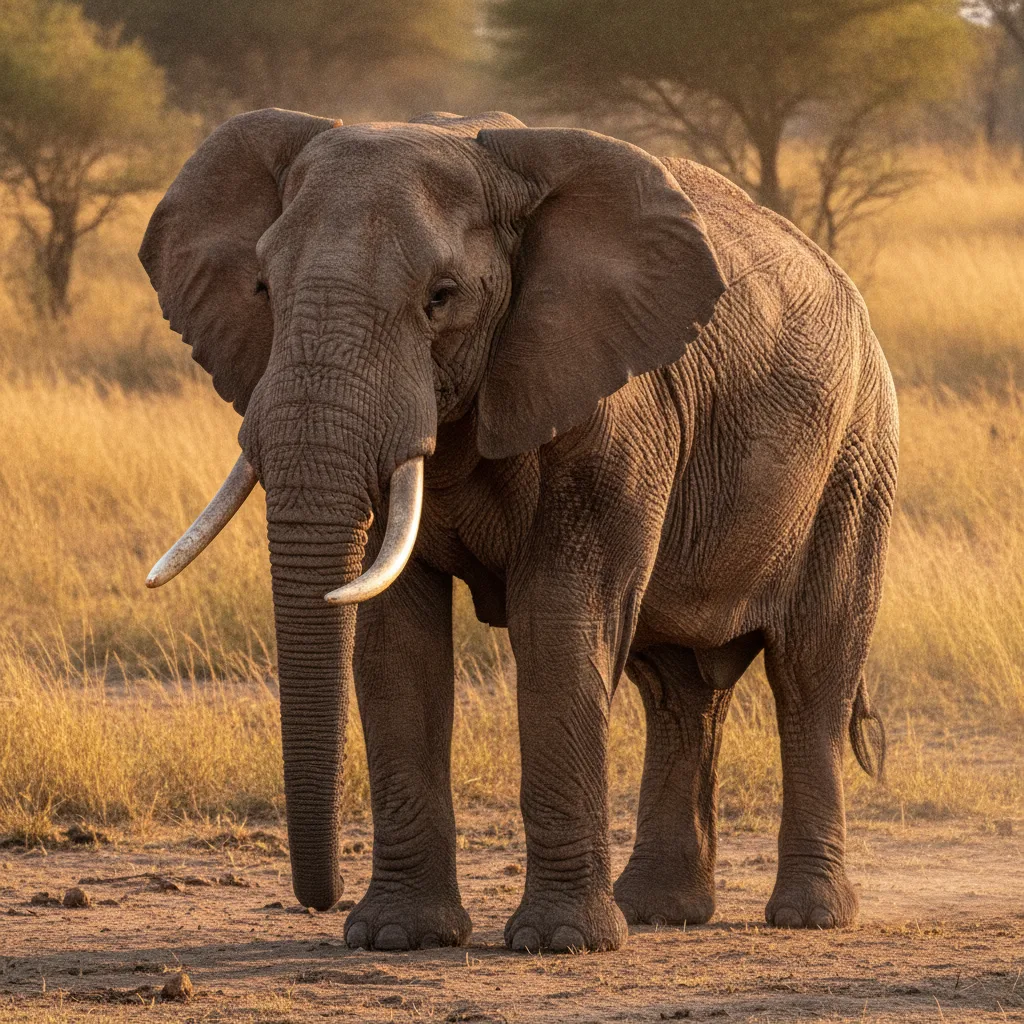
Elephants at a glance
| Scientific name | Elephantidae |
|---|---|
| IUCN status | Vulnerable to Critically Endangered (species-specific) |
| Population | 450,000 - 500,000 |
| Population trend | decreasing |
| Weight | 4000–12000 kg |
| Length | 3–4 m |
| Lifespan | 60–75 years |
| Top speed | 40 km/h |
| Class | Mammalia |
| Order | Proboscidea |
| Family | Elephantidae |
| Known species | 3 |
Need to know
- Elephants are the largest land mammals on Earth.
- They have complex social systems, forming matriarchal families.
- Their trunks have over 40,000 muscles and are used for a variety of tasks.
- Elephants are keystone species and shape their environment.
- They communicate via low-frequency infrasound over long distances.
- Poaching for ivory and habitat loss threaten all elephant species.
About the Elephants
Elephants are iconic, highly intelligent mammals belonging to the family Elephantidae, with only three living species today. These giants exhibit incredible intelligence, emotional depth, and complex social structures. They are recognized for their massive size, distinctive trunks, and large ears (especially in African species). Elephants are essential to their ecosystems, playing a crucial role in shaping landscapes by uprooting trees, creating water holes, and dispersing seeds. Their populations have been severely impacted by habitat loss and poaching for ivory, placing all three species under significant conservation concern.
Physical characteristics
Size: 2.0 to 4.0 meters tall at the shoulder. Weight: 2,000 to 12,000 kg. Lifespan: 50-60 years in the wild, up to 75 years in captivity.
- Prehensile trunk with two finger-like projections (African) or one (Asian)
- Large, fan-shaped ears (especially African elephants)
- Tusks made of ivory (both sexes in African elephants, mostly males in Asian elephants)
- Thick, wrinkled gray skin with sparse bristly hair
- Column-like legs and massive, rounded bodies
Notable species
- African Savanna Elephant (Loxodonta africana) — Endangered. Savannas, grasslands, woodlands Regions: East Africa, Southern Africa, West Africa, Central Africa, Miombo woodlands.
- African Forest Elephant (Loxodonta cyclotis) — Critically Endangered. Tropical and subtropical forests Regions: Congo Basin, Central Africa, Gabon, Republic of the Congo, Ivory Coast.
- Asian Elephant (Elephas maximus) — Endangered. Forest, grassland, and scrubland ecosystems Regions: India, Sri Lanka, Southeast Asia, Sumatra, Bangladesh.
Habitat and range
Original range: Sub-Saharan Africa and South/Southeast Asia, formerly widespread across Eurasia and Africa until recent millennia.
Current distribution: Fragmented populations in Africa (savannas, forests) and South, Southeast Asia—much reduced from historical ranges.
Preferred environments: Savannas, Grasslands, Tropical forests, Woodlands, Scrublands, River valleys
Regions: East Africa, Southern Africa, West Africa, Congo Basin, India, Sri Lanka, Sumatra, Southeast Asia, Central Africa
Where to see Elephants
- Serengeti National Park, Tanzania — June to October. Large herds can be observed during the dry season around water sources.
- Chobe National Park, Botswana — May to October. Home to one of the largest elephant populations in Africa; best seen on river cruises.
- Udawalawe National Park, Sri Lanka — Throughout the year; best from December to April. Best place in Asia for observing wild Asian elephants in open country.
- Dzanga-Sangha Reserve, Central African Republic — December to April. One of the best forest locations to see African forest elephants.
Behavior and diet
Diet: Herbivorous, consuming grasses, leaves, bark, roots, and fruit. May drink up to 200 liters of water daily.
Social structure: Matriarchal family groups led by the oldest female, generally consisting of related females and their offspring. Adult males often roam alone or in bachelor groups.
Communication: Elephants communicate using a variety of vocalizations (trumpets, rumbles), infrasound (low-frequency sound), touch, and body language.
- Mourning rituals for deceased herd members
- Complex tool use and problem-solving
- Seasonal long-distance migrations for food and water
- Dust and mud bathing for skin care and parasite control
Interactions with other animals
- Lions (predator): Lions occasionally prey on young or weak elephants, usually when hunting in prides.
- Humans (competitive): Humans compete for land and resources; elephants are sometimes killed for crop raiding or ivory.
- Baobab Tree (competitive): Elephants damage or destroy baobab trees while seeking water and minerals in the bark.
Conservation
IUCN Red List status: Vulnerable to Critically Endangered (species-specific)
Threats
- Poaching for ivory and body parts
- Habitat loss and fragmentation
- Human-wildlife conflict
- Illegal wildlife trade
- Climate change impacts
Conservation efforts
- Anti-poaching patrols and surveillance
- International ivory trade bans (CITES)
- Community-based conservation programs
- Translocation and restoration of habitat corridors
- Genetic and population monitoring
How to help
- Support reputable elephant conservation organizations
- Never buy ivory or wildlife products
- Promote sustainable tourism
- Raise awareness about elephant conservation issues
- Advocate for stronger legal protection of elephants and their habitats
Elephants facts for kids
Elephants are the biggest land animals on Earth! They have long trunks and big ears, and they love to live with their families. Elephants are very smart and can even show their feelings.
- Elephants use their trunks like a hand to pick up things.
- Baby elephants are called calves, and they like to play in the mud.
- Elephants make deep sounds that humans can’t hear.
- Their huge ears help cool them down when it’s hot.
- Elephants can eat more than 100 kg of food every day!
Did you know? Did you know that some elephants can remember where water is hidden for many years—even during the driest times?
Watch & learn
- The Secret Life of Elephants - Exploring Family Bonds — BBC Earth. This documentary delves into the social structure, emotional intelligence, and close family bonds of African elephants, with stunning wildlife footage and expert narration from BBC Earth’s renowned team.
- Epic Encounters: Elephant Herds on the Move in Botswana — National Geographic. Follow massive herds of African elephants in Botswana as they migrate across the Okavango Delta, showcasing their survival instincts and interactions with other wildlife.
- African Elephants: Giants of the Savanna — Smithsonian Channel. A cinematic journey into the world of African savanna elephants, featuring their daily routines, communication skills, and the challenges they face from predators and human encroachment.
- Elephant Intelligence and Memory: The Mind of the Mammal — PBS Nature. An insightful exploration of elephant cognition and memory, highlighting groundbreaking scientific studies and real-life stories of empathy and learning among these intelligent mammals.
- The Asian Elephant: Struggle for Survival — Nat Geo Wild. Discover the unique challenges faced by Asian elephants, including habitat loss and human conflict, paired with stories of conservation efforts and the intricate lives of these gentle giants.
Sources
Facts on this page are checked against these references. Follow them for the primary data.
- IUCN Red List — Conservation status, population trend and range assessment for Elephantidae
- Encyclopaedia Britannica — Reviewed encyclopaedia entry on the elephants
- National Geographic — Articles, photographs and field reporting on the elephants