Polar Bear
Ursus maritimus
Polar bears live on the sea ice of the Arctic Ocean, where they hunt ringed and bearded seals at breathing holes and along the ice edge. They are the largest land carnivores, with males weighing up to 600 kilograms, and their fur is actually translucent — it looks white because it scatters light over black skin. The species is listed as Vulnerable, its main threat being the loss of summer sea ice.
Quick facts: Size Males average 2.4–2.6 meters long, females about 1.8–2.0 meters. · Lifespan Typically 15–18 years in the wild; maximum recorded 34 years. · IUCN status Vulnerable
Print the fact sheet — a free one-page PDF for homeschool and classroom use
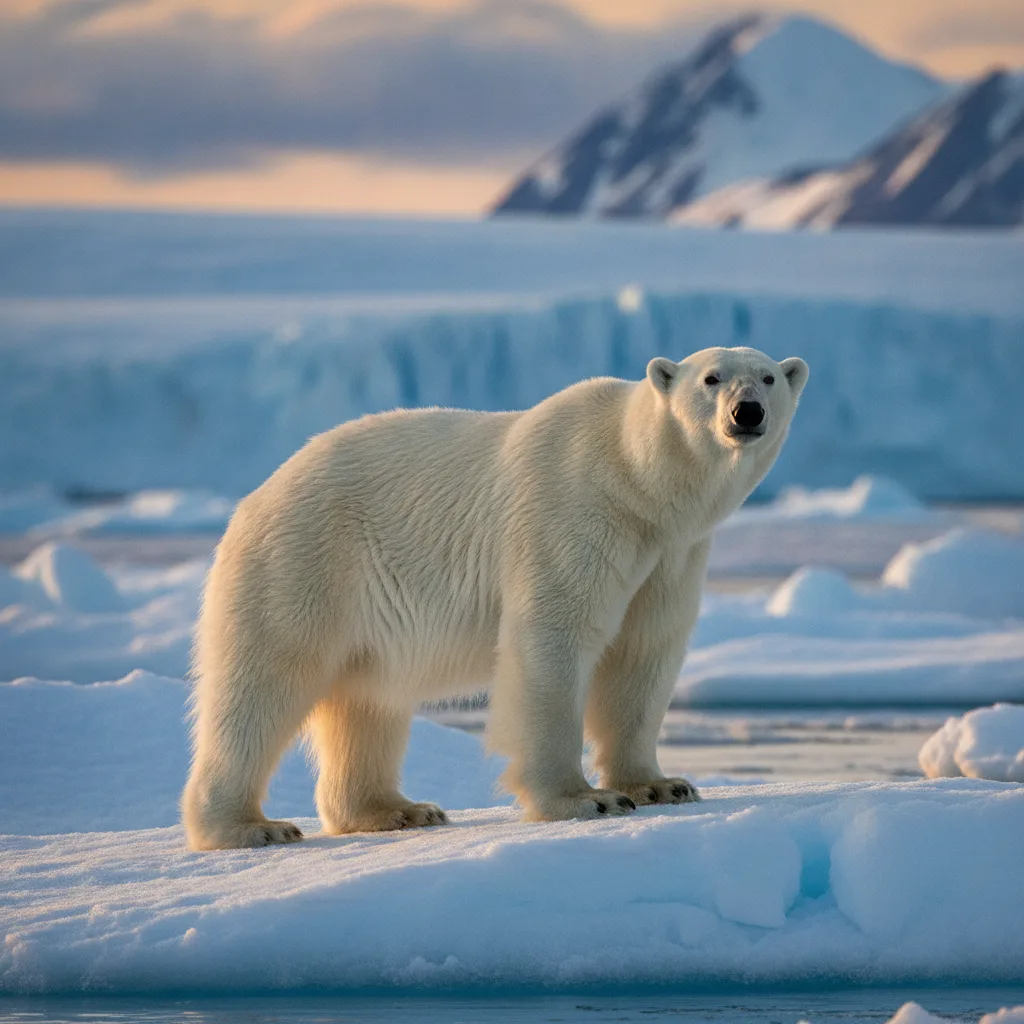
Polar Bear at a glance
| Scientific name | Ursus maritimus |
|---|---|
| IUCN status | Vulnerable |
| Population | 22,000-31,000 |
| Population trend | decreasing |
| Weight | 450–800 kg |
| Length | 2.4–3 m |
| Lifespan | 15–34 years |
| Top speed | 40 km/h |
| Class | Mammalia |
| Order | Carnivora |
| Family | Ursidae |
Need to know
- Polar bears are considered marine mammals, spending much of their lives on sea ice and swimming between floes.
- They are the largest living bear species and the world's largest land carnivores.
- Polar bears rely almost exclusively on seals for food, mainly ringed and bearded seals.
- Their fur is actually translucent, not white, and their skin underneath is black to absorb heat.
- Climate change and melting sea ice pose the greatest threat to polar bear survival.
- Females dig maternity dens in snowdrifts to give birth and nurse cubs.
About the Polar Bear
The polar bear (Ursus maritimus) is a massive carnivorous mammal native to the Arctic, perfectly adapted to some of Earth's harshest conditions. As the largest bear species and the apex predator of the Arctic marine ecosystem, polar bears play a crucial role in regulating seal populations and maintaining ecological balance. Their survival is closely tied to the health of sea ice, which they use for resting, hunting, and traveling vast distances across the frozen seascape. Polar bears have evolved a range of adaptations: water-repellent fur, thick blubber for insulation, and large, webbed paws for efficient swimming.
In recent decades, the global polar bear population has declined or become more fragmented, primarily due to global warming and melting sea ice. International conservation groups and governments are engaged in ongoing research and management to mitigate these threats, but their future remains uncertain as Arctic ice continues to shrink.
Physical characteristics
Size: Males average 2.4–2.6 meters long, females about 1.8–2.0 meters.. Weight: Males average 400–600 kg; females 200–350 kg.. Lifespan: Typically 15–18 years in the wild; maximum recorded 34 years..
- Long neck and narrow skull
- Large, paddle-shaped, partially webbed paws
- Translucent, hollow fur fibers
- Thick layer of blubber for insulation
- Short, fur-covered tail and small rounded ears
Notable species
- Polar Bear (Ursus maritimus) — Vulnerable. Sea ice and coastal regions throughout the circumpolar Arctic Regions: Arctic Ocean, Barents Sea, Chukchi Sea, Beaufort Sea, Hudson Bay, Greenland Sea, Canadian Arctic Archipelago, Baffin Bay.
Habitat and range
Original range: Circumpolar Arctic, including sea ice habitats north of the Arctic Circle.
Current distribution: Distributed throughout the circumpolar Arctic—found wherever sea ice exists for significant parts of the year.
Preferred environments: Annual and multi-year sea ice, Coastal shorelines near the Arctic Ocean, Ice floes and pack ice, Polynyas (areas of open water within sea ice)
Regions: Arctic Ocean, Chukchi Sea, Beaufort Sea, Barents Sea, Laptev Sea, Greenland Sea, Canadian Arctic Archipelago, Baffin Bay, Hudson Bay, Svalbard
Where to see Polar Bear
- Churchill, Hudson Bay — October–November. Known as the 'Polar Bear Capital of the World', bears gather along the shore waiting for winter sea ice to form.
- Svalbard, Barents Sea — April–August. Expedition cruises offer opportunities to observe polar bears hunting on drifting ice.
- Wrangel Island, Chukchi Sea — July–September. A critical feeding and denning site, especially for sighting mothers with cubs.
Behavior and diet
Diet: Primarily seals, especially ringed and bearded seals, supplemented occasionally by birds, walrus carrion, fish, kelp, and whale carcasses.
Social structure: Mostly solitary, except for mothers with cubs and during seasonal feeding; mature bears come together briefly where food is abundant.
Communication: Polar bears communicate through vocalizations (growls, roars, chuffing), chemical scent markings, and visual cues (body posture, facial expressions).
- Ambush hunting: Waiting silently by seal breathing holes to catch prey.
- Extended fasting: Surviving months with little or no food when sea ice retreats.
- Long-distance swimming: Capable of continuous swims over 100 km across open water.
- Snow denning: Pregnant females dig deep dens in snowdrifts to give birth and shelter cubs.
Interactions with other animals
- Ringed seal (Pusa hispida) (prey): The primary food source for polar bears; hunted mainly at breathing holes and pupping lairs.
- Bearded seal (Erignathus barbatus) (prey): Another important prey species, especially for large males.
- Arctic fox (Vulpes lagopus) (competitive): Often trail polar bears to scavenge leftover seal carcasses.
- Walrus (Odobenus rosmarus) (predator/prey (rarely)): Polar bears occasionally prey on walrus calves or scavenge carcasses, but adult walruses can defend themselves effectively.
Conservation
IUCN Red List status: Vulnerable
Threats
- Climate change and loss of sea ice habitat
- Pollution (persistent organic pollutants)
- Oil and gas exploration and spills
- Human–bear conflicts
- Overharvesting/hunting in some locales
Conservation efforts
- International Agreement on the Conservation of Polar Bears (1973)
- Protected areas and hunting quotas in Arctic nations
- Community-based monitoring and management
- Polar Bear Specialist Group (PBSG) conservation research
How to help
- Reduce fossil fuel consumption to slow global warming.
- Support conservation organizations working in the Arctic.
- Participate in citizen science and public awareness campaigns.
- Adopt sustainable seafood and eco-friendly products.
- Advocate for policies to protect polar bear habitats.
Polar Bear facts for kids
Polar bears are giant, powerful bears that live in the icy Arctic. They have thick fur and blubber to keep them warm and spend much of their time walking or swimming on sea ice. Their favorite food is seals, which they hunt using their excellent sense of smell.
- Polar bears can smell a seal’s breathing hole from almost a mile away!
- A polar bear’s fur isn’t actually white—it’s see-through!
- Polar bears are amazing swimmers and can paddle for days without stopping.
- Baby polar bears are born tiny and fluffy, about the size of a guinea pig.
- Polar bears have black skin under their fur to help soak up the sun’s warmth.
Did you know? Did you know that polar bears are the biggest bears in the world and can weigh more than 10 grown-up humans combined?
Watch & learn
- Polar Bear: Queen of the Arctic – Remarkable Footage of Ursus maritimus in the Wild — BBC Earth. This stunning documentary explores the life and challenges faced by polar bears in their icy habitat, with incredible close-up footage and expert narration. BBC Earth's high production values make this an unmatched immersive experience.
- National Geographic: Face to Face with Polar Bears – Survival in a Changing Climate — National Geographic. Dive deep into the daily struggles of Ursus maritimus as they hunt, travel, and adapt to diminishing ice in a warming Arctic, filmed by National Geographic's legendary wildlife crews.
- The Polar Bear Family and Me – Natural History Adventure Among Ursus maritimus — BBC Earth. Cameraman Gordon Buchanan lives alongside a polar bear family, capturing intimate moments and behavior rarely seen. The series provides a profound look into migration, hunting, and maternal care.
- Smithsonian Channel: Mighty Polar Bear – Apex Predator of the North — Smithsonian Channel. Experience breathtaking Arctic scenes as the documentary highlights the hunting techniques, physical adaptations, and cultural significance of the polar bear through expert interviews and powerful footage.
- PBS Nature: Snow Bears – A True Story of Courage and Survival — PBS Nature. Follow the epic journey of a polar bear mother and her cubs as they trek across one of Earth's most extreme environments. With family-friendly narration and beautiful cinematography, it's perfect for all ages.
Sources
Facts on this page are checked against these references. Follow them for the primary data.
- IUCN Red List — Conservation status, population trend and range assessment for Ursus maritimus
- Encyclopaedia Britannica — Reviewed encyclopaedia entry on the polar bear
- National Geographic — Articles, photographs and field reporting on the polar bear