Whale
Cetacea
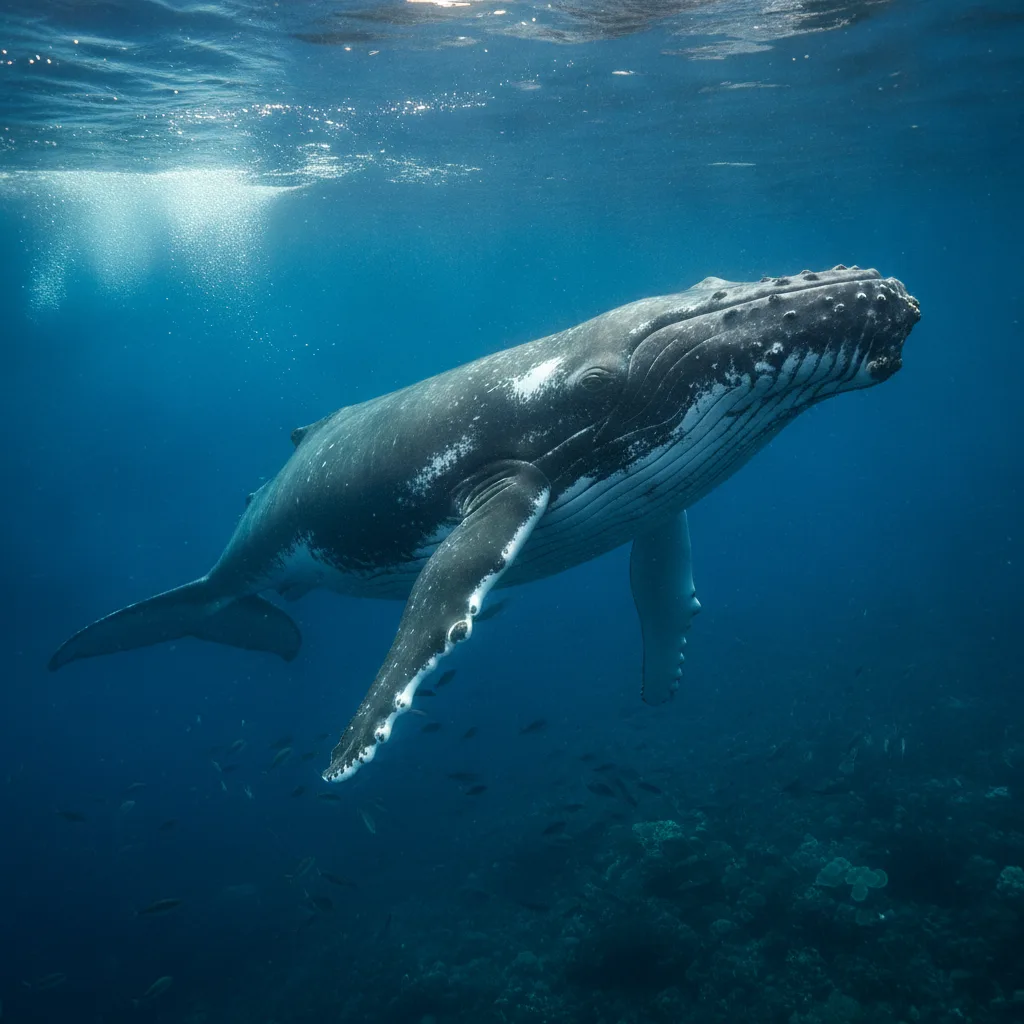
Whales are fully aquatic mammals split into two groups: baleen whales that strain krill and small fish through plates in their mouths, and toothed whales such as sperm whales and orcas. Humpbacks travel up to 8,000 kilometres each way between polar feeding grounds and tropical breeding waters, one of the longest migrations of any mammal. Commercial whaling pushed several species close to extinction; many have recovered since the 1986 moratorium, but the North Atlantic right whale still numbers only a few hundred.
Quick facts: Size 4 to 33 meters in length, depending on species · Lifespan Typically 30–90 years, with some species exceeding 100 years · IUCN status Varies by species, from Least Concern to Endangered
Print the fact sheet — a free one-page PDF for homeschool and classroom use
Whales at a glance
| Scientific name | Cetacea |
|---|---|
| IUCN status | Varies by species, from Least Concern to Endangered |
| Population | 1,300,000 - 1,500,000 |
| Population trend | increasing |
| Weight | 60000–180000 kg |
| Length | 15–33 m |
| Lifespan | 40–110 years |
| Top speed | 50 km/h |
| Class | Mammalia |
| Order | Cetacea |
| Family | various (e.g., Balaenopteridae, Physeteridae, Delphinidae) |
| Known species | 90 |
Need to know
- Blue whales are the largest animals ever known to exist.
- Some sperm whales can dive deeper than 2,000 meters and hold their breath for over an hour.
- Whales evolved from land-dwelling mammals over 50 million years ago.
- Different whale species communicate using complex sounds and songs, some audible hundreds of kilometers away.
- Many whales undertake migrations of thousands of kilometers annually.
- Whaling nearly drove several whale species to extinction in the 20th century, but some populations are now recovering.
About the Whales
Whales are a group of fully aquatic marine mammals recognized for their enormous size and extraordinary adaptations to ocean life. They are divided into two suborders: baleen whales (Mysticeti), which filter feed using comb-like baleen plates, and toothed whales (Odontoceti), which include sperm whales, orcas, and other species with teeth. These animals occupy all the world's oceans, from the icy polar seas to tropical waters, and some species undertake the longest migrations in the animal kingdom.
Whales play a vital role in marine ecosystems, cycling nutrients and connecting different oceanic regions. Their behaviors—from acrobatic breaches to haunting songs—make them both biologically significant and culturally iconic. Many are slow to reproduce, living long lives, and forming strong social bonds, especially among species like orcas and humpbacks.
Physical characteristics
Size: 4 to 33 meters in length, depending on species. Weight: 1,000 kg (smallest) to 180,000 kg (blue whale). Lifespan: Typically 30–90 years, with some species exceeding 100 years.
- Streamlined, muscular bodies
- Horizontal tail flukes
- Blowholes on top of head (single for toothed, double for baleen)
- Large pectoral fins (esp. humpbacks)
- Coloration varies: grey, blue-grey, black & white, mottled
Notable species
- Blue Whale (Balaenoptera musculus) — Endangered. Open oceans, primarily temperate and polar waters Regions: North Atlantic Ocean, South Atlantic Ocean, North Pacific Ocean, Indian Ocean, Southern Ocean, waters off Antarctica.
- Humpback Whale (Megaptera novaeangliae) — Least Concern. Coastal waters, continental shelves, open ocean Regions: North Pacific Ocean, South Pacific Ocean, Atlantic Ocean, Indian Ocean, Southern Ocean.
- Gray Whale (Eschrichtius robustus) — Least Concern (Eastern), Critically Endangered (Western). Shallow coastal waters, lagoons, Arctic and sub-Arctic seas Regions: North Pacific Ocean, Bering Sea, Chukchi Sea, Sea of Okhotsk.
- Sperm Whale (Physeter macrocephalus) — Vulnerable. Deep offshore waters, continental slopes, ocean basins Regions: Atlantic Ocean, Pacific Ocean, Indian Ocean, Mediterranean Sea, Southern Ocean.
- Orca (Killer Whale) (Orcinus orca) — Data Deficient (globally); some regional populations Endangered. Coastal waters, open ocean, polar to tropical seas Regions: North Pacific Ocean, South Pacific Ocean, Atlantic Ocean, Indian Ocean, Antarctic Ocean, Mediterranean Sea.
- Fin Whale (Balaenoptera physalus) — Vulnerable. Deep offshore waters, subpolar and temperate oceans Regions: North Atlantic Ocean, North Pacific Ocean, Indian Ocean, Southern Ocean, waters off Iceland.
Habitat and range
Original range: Marine environments across the world's oceans; whales evolved from terrestrial ancestors in the ancient Tethys Sea region.
Current distribution: Now found throughout all oceans, from polar to tropical waters, in both deep offshore and coastal zones.
Preferred environments: Open ocean (pelagic), Continental shelves, Polar ice edges, Coastal bays and estuaries, Deep trenches and slopes
Regions: North Atlantic Ocean, South Atlantic Ocean, North Pacific Ocean, South Pacific Ocean, Indian Ocean, Southern Ocean, Mediterranean Sea, Arctic Ocean, Bering Sea, Chukchi Sea, Sea of Okhotsk
Where to see Whales
- Monterey Bay, California, Pacific Ocean — May to November. Excellent for humpback and blue whales, daily whale-watching tours.
- Húsavík, Iceland, North Atlantic Ocean — June to August. Best for minke, humpback, and even blue whales. Polar environment sightings.
- Hermanus, South Africa, South Atlantic Ocean — June to November. Land-based and boat-based whale watching. Ideal for southern right whales.
Behavior and diet
Diet: Baleen whales primarily eat krill and small schooling fish; toothed whales eat fish, squid, and in some cases, marine mammals.
Social structure: Varies by species. Some form large, fluid groups (pods), while others are mainly solitary except during breeding or migration.
Communication: Extensive vocalizations: songs, clicks, whistles, and pulsed calls. Baleen whales (e.g., humpbacks) produce elaborate songs; toothed whales use echolocation.
- Cooperative feeding behaviors like bubble-net feeding (humpbacks)
- Long-distance migration between feeding and breeding grounds
- Breaching and tail-slapping displays
- Deep, prolonged dives to forage for prey (sperm whales)
Interactions with other animals
- Krill (prey): Many baleen whales, like blue and fin whales, feed on massive quantities of krill.
- Orcas (predator/competitive): Orcas hunt other whale species, especially calves, and also compete for similar food sources.
- Remoras (symbiotic): Remoras attach to whales, benefiting from food scraps and transportation.
- Barnacles (commensal): Barnacles attach to the skin of gray and humpback whales, causing no direct harm.
Conservation
IUCN Red List status: Varies by species, from Least Concern to Endangered
Threats
- Commercial whaling (historic and some ongoing)
- Ship strikes
- Entanglement in fishing gear
- Noise pollution
- Climate change affecting prey distribution
- Pollution and plastic debris
Conservation efforts
- Global whaling moratorium by International Whaling Commission (IWC)
- Protected marine reserves and sanctuaries
- Ship speed restrictions in whale-rich zones
- Entanglement response teams and modified fishing gear
- Public education and responsible whale-watching initiatives
How to help
- Support responsible whale-watching over harmful tourism
- Reduce plastic use to protect ocean habitats
- Promote policies that regulate ship speeds in whale migratory routes
- Support NGOs focused on marine conservation
- Learn about and share information on the threats whales face
Whales facts for kids
Whales are the biggest animals in the world and live in all of the oceans! Some whales eat tiny shrimp called krill, while others have teeth and eat fish. Whales sing songs, dive deep, and sometimes leap out of the water—a sight you'll never forget.
- Blue whales are longer than three school buses.
- Baby whales are called calves and can weigh as much as a car at birth.
- Humpback whales love to jump out of the water and flip their tails.
- Sperm whales have giant square heads and can dive very deep.
- Orcas, also known as killer whales, have black and white coloring and live in families called pods.
Did you know? Did you know a blue whale's heart is as big as a small car and can weigh over 180 kg (400 lbs)?
Watch & learn
- Blue Whales: Giants of the Deep - Full Documentary — BBC Earth. An awe-inspiring documentary capturing the size, behavior, and biology of the blue whale, the largest animal on Earth. Includes stunning footage of blue whales feeding and communicating in the wild.
- Epic Whale Encounters in the Wild — National Geographic. National Geographic's team captures breathtaking encounters with numerous whale species, exploring their migration, feeding, and social interactions with expert narration and rare close-up footage.
- Extraordinary Sperm Whales: The Largest Toothed Predator — Smithsonian Channel. This documentary explores the lives of sperm whales, revealing their social structures, communication skills, and hunting techniques in the open ocean.
- Spy in the Pod: Dolphins and Whales Revealed — PBS Nature. Using innovative spy cameras, this documentary uncovers the private lives of whales and dolphins, providing viewers with unique insights into their social behavior and family bonds.
- Humpback Whales: Song of the Deep — National Geographic WILD. Focused on humpback whales, this documentary investigates their migration routes, complex songs, and unique feeding strategies through superb underwater cinematography.
Sources
Facts on this page are checked against these references. Follow them for the primary data.
- IUCN Red List — Conservation status, population trend and range assessment for Cetacea
- Encyclopaedia Britannica — Reviewed encyclopaedia entry on the whales
- National Geographic — Articles, photographs and field reporting on the whales