Bald Eagle
Haliaeetus leucocephalus
The bald eagle is the national bird of the United States, found from Alaska and Canada to Mexico near coasts, rivers and large lakes where it can take fish. Pairs build the largest tree nests of any bird, reusing and adding to them for years until some weigh over a tonne. Once reduced to about 400 nesting pairs in the lower 48 states by DDT, it recovered to more than 70,000 pairs and was removed from the US endangered species list in 2007.
Quick facts: Size 70–102 cm (28–40 inches) in length; wingspan 1.8–2.3 m (6–7.5 ft) · Lifespan typically 20–30 years in the wild · IUCN status Least Concern
Print the fact sheet — a free one-page PDF for homeschool and classroom use
Bald Eagle at a glance
| Scientific name | Haliaeetus leucocephalus |
|---|---|
| IUCN status | Least Concern |
| Population | 316,700 |
| Population trend | increasing |
| Weight | 4.5–6.3 kg |
| Length | 0.85–1.1 m |
| Lifespan | 20–38 years |
| Top speed | 56 km/h |
| Class | Aves |
| Order | Accipitriformes |
| Family | Accipitridae |
Need to know
- Bald Eagles can spot fish from over a mile (1.6 km) away with their exceptional vision.
- They were removed from the U.S. Endangered Species List in 2007 due to a remarkable recovery.
- Bald Eagles build the largest tree nests of any bird in North America—up to 4 meters deep and 2.5 meters wide.
- The name 'bald' comes from an old English word meaning 'white-headed', not hairless.
- Juvenile Bald Eagles are brown with white mottling and acquire their white head and tail at 4–5 years old.
- Bald Eagles are a symbol of the United States, featured on the national seal.
About the Bald Eagle
The Bald Eagle (Haliaeetus leucocephalus) is one of the most iconic birds of North America, instantly recognizable by its striking white head and tail contrasted against a dark brown body and wings. As North America’s largest native raptor and a true sea eagle, Bald Eagles primarily inhabit areas near large bodies of open water, where fish are abundant and mature trees are available for nesting.
Once pushed to the brink of extinction in the lower 48 states, Bald Eagles have made a dramatic recovery thanks to intensive conservation efforts, including the banning of DDT and habitat protection. They are famed for their enormous nests, breathtaking aerial displays, and role as a symbol of strength and freedom in the United States.
The Bald Eagle is part of a group known as sea or fish eagles (genus Haliaeetus), which includes some of the largest birds of prey worldwide. There is significant diversity among sea eagle species, each occupying unique regions from the coasts of Eurasia and Africa to the rivers of Australia.
Physical characteristics
Size: 70–102 cm (28–40 inches) in length; wingspan 1.8–2.3 m (6–7.5 ft). Weight: 3–6.3 kg (6.6–14 lbs), females larger than males. Lifespan: typically 20–30 years in the wild.
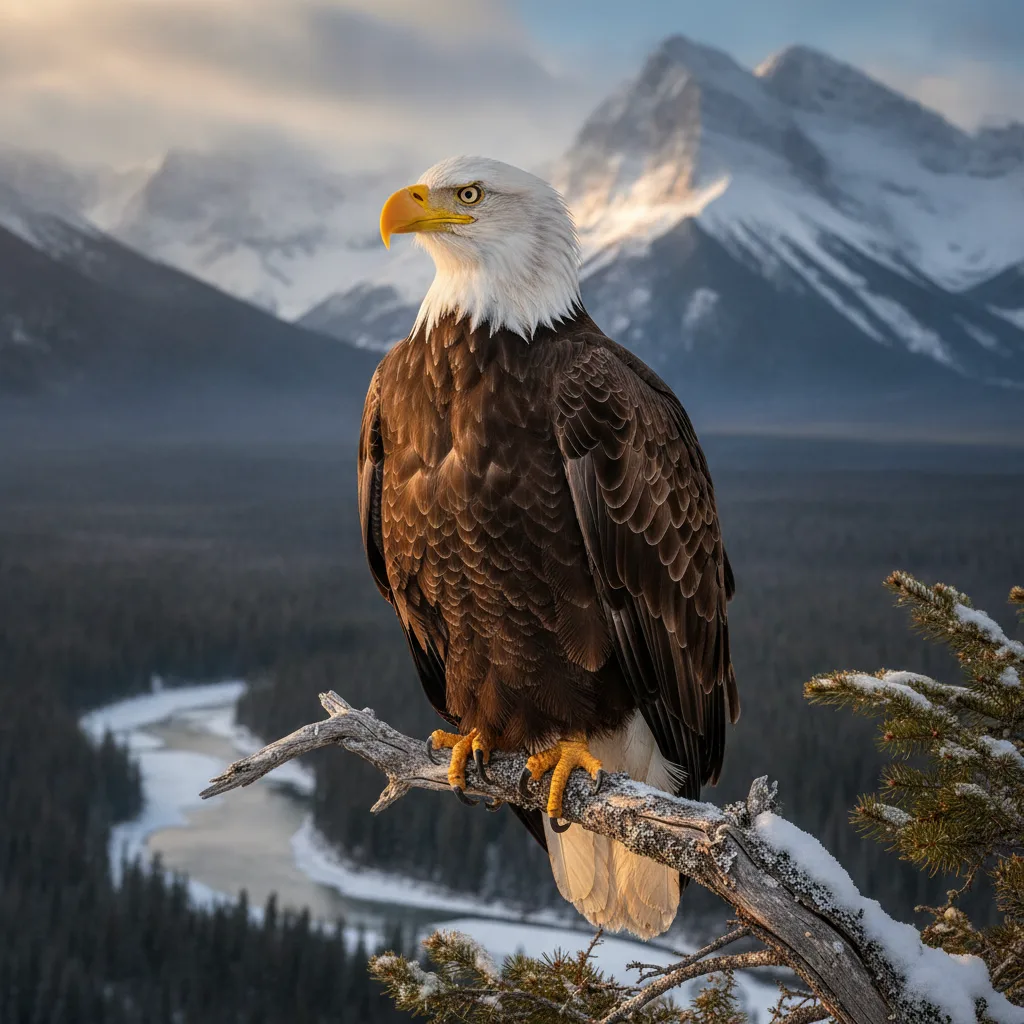
- Bright white head and tail (adults)
- Dark brown body and wings
- Yellow, hooked beak
- Large, powerful talons
- Intense golden-yellow eyes
Notable species
- Bald Eagle (Haliaeetus leucocephalus) — Least Concern. Near large lakes, rivers, reservoirs, and coastal habitats with abundant fish and mature trees Regions: Alaska, Canada, United States (continental), Northern Mexico, Great Lakes region, Pacific Northwest.
- Steller’s Sea Eagle (Haliaeetus pelagicus) — Vulnerable. Coastal sea cliffs, river mouths, and wintering along ice-free seacoasts Regions: Sea of Okhotsk, Bering Sea, Coastal Kamchatka, Hokkaido (Japan).
- White-tailed Eagle (Haliaeetus albicilla) — Least Concern. Coastal lakes, rivers, and wetlands with large old trees or cliffs Regions: Northern Europe, Eastern Europe, Siberia, Iceland, Coastal British Isles.
- African Fish Eagle (Haliaeetus vocifer) — Least Concern. Large lakes, rivers, and reservoirs across Africa Regions: Sub-Saharan Africa, Rift Valley lakes, Lake Victoria, Zambezi River.
- White-bellied Sea Eagle (Haliaeetus leucogaster) — Least Concern. Coastal coasts, islands, large rivers, and estuaries Regions: Indian Ocean islands, Southeast Asia, Northern Australia, Coral Sea.
Habitat and range
Original range: Throughout much of North America, especially near coasts, rivers, and lakes from Alaska and Canada south through the continental United States.
Current distribution: Widespread across North America, particularly abundant in Alaska, Canada, and the contiguous United States, with range expansion due to recovery.
Preferred environments: Large freshwater lakes, Rivers with abundant fish, Coastal estuaries, Wetlands with tall trees, Reservoirs and marshes
Regions: Alaska, Canada, United States (excluding Hawaii), Northern Mexico, Pacific Northwest, Great Lakes region, Chesapeake Bay, Florida Everglades
Where to see Bald Eagle
- Alaska (Kenai Peninsula, Chilkat Bald Eagle Preserve) — October to March. Chilkat Bald Eagle Preserve hosts thousands in late fall; large gatherings occur along salmon runs.
- Pacific Northwest (Puget Sound, Washington) — Late winter to spring. Nesting pairs are observable; look around large lakes and river mouths.
- Chesapeake Bay, Maryland/Virginia — Year-round, best in winter. Home to one of the largest populations in the lower 48 states.
Behavior and diet
Diet: Primarily fish, but also waterfowl, small mammals, carrion, and occasionally reptiles and amphibians.
Social structure: Usually solitary or in pairs, but may gather in groups near abundant food sources, especially during winter.
Communication: Use high-pitched whistles, chirps, and chatters; visual displays such as aerial cartwheels and postures.
- Dramatic aerial courtship displays, including talon-locking spirals toward the ground.
- Nest reuse, often adding to the same nest for years, resulting in very large nest structures.
- Opportunistic kleptoparasitism, stealing prey from other birds such as Ospreys.
- Soars using thermal updrafts to cover large territories efficiently.
Interactions with other animals
- Osprey (competitive): Bald Eagles often steal fish caught by Ospreys through aggressive pursuits.
- Fish (predator): Primary food source; caught with powerful talons during swooping dives.
- Crows (competitive): Crows may mob Bald Eagles to drive them away from nests or carrion.
- Mallard Ducks (predator): Occasionally prey upon waterfowl when fish are scarce.
Conservation
IUCN Red List status: Least Concern
Threats
- Habitat loss and degradation
- Lead poisoning from spent ammunition and fishing tackle
- Human disturbance during nesting
- Occasional illegal shooting and trapping
- Environmental pollutants (residual effects of pesticides)
Conservation efforts
- DDT ban in the United States (1972)
- Legal protection under the Bald and Golden Eagle Protection Act
- Public education on lead-free fishing and hunting
- Habitat restoration and nest monitoring programs
How to help
- Dispose of fishing line and tackle properly to prevent entanglement and poisoning
- Use non-lead ammunition and fishing sinkers
- Support conservation organizations that protect eagle habitats
- Respect nesting sites by keeping a safe distance
- Advocate for wetland and forest conservation
Bald Eagle facts for kids
Bald Eagles are big, powerful birds with white heads and tails. They live near water and catch fish with their super-sharp claws. Once endangered, they are now happily soaring all over North America again.
- Bald Eagles can see fish from very high in the air.
- Their nests can be bigger than a dining table!
- Young eagles don’t get white heads until they’re about five years old.
- Bald Eagles are the national bird of the United States.
- They make a lot of high-pitched, squeaky calls.
Did you know? Bald Eagles hold hands (lock talons) and twirl through the air during courtship!
Watch & learn
- The Bald Eagle: America's Majestic Hunter - Full Documentary — Smithsonian Channel. An in-depth look at the life, hunting skills, and recovery of the Bald Eagle, including beautiful footage and insights from ornithologists. Smithsonian Channel is well-known for accurate, high-quality wildlife documentaries.
- Bald Eagles: Flight of the Survivors — PBS Nature. This acclaimed PBS Nature episode highlights the Bald Eagle’s impressive comeback from near-extinction, featuring exclusive nest footage and interviews with eagle experts.
- Bald Eagle: Apex Predator of North America — National Geographic Wild. National Geographic Wild showcases the hunting prowess, nesting behavior, and conservation stories of the Bald Eagle with stunning visuals and insightful narration.
- Haliaeetus leucocephalus: Following the Life of America's Symbol — BBC Earth. BBC Earth explores the Bald Eagle’s ecological significance, family structure, and the challenges they face, using remarkable cinematic techniques and animal behavior experts.
- The Comeback of the Bald Eagle - Conservation Success Story — Smithsonian Channel. Focus on the conservation history, featuring interviews with biologists and dramatic scenes of Bald Eagle recovery efforts across the US. Smithsonian Channel provides scientifically sound context throughout.
Sources
Facts on this page are checked against these references. Follow them for the primary data.
- IUCN Red List — Conservation status, population trend and range assessment for Haliaeetus leucocephalus
- Encyclopaedia Britannica — Reviewed encyclopaedia entry on the bald eagle
- National Geographic — Articles, photographs and field reporting on the bald eagle