African Wild Dog
Lycaon pictus
African wild dogs live in packs across the savannas and woodlands of sub-Saharan Africa, each animal marked with its own blotched coat of black, tan and white. They are among the most successful hunters on the continent, with a higher share of chases ending in a kill than lions manage, and the whole pack feeds pups and injured members. Around 6,600 remain, fragmented across a few strongholds, and the species is Endangered.
Quick facts: Size 75–112 cm in body length, with a tail of 30–41 cm · Lifespan 8–10 years in the wild · IUCN status Endangered
Print the fact sheet — a free one-page PDF for homeschool and classroom use
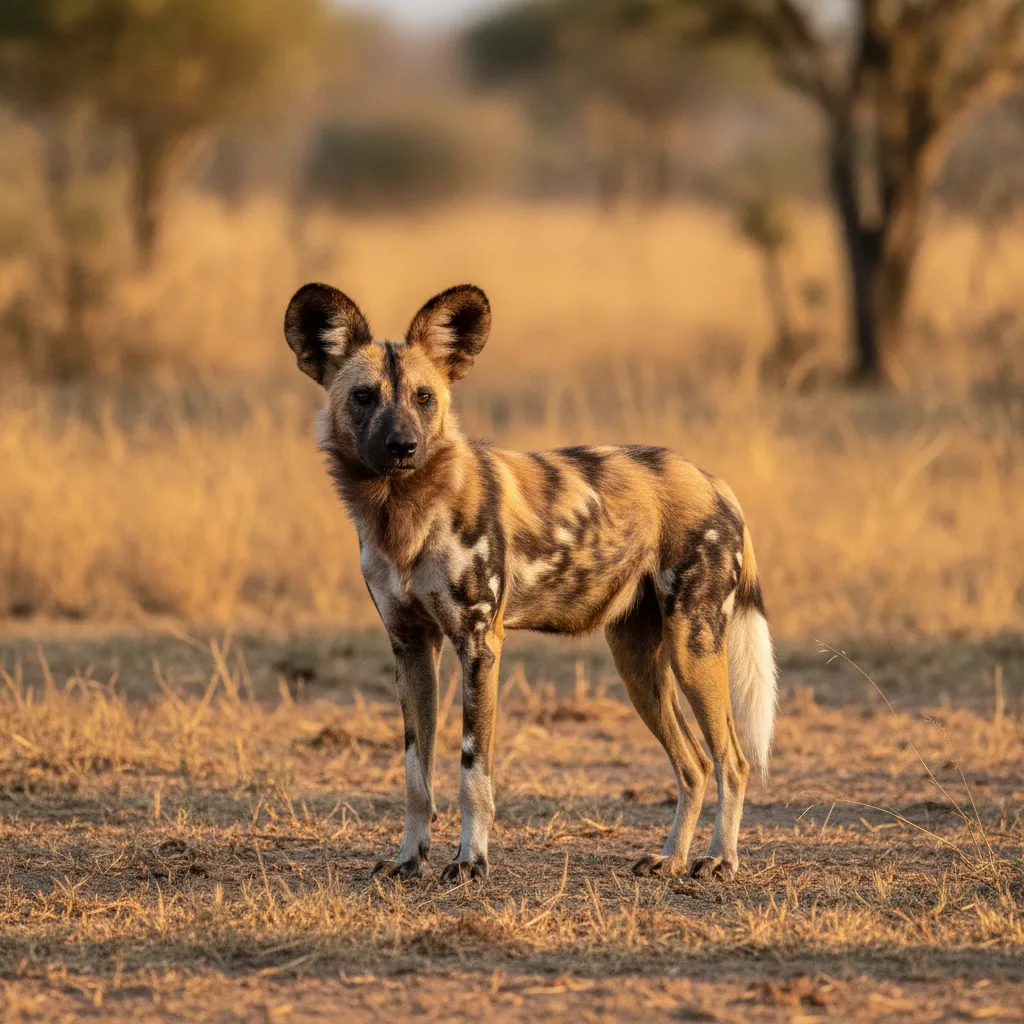
African Wild Dog at a glance
| Scientific name | Lycaon pictus |
|---|---|
| IUCN status | Endangered |
| Population | 6,000 - 6,600 |
| Population trend | decreasing |
| Weight | 25–36 kg |
| Length | 100–112 cm |
| Lifespan | 8–13 years |
| Top speed | 60 km/h |
| Class | Mammalia |
| Order | Carnivora |
| Family | Canidae |
Need to know
- The African wild dog is the only extant species in the genus Lycaon, distinct from all other canids.
- They have the highest hunting success rate (over 70%) of any African carnivore.
- African wild dogs live in highly social packs with strong cooperative bonds.
- Each dog’s coat pattern is unique, much like a human fingerprint.
- Major threats include habitat fragmentation, diseases like canine distemper, and persecution by humans.
- Individual packs roam huge territories, often covering more than 1,500 square kilometers.
About the African Wild Dog
The African wild dog (Lycaon pictus), also known as the painted dog or painted wolf, is a highly social and intelligent canid native to sub-Saharan Africa. Famed for its striking, patchy fur and its exceptional teamwork and hunting skills, the species is unique among canids due to its four-toed feet and elaborate cooperating behaviors. Once widespread across Africa, the species has suffered dramatic declines due to habitat loss, disease, and human conflict, making it one of the continent’s most endangered carnivores.
African wild dogs form packs that are among the tightest social structures of any mammal, involving deep cooperation in hunting, feeding, pup-rearing, and care of injured members. Their distinctive appearance, stamina, and remarkable teamwork have earned them an important place in African ecosystems and conservation.
Physical characteristics
Size: 75–112 cm in body length, with a tail of 30–41 cm. Weight: 18–36 kg. Lifespan: 8–10 years in the wild.
- Large, rounded, bat-like ears
- Mottled fur with irregular black, yellow, brown, and white patches
- Long, slender limbs for high-speed pursuits
- Only four toes on each foot
- Black muzzle and bushy white-tipped tail
Notable species
- African Wild Dog (Lycaon pictus) — Endangered. Open savannahs, grasslands, woodlands, and semi-arid zones but avoids dense forest and deserts Regions: East Africa, Southern Africa, Central Africa, West Africa, Kalahari Desert, Okavango Delta.
Habitat and range
Original range: Widespread throughout sub-Saharan Africa, from the Sahel to South Africa and from West to East Africa.
Current distribution: Now restricted to fragmented populations mainly in Southern Africa (Botswana, Zimbabwe, Namibia, South Africa), East Africa (Tanzania, Kenya), and a few tiny, scattered West and Central African populations.
Preferred environments: Open savannah, Dry woodland, Semi-arid plains, Grassland, Lightly wooded bushland
Regions: East Africa, Southern Africa, Central Africa, West Africa, Kalahari Desert, Okavango Delta, Serengeti, Kruger National Park
Where to see African Wild Dog
- Okavango Delta, Botswana — April to October (dry season). Botswana’s Moremi Game Reserve is a stronghold for wild dogs, and the open terrain is ideal for sightings.
- Kruger National Park, South Africa — May to September (dry season). Early morning game drives offer the best chance to see packs hunting or traveling.
- Selous Game Reserve, Tanzania — June to October. The reserve supports a key East African population; remote and less crowded than other parks.
Behavior and diet
Diet: Primarily hunt medium-sized ungulates (especially impala and gazelles), but will also eat hares, birds, and occasionally larger prey like wildebeest calves.
Social structure: Live in cohesive packs of 6–27 individuals, led by a dominant breeding pair. All pack members assist with hunting, feeding, and pup rearing.
Communication: Highly vocal, using twittering, squeaking, and 'hoo' calls for contact and coordination; also use scent marking and visual cues.
- Cooperative hunting in tightly coordinated chases with strategic roles.
- Regurgitation of food for pups and other pack members.
- Intensive care for sick, injured, or old individuals, with pack support.
- Complex greeting rituals with submissive, animated postures and squeaks.
Interactions with other animals
- Lion (competitive): Lions will kill African wild dogs and their pups to reduce competition for prey.
- Spotted Hyena (competitive): Hyenas often steal kills from wild dogs, leading to frequent confrontations.
- Impala (prey): Impala are a primary prey species, hunted in coordinated pack chases.
- Jackal (competitive): Jackals sometimes scavenge leftovers from wild dog kills.
Conservation
IUCN Red List status: Endangered
Threats
- Habitat fragmentation and loss
- Persecution and retaliatory killings by farmers
- Infectious diseases (especially canine distemper and rabies from domestic dogs)
- Road accidents
- Competition and predation from larger carnivores
Conservation efforts
- Establishment and expansion of protected wild dog reserves in Southern and East Africa
- Vaccination programs to control canine diseases
- Community education and conflict mitigation with local farmers
- Translocation and reintroduction programs to boost fragmented populations
- Long-term ecological monitoring
How to help
- Support African wild dog conservation organizations.
- Promote efforts to reduce disease spread from domestic dogs (e.g., vaccination).
- Sponsor anti-poaching and habitat protection projects.
- Raise awareness about the species’ endangered status.
- Travel responsibly in Africa and choose eco-friendly wildlife tourism.
African Wild Dog facts for kids
African wild dogs are amazing animals that live in Africa and work together as a team. They have colorful patchy fur and live in families that care for each other. Sadly, there aren’t many left in the wild, so people are working hard to protect them.
- Every wild dog’s fur pattern is one-of-a-kind, like a fingerprint!
- They can run as fast as a car driving through the city (up to 60 km/h)!
- Wild dogs are great helpers; they share food with pups and sick friends.
- Their big round ears help them hear very well and stay cool.
Did you know? Did you know African wild dogs hunt in groups and almost always catch their food, making them the best hunters in Africa?
Watch & learn
- African Wild Dogs: Relentless Hunters of the Savannah — BBC Earth. This documentary segment from BBC Earth follows a pack of African wild dogs as they coordinate intricate hunts and display complex social structure, capturing thrilling footage of their lives on the African plains.
- Fearless: Living With African Wild Dogs — PBS Nature. PBS Nature explores the challenges and triumphs of Lycaon pictus, revealing their adaptability, intelligence, and family bonds in the wild, and how they survive against predators and environmental threats.
- Social Intelligence of Africa’s Wild Dogs — Smithsonian Channel. This insightful feature focuses on the fascinating social behaviors of African wild dogs, including cooperation, leadership, and pack bonding, as observed in their natural southern African habitats.
- African Wild Dogs: Vanishing Predators — National Geographic Wild. National Geographic Wild investigates the endangered status of the species, chronicling the struggles African wild dogs face from habitat loss and human conflict, and the conservation efforts to protect them.
- African Wild Dogs: The Painted Wolves of Africa — BBC Earth. Stunning visuals and compelling storytelling make this BBC Earth documentary a must-watch for understanding the ecological importance, hunting techniques, and unique coat patterns of the African wild dog.
Sources
Facts on this page are checked against these references. Follow them for the primary data.
- IUCN Red List — Conservation status, population trend and range assessment for Lycaon pictus
- Encyclopaedia Britannica — Reviewed encyclopaedia entry on the african wild dog
- National Geographic — Articles, photographs and field reporting on the african wild dog