Great White Shark
Carcharodon carcharias
Great white sharks range through temperate and subtropical coastal waters worldwide, with well-studied populations off South Africa, Australia, California and the northeast United States. They can keep parts of their body warmer than the surrounding sea, and tagged individuals have crossed the Indian Ocean from South Africa to Australia and back. The species is Vulnerable and is protected in many countries.
Quick facts: Size Typical length 3.5–4.0 m; maximum verified up to 6.4 m · Lifespan Typically 40–70+ years · IUCN status Vulnerable
Print the fact sheet — a free one-page PDF for homeschool and classroom use
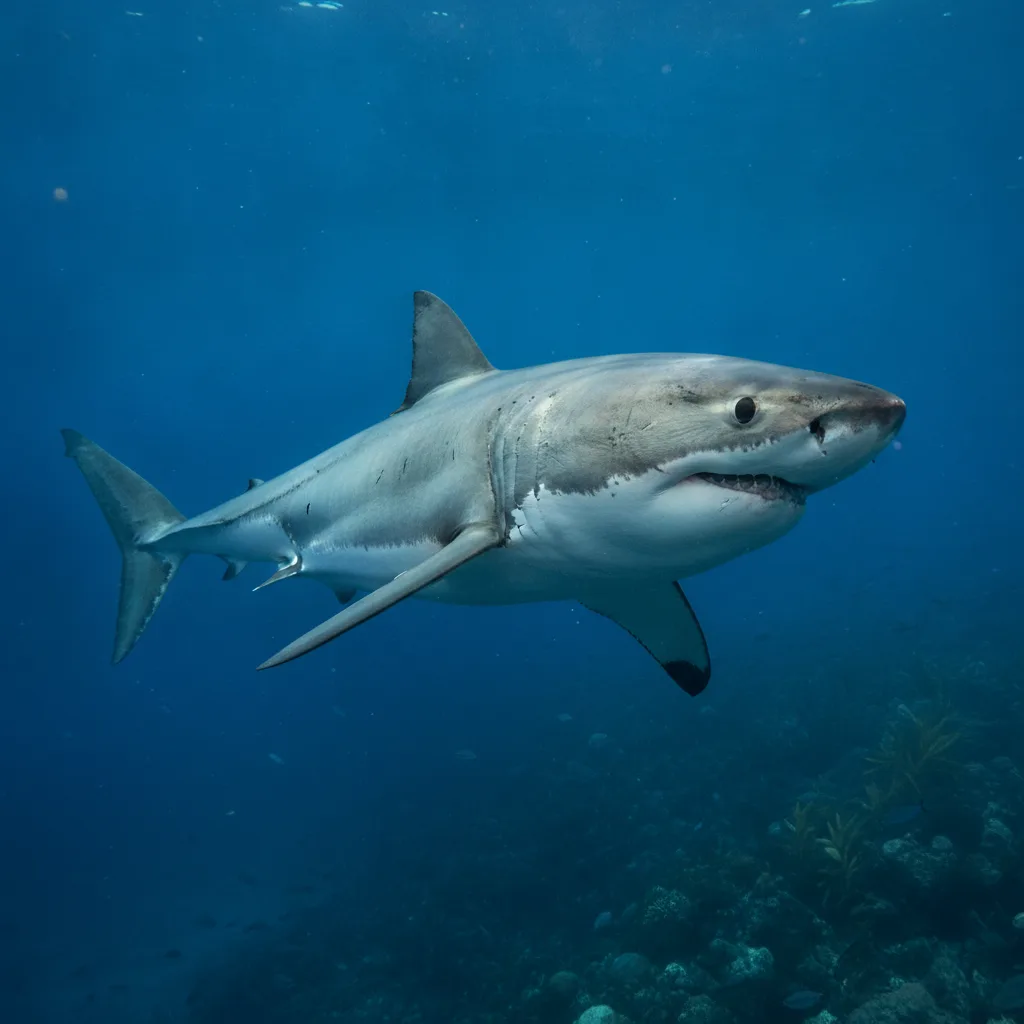
Great White Shark at a glance
| Scientific name | Carcharodon carcharias |
|---|---|
| IUCN status | Vulnerable |
| Population | 3,500–6,000 |
| Population trend | decreasing |
| Weight | 1100–1950 kg |
| Length | 4–6.4 m |
| Lifespan | 40–73 years |
| Top speed | 56 km/h |
| Class | Chondrichthyes |
| Order | Lamniformes |
| Family | Lamnidae |
Need to know
- Great white sharks are the largest predatory fish on Earth.
- They can detect a single drop of blood in 10 billion drops of water.
- Great whites are endothermic (partial warm-blooded), allowing them to hunt in colder waters.
- They often breach (leap entirely out of the water) when hunting seals.
- The species is listed as Vulnerable globally due to overfishing and accidental bycatch.
- Great white sharks can travel thousands of kilometers across oceans.
About the Great White Shark
The great white shark (Carcharodon carcharias) is the ocean’s most iconic and widely recognized predatory fish. Endowed with powerful jaws, serrated teeth, and remarkable speed, the great white rules as an apex predator in temperate and subtropical seas worldwide. Despite their fearsome reputation, great whites are critical to marine ecosystems, helping to regulate populations of marine mammals and large fish.
While famous for their size and spectacular hunting habits, including breaching, great whites are highly migratory and exhibit complex social and hunting behaviors. They are also vulnerable: targeted for their fins, teeth, and jaws, and caught as bycatch, global populations have declined noticeably in recent decades. Ongoing scientific research and conservation efforts are crucial to securing their future and furthering our understanding of these awe-inspiring animals.
Physical characteristics
Size: Typical length 3.5–4.0 m; maximum verified up to 6.4 m. Weight: Average 1,100 kg; largest individuals nearly 2,000 kg. Lifespan: Typically 40–70+ years.
- Robust, conical snout
- Large, black, round eyes
- Massive triangular, serrated teeth arranged in multiple rows
- Counter-shaded coloration: slate-gray dorsally, white ventrally
- Crescent-shaped tail fin and large, pointed dorsal fin
Notable species
- Great White Shark (Carcharodon carcharias) — Vulnerable. Temperate and subtropical coastal and offshore waters, often near seal colonies, continental shelves, and occasionally open ocean Regions: Northeast Pacific Ocean, Southwest Pacific Ocean, Northwest Atlantic Ocean, Southwest Atlantic Ocean, Indian Ocean, Mediterranean Sea, waters off South Africa, waters off Southern Australia.
Habitat and range
Original range: Temperate coastal regions of the ancient Tethys Sea and early Atlantic and Pacific Oceans
Current distribution: Found in temperate and subtropical coastal and offshore waters of all major oceans, especially near concentrations of seals and large fish.
Preferred environments: Temperate continental shelf waters, Coastal regions with abundant marine mammals, Open ocean (pelagic zone), Island surroundings, Cool, nutrient-rich upwelling zones
Regions: Northeast Pacific Ocean, Northwest Pacific Ocean, Southwest Pacific Ocean, Northwest Atlantic Ocean, Southwest Atlantic Ocean, Mediterranean Sea, Indian Ocean, Southern Ocean, waters off South Africa, waters off California, waters off southern Australia, waters off New Zealand, waters off Japan, waters off Chile
Where to see Great White Shark
- Dyer Island, waters off Gansbaai, South Africa — May to September. World-renowned for cage diving with large numbers of great white sightings.
- Isla Guadalupe, Pacific Ocean, Mexico — July to November. Crystal clear waters ideal for underwater observation.
- Neptune Islands, South Australia — April to July. Prime location for observing great whites attracted by abundant seals.
- Farallon Islands, California — September to November. Most sightings occur when elephant seals are present.
Behavior and diet
Diet: Primarily marine mammals (seals, sea lions, dolphins), large fish (tuna, rays, other sharks), and carrion; young sharks mainly eat fish and rays.
Social structure: Mostly solitary or loosely associating individuals; may aggregate temporarily where prey is abundant.
Communication: Use body language such as jaw gaping, arching, and swimming patterns; possible chemical cues in water.
- Breaching – leaping clear out of the water while ambushing prey, especially seals.
- Long-distance oceanic migrations, sometimes over 3,000 km between feeding and breeding grounds.
- Hierarchical feeding order at carcasses, with size and dominance dictating access.
- Investigative ‘test bites’—using their mouth to explore unfamiliar objects.
Interactions with other animals
- Seals (prey): Primary prey for adult great whites; ambush tactics often used near the surface or shoreline.
- Killer Whales (Orca) (competitive): Occasionally prey upon and displace great whites from favorite hunting grounds, such as around South Africa.
- Other sharks (competitive/predatory): Great whites may prey on smaller sharks and compete with other large sharks for food.
- Humans (accidental): Occasionally bite humans (often test bites), but humans are not typical prey and most attacks are non-fatal.
Conservation
IUCN Red List status: Vulnerable
Threats
- Overfishing (targeted and as bycatch)
- Habitat degradation
- Decline of prey stocks
- Illegal trade in jaws, teeth, fins
- Entanglement in fishing gear
- Slow reproductive rate
Conservation efforts
- International trade bans (CITES Appendix II)
- Marine protected areas established for key populations
- Regulations limiting shark finning and targeted fishing
- Tagging and monitoring programs for population tracking
- Public education campaigns reducing fear and misinformation
How to help
- Support organizations protecting sharks and marine habitats
- Promote and consume only sustainably harvested seafood
- Oppose and report illegal fishing of sharks
- Participate in citizen science initiatives and beach cleanups
- Educate others about the ecological importance of sharks
Great White Shark facts for kids
The great white shark is one of the biggest and most powerful sharks in the ocean! They have huge, sharp teeth and love to hunt for seals and big fish. Even though people are scared of them, great white sharks help keep the ocean healthy.
- Great white sharks can smell blood from far away—almost like a superpower!
- They can jump completely out of the water when they hunt.
- Their teeth are shaped like triangles and have sharp edges.
- Even though they're big, great whites are born from eggs that hatch inside their mom.
- Great whites have to keep swimming to breathe!
Did you know? A great white shark can have more than 300 teeth in its mouth at once, and if one breaks, a new one quickly grows in its place!
Watch & learn
- Great White Shark: Ultimate Predators – Hunting Techniques and Behavior — BBC Earth. This documentary provides breathtaking footage and deep insights into the predatory strategies and migratory patterns of Carcharodon carcharias, highlighting both hunting in open ocean and interactions near shorelines.
- Inside the Kill Zone: Great White Shark’s Attack Strategy — National Geographic. A high-production, science-focused exploration of how Great White Sharks locate, stalk, and strike their prey—complete with slow-motion analysis and expert commentary.
- Secrets of the Great White Shark: Shark Biology and Super Senses — Smithsonian Channel. This episode dives into the physiology, sensory abilities, and mysterious behaviors of Great White Sharks, exploring how evolution has made them such effective apex predators.
- The Mysterious Life of Great White Sharks: Migration and Conservation — PBS Nature. PBS Nature investigates the long-distance migrations, breeding challenges, and conservation status of Great White Sharks, blending stunning visuals with the latest research.
- Great White Sharks Up Close: Breaching and Feeding in South Africa — Nat Geo Wild. This film offers rare up-close footage of Great White Sharks breaching and feeding in South African waters, illuminating their role in ocean ecosystems and interactions with seals.
Sources
Facts on this page are checked against these references. Follow them for the primary data.
- IUCN Red List — Conservation status, population trend and range assessment for Carcharodon carcharias
- Encyclopaedia Britannica — Reviewed encyclopaedia entry on the great white shark
- National Geographic — Articles, photographs and field reporting on the great white shark