Lion
Panthera leo
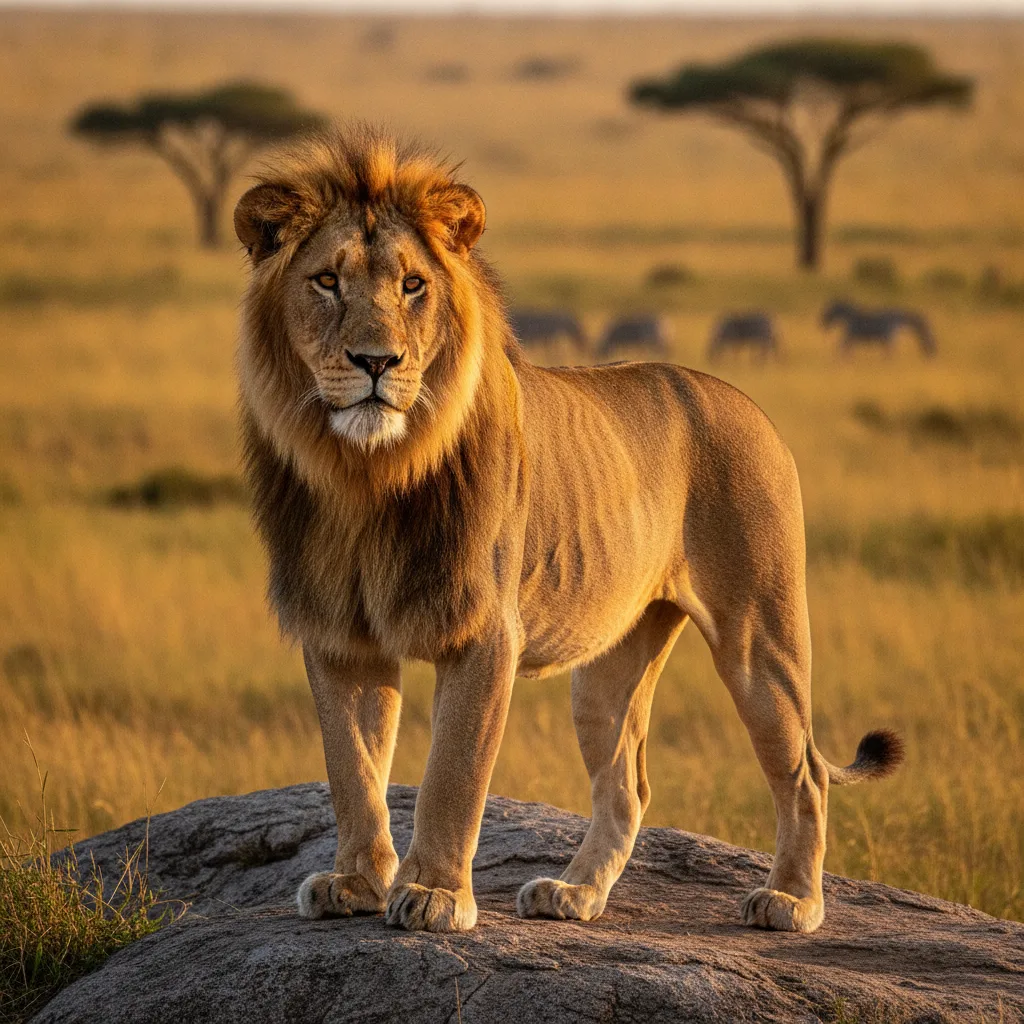
Lions are the only truly social cats, living in prides of related females, their cubs and a coalition of males across the savannas of sub-Saharan Africa, with one small remnant population in India's Gir Forest. A male's roar carries for several kilometres and serves both to mark territory and to gather scattered pride members. The species is listed as Vulnerable by the IUCN after numbers fell by roughly 40% in two decades.
Quick facts: Size 1.7–2.5 meters body length; 0.9–1.2 meters shoulder height · Lifespan 10–14 years in the wild, up to 22 years in captivity · IUCN status Vulnerable
Print the fact sheet — a free one-page PDF for homeschool and classroom use
Lions at a glance
| Scientific name | Panthera leo |
|---|---|
| IUCN status | Vulnerable |
| Population | 23,000 - 25,000 |
| Population trend | decreasing |
| Weight | 190–250 kg |
| Length | 2–2.5 m |
| Lifespan | 12–22 years |
| Top speed | 80 km/h |
| Class | Mammalia |
| Order | Carnivora |
| Family | Felidae |
Need to know
- Lions are the only truly social big cats, living in complex prides.
- A lion's roar can be heard up to 8 kilometers away.
- All modern wild Asiatic lions live in a single forest in India: Gir Forest.
- Male lions grow impressive manes that vary in color and size with age and genetics.
- Lions can sprint up to 80 km/h but only for short distances.
- Lions are currently extinct in over 90% of their historic range.
About the Lions
Lions (Panthera leo) are one of the most iconic large carnivores, once widespread across Africa, Asia, and Europe. Today, wild lions are mostly confined to sub-Saharan Africa, with a single remnant population of Asiatic lions in India's Gir Forest. Renowned for their social behavior, lions live in prides —a rarity among big cats— comprising related females, their cubs, and a coalition of males.
Males are easily distinguished by their manes, while both sexes are formidable hunters that play a pivotal role in maintaining ecosystem balance. Lions occupy savannahs, open woodlands, and dry forests where prey is abundant. Significant population declines in the past century have led to their listing as Vulnerable by the IUCN, with some regional populations Critically Endangered.
Physical characteristics
Size: 1.7–2.5 meters body length; 0.9–1.2 meters shoulder height. Weight: 120–250 kg (males heavier than females). Lifespan: 10–14 years in the wild, up to 22 years in captivity.
- Large muscular body
- Males have a mane around head, neck, and chest
- Rounded ears with black markings
- Long tail with a tufted tip
- Large, powerful jaws
Notable species
- African Lion (Panthera leo leo) — Vulnerable. Savannahs, grasslands, open woodlands Regions: East Africa, Southern Africa, West Africa, Central Africa, Kalahari Desert, Serengeti, Okavango Delta.
- Asiatic Lion (Panthera leo persica) — Endangered. Dry deciduous forests, scrub, and savannah Regions: Gir Forest, Gujarat, Western India.
- Southern African Lion (Panthera leo melanochaita) — Vulnerable. Grasslands, savannahs, open forests Regions: Botswana, Namibia, South Africa, Zimbabwe, Mozambique, Okavango Delta.
- West African Lion (Panthera leo leo (West African population)) — Critically Endangered. Dry savannah, woodland mosaic Regions: West Africa, Niger, Benin, Burkina Faso, Nigeria, Mali, W-Arly-Pendjari Complex.
- Northeast Congo Lion (Panthera leo leo (Northeast Congo population)) — Critically Endangered. Transitions between savannah and forest Regions: Central Africa, Democratic Republic of Congo, Central African Republic, Garamba National Park.
Habitat and range
Original range: Lions originally ranged across Africa, the Middle East, southwestern Asia, and even parts of southern Europe.
Current distribution: Now largely restricted to fragmented populations in sub-Saharan Africa, with a single population in the Gir Forest of India.
Preferred environments: Savannah, Grassland, Open woodland, Dry forest, Shrubland
Regions: East Africa, Southern Africa, West Africa, Central Africa, Kalahari Desert, Serengeti, Okavango Delta, Gir Forest (India)
Where to see Lions
- Serengeti National Park, Tanzania — June to October. Lions can often be seen during game drives in the dry season as they are more likely to gather near available water.
- Masai Mara National Reserve, Kenya — July to October. The wildebeest migration draws large prides and is excellent for lion viewing.
- Okavango Delta, Botswana — May to September. Prime season for both water-based and land-based lion sightings.
- Gir Forest National Park, India — December to April. Home to all wild Asiatic lions; closed mid-June to mid-October for monsoon.
Behavior and diet
Diet: Obligate carnivores, primarily hunting medium to large ungulates such as wildebeest, zebra, buffalo, gazelle, and occasionally scavenging.
Social structure: Live in prides consisting of related females, their cubs, and coalitions of 1–4 males. Females cooperate in hunting and cub-rearing; males protect territory and pride.
Communication: Communicate via vocalizations (roars, grunts, growls, moans), visual signals, scents (territorial marking), and tactile signals like nuzzling.
- Cooperate in prey stalking and ambush as a team.
- Territorial roaring to communicate pride ownership.
- Allosuckling—females nurse each other's cubs.
- Social grooming strengthens pride bonds.
Interactions with other animals
- Spotted Hyena (competitive): Hyenas and lions compete intensely for food and territory, often engaging in hostile encounters.
- Buffalo (prey): Cape buffalo are dangerous but important prey for lions, sometimes resulting in injuries on both sides.
- Vulture (competitive): Vultures often scavenge lion kills; lions may chase vultures off but sometimes ignore them.
- Zebra (prey): Zebra are frequently hunted by lions, especially in open grassland habitats.
Conservation
IUCN Red List status: Vulnerable
Threats
- Habitat loss and fragmentation
- Human-wildlife conflict (retaliatory killings, livestock protection)
- Depletion of prey base
- Illegal hunting and poaching
- Disease transmission from domestic animals
Conservation efforts
- Anti-poaching patrols and law enforcement
- Community-based conservation and education programs
- Translocation and reintroduction projects
- Establishment and expansion of protected areas
- Ecotourism generating funding for conservation
How to help
- Support conservation organizations working with lions.
- Promote and participate in responsible wildlife tourism.
- Advocate for habitat protection and anti-poaching laws.
- Educate others about the importance of lions and biodiversity.
- Avoid supporting trophy hunting and illegal wildlife trade.
Lions facts for kids
Lions are big, strong cats that live together in families called prides. They are famous for their loud roars and the males’ big, fluffy manes. Today, most lions live in Africa’s grasslands, but a small group lives in India.
- A lion’s roar can be heard 8 km (5 miles) away!
- Lion cubs like to play and wrestle with each other.
- Boy lions (males) have hairy manes, but girl lions (females) don’t.
- Lions sleep more than 16 hours every day.
- Lions only live in the wild in Africa and a small area of India.
Did you know? Did you know? Lions are the only cats that live in groups called prides!
Watch & learn
- Lions: Kings of the African Savannah | BBC Earth Documentary — BBC Earth. This BBC Earth feature dives deep into the social structures, hunting strategies, and family dynamics of Panthera leo, filmed with stunning close-up footage and narrated by renowned naturalists.
- Brothers in Blood: The Lion Documentary | National Geographic Wild — National Geographic Wild. A gripping investigation into the infamous Mapogo lion coalition, revealing how these big cats conquered a vast territory using rarely witnessed behaviors. Essential viewing for any lion enthusiast.
- The World’s Deadliest: Lions | Smithsonian Channel — Smithsonian Channel. Explore the predatory instincts and powerful teamwork of lions in this Smithsonian Channel special which explains how Panthera leo maintains its status as Africa's apex predator.
- Lions Unleashed: Undercover in the Pride | PBS Nature — PBS Nature. This PBS Nature documentary showcases groundbreaking footage using hidden cameras to reveal never-before-seen aspects of lion pride life, including cub rearing and dominance battles.
- Epic Lion Hunts: Surviving the Wild | BBC Earth — BBC Earth. Watch the breathtaking tactics of lionesses as they coordinate hunts and defend their young against predators, all captured in vivid detail with high-speed camera work.
Sources
Facts on this page are checked against these references. Follow them for the primary data.
- IUCN Red List — Conservation status, population trend and range assessment for Panthera leo
- Encyclopaedia Britannica — Reviewed encyclopaedia entry on the lions
- National Geographic — Articles, photographs and field reporting on the lions