Blue Whale
Balaenoptera
The blue whale is the largest animal known to have ever lived, reaching around 30 metres and 150 tonnes or more, yet it feeds almost entirely on krill, straining several tonnes a day through its baleen. Its heart is about the size of a small car and its low-frequency calls travel hundreds of kilometres underwater. Twentieth-century whaling removed roughly 99% of the Antarctic population, and the species remains Endangered.
Quick facts: Size 20–33 m (65–108 ft) in length · Lifespan average 70–90 years, with some reaching 100+ years · IUCN status Endangered
Print the fact sheet — a free one-page PDF for homeschool and classroom use
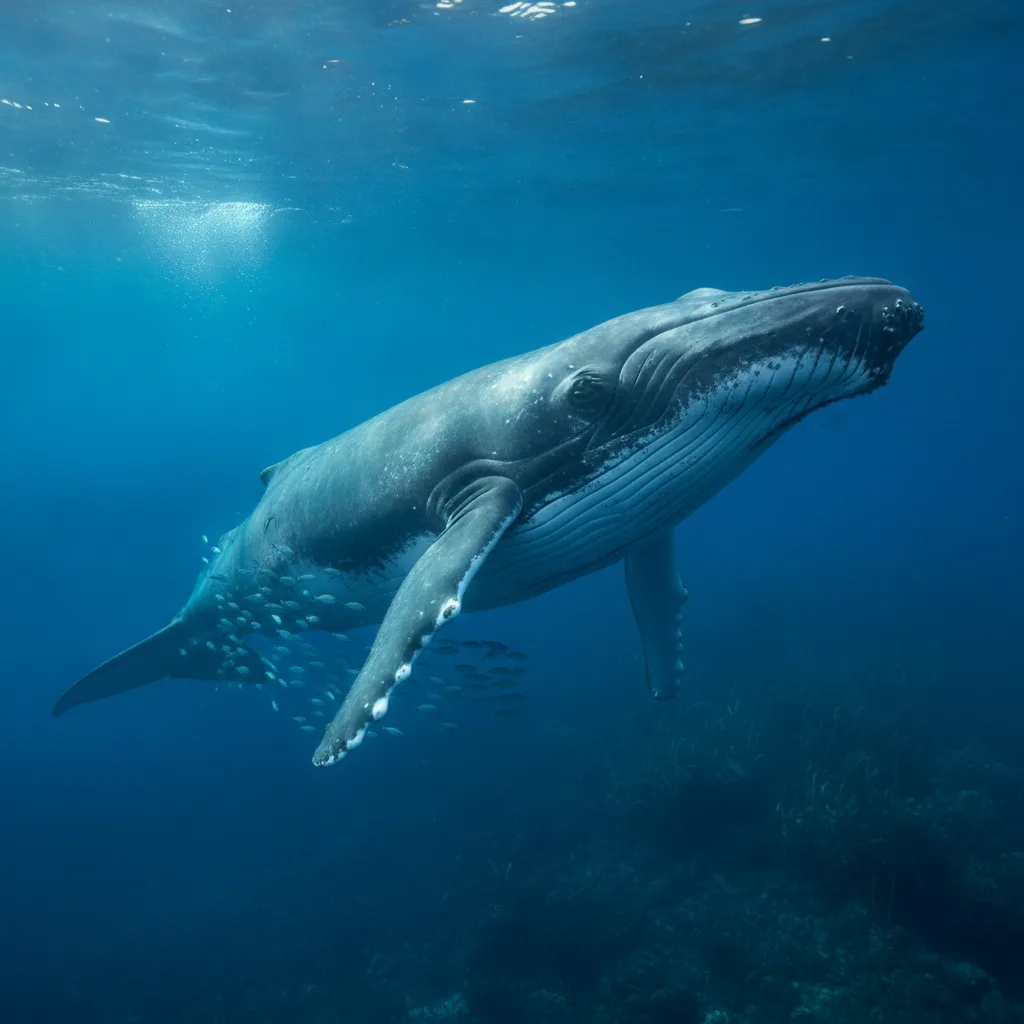
Blue Whale at a glance
| Scientific name | Balaenoptera |
|---|---|
| IUCN status | Endangered |
| Population | 10,000 - 25,000 |
| Population trend | increasing |
| Weight | 110000–180000 kg |
| Length | 24–33 m |
| Lifespan | 80–110 years |
| Top speed | 48 km/h |
| Class | Mammalia |
| Order | Cetacea |
| Family | Balaenopteridae |
Need to know
- The blue whale is the largest animal ever known, reaching lengths up to 33 meters (108 feet).
- A blue whale's heart alone can weigh as much as an automobile (over 180 kg).
- Blue whales produce the loudest animal vocalizations on Earth, heard hundreds of kilometers away underwater.
- They primarily feed on tiny krill, consuming up to 4 tons per day during peak feeding.
- Blue whales were driven nearly to extinction by commercial whaling, with only a fraction of their former population left today.
- Despite their size, blue whales are gentle giants and pose no threat to humans.
About the Blue Whale
The blue whale (Balaenoptera musculus) is an awe-inspiring marine mammal and holds the title of the largest animal to have ever existed on Earth, surpassing even the largest dinosaurs in both length and mass. Blue whales can be found in every major ocean except the Arctic and migrate thousands of kilometers every year between their summer feeding grounds and winter breeding areas. Possessing a sleek, streamlined body with a broad, flat head, these titans glide through the oceans, their hauntingly low-frequency songs reverberating across the deep.
Blue whales were once abundant, but relentless hunting during the 20th century reduced their numbers by as much as 97%. International protections now support their slow recovery, but populations remain at a fraction of pre-whaling numbers, and some subspecies, such as the Antarctic blue whale, are still critically endangered. Blue whales inspire conservation efforts and captivate scientists and nature enthusiasts alike with their immense size, mysterious migrations, and vital role in marine ecosystems.
Physical characteristics
Size: 20–33 m (65–108 ft) in length. Weight: 70,000–150,000 kg (max up to 180,000 kg). Lifespan: average 70–90 years, with some reaching 100+ years.
- Extremely large size with streamlined, elongated body
- Broad, U-shaped head with a prominent ridge
- Small dorsal fin set far back on the body
- Blue-gray mottled coloration
- Long throat grooves (pleats) for gulp-feeding
Notable species
- Northern Blue Whale (Balaenoptera musculus musculus) — Endangered. Open ocean, high latitude feeding grounds in summer, subtropical waters in winter Regions: North Atlantic Ocean, North Pacific Ocean, Norwegian Sea, Gulf of Alaska, waters off Iceland.
- Antarctic Blue Whale (Balaenoptera musculus intermedia) — Critically Endangered. Open icy waters of the Southern Ocean, migrates to lower latitudes during winter Regions: Southern Ocean, Ross Sea, Weddell Sea, Scotia Sea, waters off Antarctica.
- Pygmy Blue Whale (Balaenoptera musculus brevicauda) — Data Deficient. Warm and temperate waters, typically Indian Ocean regions Regions: Indian Ocean, Southeast Indian Ocean, waters off Sri Lanka, waters off Western Australia.
- Chilean Blue Whale (Balaenoptera musculus unnamed subspecies (Chilean population)) — Endangered. Southeast Pacific coastal and offshore waters Regions: Southeast Pacific Ocean, waters off Chile, Gulf of Corcovado.
Habitat and range
Original range: Ancient blue whale ancestors evolved in temperate to polar marine environments and spread throughout Earth's oceans millions of years ago.
Current distribution: Today, blue whales inhabit almost all the world’s major oceans, except the Arctic. They have distinct feeding and breeding populations tied to the North Atlantic, North Pacific, Indian, Southern, and Southeast Pacific Oceans.
Preferred environments: Open ocean (pelagic zone), Cold and temperate shelf waters near krill blooms, Polar to subpolar waters for feeding (summer), Tropical to subtropical waters for breeding (winter)
Regions: North Atlantic Ocean, North Pacific Ocean, Indian Ocean, Southern Ocean, Norwegian Sea, Gulf of Alaska, Ross Sea, Weddell Sea, Scotia Sea, Southeast Pacific Ocean, waters off Iceland, waters off Antarctica, waters off Chile, waters off Sri Lanka, waters off Western Australia
Where to see Blue Whale
- Gulf of St. Lawrence, Canada — July to September. Look for blows and feeding activity along krill blooms in deep waters.
- Gulf of Corcovado, Chile — January to March. Prime feeding grounds for the Chilean blue whale population.
- Southern Ocean, near Antarctica — December to February. Antarctic blue whales feed in ice-edge waters during the southern summer.
- Waters off Sri Lanka (Indian Ocean) — March to April. Pygmy blue whales can be seen close to shore, especially on whale-watching tours.
Behavior and diet
Diet: Blue whales feed almost exclusively on krill, occasionally supplementing with other zooplankton such as copepods.
Social structure: Primarily solitary or found in pairs (especially mother and calf), with occasional loose groups in rich feeding areas.
Communication: Utilize low-frequency songs and pulses (as low as 10 Hz) that travel hundreds of kilometers; likely used for navigation, mate attraction, and social communication.
- Gulp feeding: engulfing vast volumes of water and filtering krill through baleen plates
- Long-range vocalizations: loudest animal sounds on Earth, used for communication over huge distances
- Annual migrations: thousands of kilometers between polar feeding and tropical breeding grounds
- Calf nursing: calves nurse from their mothers for 6–8 months, consuming rich milk
Interactions with other animals
- Krill (prey): Primary food source; blue whales may consume up to 4 tons of krill per day during feeding season.
- Orca (Killer Whale) (predator): Though rare, orcas sometimes attack blue whale calves and, on extremely rare occasions, adults.
- Barnacles and Remoras (symbiotic): Often attach to blue whale skin, benefiting from transport and access to food particles, while usually not harming the whale.
Conservation
IUCN Red List status: Endangered
Threats
- Ship strikes in busy shipping lanes
- Noise pollution from ships and industrial activities
- Entanglement in fishing gear
- Climate change affecting krill abundance
- Pollution (chemical and plastic)
Conservation efforts
- International Whaling Commission (IWC) ban on commercial whaling
- Marine protected areas along migratory and feeding routes
- Monitoring shipping lanes and vessel speed regulations
- Research and monitoring using satellite tracking and acoustic surveys
- International cooperation for habitat and species protection
How to help
- Support and advocate for marine protected areas
- Reduce plastic and chemical pollution in oceans
- Promote responsible whale watching practices
- Raise awareness about blue whale conservation
- Support organizations focused on marine mammal research
Blue Whale facts for kids
Blue whales are the biggest animals that have ever lived—even bigger than the dinosaurs! These gentle giants eat tiny shrimp-like animals called krill and make the loudest sounds of any creature on Earth.
- A blue whale's heart is as big as a small car!
- Baby blue whales (calves) can drink over 200 liters of milk every day.
- They can be longer than two school buses lined up.
- Blue whales don't have teeth. Instead, they have baleen plates to filter food.
- Even though they are huge, blue whales eat one of the smallest creatures in the sea.
Did you know? Did you know a blue whale's tongue can weigh as much as an elephant?
Watch & learn
- Blue Whale: The Giant of the Ocean | BBC Earth — BBC Earth. This BBC Earth documentary segment captures the blue whale’s colossal size and explores its elusive behaviors and migratory patterns, offering stunning underwater footage rarely seen elsewhere.
- Kings of the Ocean: Blue Whale Documentary | National Geographic Wild — National Geographic Wild. National Geographic Wild delivers breathtaking close-ups and informative narration on the blue whale’s feeding, communication, and conservation status, drawing from research around the world's oceans.
- The Secret Life of Blue Whales | PBS Nature — PBS Nature. This feature investigates the blue whale’s role in marine ecosystems, unique adaptations for ocean survival, and looks at environmental factors affecting their future, with clear visual storytelling.
- Inside the World's Largest Animal: Blue Whale Anatomy | Smithsonian Channel — Smithsonian Channel. Smithsonian Channel presents in-depth analysis of the blue whale’s physiology and mechanics, breaking down how this extraordinary mammal sustains its record-breaking size.
- Blue Whale Superpod: Unseen Footage | BBC Earth — BBC Earth. This documentary highlights rare footage of a blue whale 'superpod', providing insight into their social behavior, feeding strategies, and the broad scope of their global presence.
Sources
Facts on this page are checked against these references. Follow them for the primary data.
- IUCN Red List — Conservation status, population trend and range assessment for Balaenoptera
- Encyclopaedia Britannica — Reviewed encyclopaedia entry on the blue whale
- National Geographic — Articles, photographs and field reporting on the blue whale