Manta Ray
Mobula
Manta rays are the largest rays, with the oceanic manta spanning up to 7 metres across, and they cruise tropical and subtropical seas filtering plankton through their wide mouths. They have the largest brain of any fish relative to body size, and individuals visit reef 'cleaning stations' where small fish pick off parasites. Both species are threatened by fishing for their gill plates: the oceanic manta is Endangered and the reef manta Vulnerable.
Quick facts: Size Average 4–5 meters, up to 7 meters (wingspan) · Lifespan 25–40 years · IUCN status Endangered (M. birostris), Vulnerable (M. alfredi)
Print the fact sheet — a free one-page PDF for homeschool and classroom use
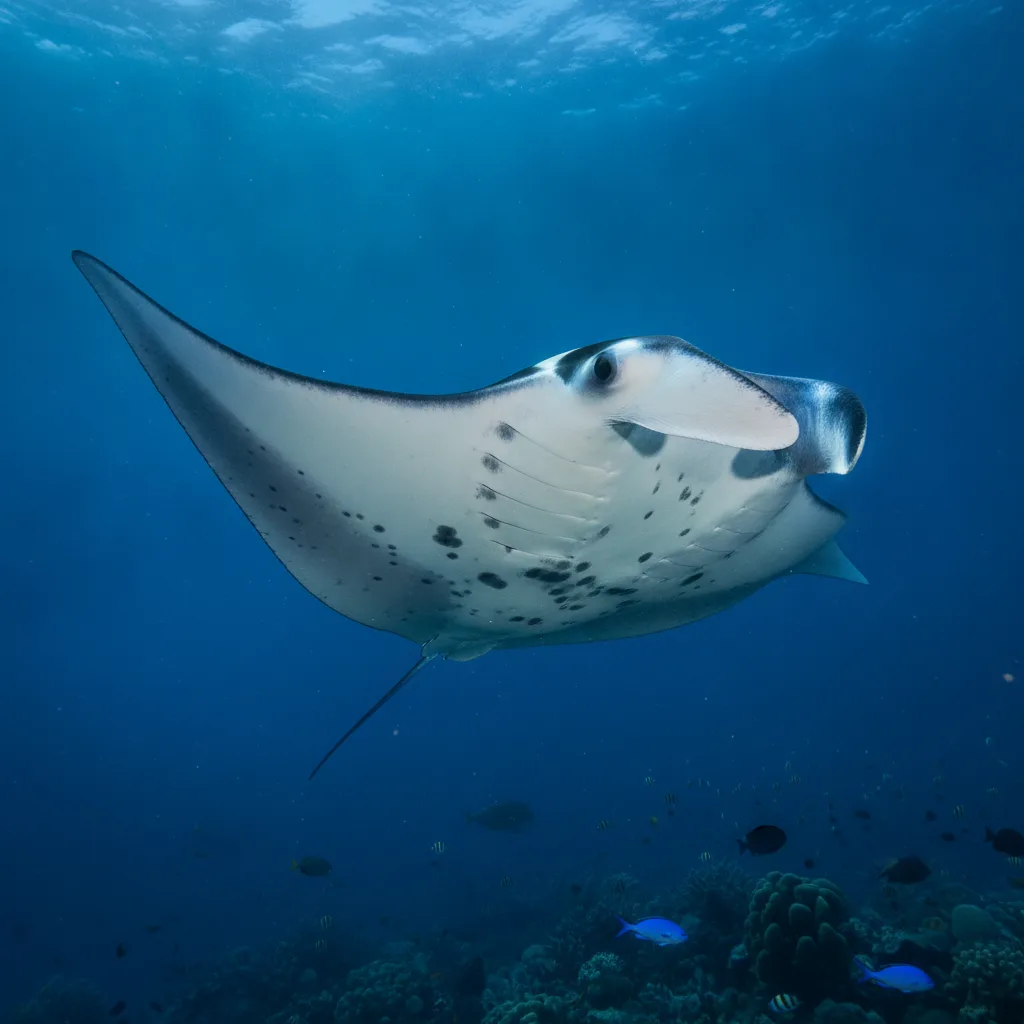
Manta Rays at a glance
| Scientific name | Mobula |
|---|---|
| IUCN status | Endangered (M. birostris), Vulnerable (M. alfredi) |
| Population | Unknown; likely tens of thousands globally |
| Population trend | decreasing |
| Weight | 1200–2000 kg |
| Length | 4.5–7 m |
| Lifespan | 25–40 years |
| Top speed | 24 km/h |
| Class | Chondrichthyes |
| Order | Myliobatiformes |
| Family | Mobulidae |
| Known species | 2 |
Need to know
- Manta rays are the largest rays on Earth, with wingspans up to 7 meters.
- They are filter feeders, consuming vast amounts of plankton by swimming with open mouths.
- Giant oceanic mantas can dive over 1,000 meters deep and undertake transoceanic migrations.
- Each manta has a unique ventral spot pattern, like a fingerprint.
- Female mantas give live birth to a single pup after a year-long gestation.
- Manta rays are listed as Vulnerable or Endangered due to fishing and habitat loss.
About the Manta Rays
Manta rays are among the ocean's most majestic and intelligent creatures, gliding effortlessly through tropical and temperate waters with their massive wing-like pectoral fins. These rays belong to the genus Mobula and comprise two distinct species: the giant oceanic manta (Mobula birostris) and the reef manta (Mobula alfredi). Both species are filter feeders, consuming microscopic plankton as they swim with wide-open mouths. Their graceful movements, curiosity around divers, and impressive size make them a favorite among ocean enthusiasts.
Manta rays are characterized by their broad, triangular pectoral fins, forward-facing cephalic lobes (which help funnel plankton into their mouths), and unique spotted underbellies. They are highly intelligent, exhibiting problem-solving and social behaviors unlike those seen in most other fish. Manta rays are threatened by unsustainable fishing, demand for their gill rakers, and habitat degradation, leading to rapidly declining populations across their range.
Physical characteristics
Size: Average 4–5 meters, up to 7 meters (wingspan). Weight: Average 1,200 kg, up to 2,000 kg. Lifespan: 25–40 years.
- Huge triangular 'wings' (pectoral fins)
- Forward-projecting cephalic lobes
- Large, terminal mouth at the head's front
- Individually unique ventral spot patterns
- Smooth, flat disc-shaped bodies; dark dorsal/white ventral coloration
Notable species
- Giant Oceanic Manta Ray (Mobula birostris) — Endangered. Prefers pelagic (open ocean) waters, often near continental shelves and offshore islands Regions: Atlantic Ocean, Pacific Ocean, Indian Ocean, Caribbean Sea, waters off Ecuador, waters off Mozambique.
- Reef Manta Ray (Mobula alfredi) — Vulnerable. Tropical and subtropical coastal reefs, lagoons, and bays Regions: Indian Ocean, Pacific Ocean, Coral Sea, Red Sea, coastal waters of Indonesia, Great Barrier Reef.
- Lesser-known Mobula Rays ('devil rays' group) (Mobula spp.) — Vulnerable - Endangered (species-dependent). Temperate to tropical open ocean and coastal areas Regions: Mediterranean Sea, Atlantic Ocean, Gulf of Mexico, Caribbean Sea, Indian Ocean.
- Chilean Devil Ray (Mobula tarapacana) — Endangered. Deep oceanic waters near seamounts and continental slopes Regions: South Atlantic Ocean, Eastern Pacific Ocean, Azores, Mediterranean Sea, off southern Brazil.
Habitat and range
Original range: Tropical and subtropical oceans worldwide, particularly near productive upwelling zones and shallow reefs.
Current distribution: Absent only in polar seas, both species still widely distributed across tropical/temperate waters but increasingly rare in heavily fished regions.
Preferred environments: Tropical open ocean (epipelagic), Coastal coral and rocky reefs, Offshore upwelling zones, Seamounts and oceanic islands, Cleaning stations
Regions: Atlantic Ocean, Pacific Ocean, Indian Ocean, Red Sea, Caribbean Sea, Coral Sea, Mediterranean Sea, Gulf of Mexico
Where to see Manta Rays
- Yap, Micronesia (Pacific Ocean) — December – May. Famous for year-round reef manta populations and predictable cleaning station activity.
- Maldives (Indian Ocean) — July – November. Multiple sites host large aggregations during monsoonal plankton blooms.
- Raja Ampat, Indonesia (Pacific Ocean) — October – April. Excellent for both reef and oceanic mantas, especially at cleaning stations.
- Revillagigedo Islands, Mexico (Pacific Ocean) — November – May. Diving with giant mantas in open ocean, often interacting with divers.
Behavior and diet
Diet: Plankton (including copepods, mysids, euphausiids, and fish eggs), tiny fish, and occasionally small crustaceans.
Social structure: Generally solitary but often gather in groups at feeding and cleaning sites; loose aggregations form during mating or in high food abundance.
Communication: Mainly visual, using body language such as looping, barrel rolls, and fin movements; may also use chemical cues.
- Visit 'cleaning stations' where smaller fish remove parasites from their bodies.
- Perform underwater acrobatics, including somersaults and barrel rolls to aid plankton feeding.
- May breach (leap out of water), possibly to remove parasites or signal fitness during mating.
- Seasonal site fidelity, returning to the same regions annually.
Interactions with other animals
- Cleaner wrasse and other cleaner fish (symbiotic): Mantas pause at cleaning stations for fish to remove parasites and dead skin.
- Large sharks (e.g., tiger sharks) (predator): Occasionally prey on juvenile or sick mantas.
- Humans (threat/observational): Main threat through fishing; some regions promote eco-tourism as sustainable interaction.
Conservation
IUCN Red List status: Endangered (M. birostris), Vulnerable (M. alfredi)
Threats
- Targeted fishing for gill rakers (used in traditional medicine)
- Bycatch in commercial fisheries
- Habitat loss (coastal development, reef damage)
- Boat strikes and pollution
- Climate change affecting ocean productivity
Conservation efforts
- Establishment of marine protected areas (MPAs)
- International trade bans (CITES Appendix II listing)
- Local fishing and catch restrictions
- Community-based eco-tourism initiatives
- Research and population monitoring
How to help
- Support sustainable, responsible manta ray tourism operators.
- Participate in citizen science via manta photo-ID projects.
- Reduce seafood consumption from unsustainable sources.
- Advocate for expanded marine protected areas and international protections.
- Educate others about the threats faced by manta rays and ocean conservation.
Manta Rays facts for kids
Manta rays are huge, gentle fish that glide through the ocean like underwater birds. They eat tiny plankton and are completely harmless to people. Each manta ray has special spots on its belly, making every one unique!
- Manta rays can grow as wide as a school bus is long!
- They have 'wings' instead of arms or fins.
- Manta rays use their gill rakers to filter tiny food from seawater.
- They sometimes jump right out of the water!
- Baby manta rays are called pups.
Did you know? Did you know that manta rays have no bones? Their bodies are made of cartilage, just like your ears!
Watch & learn
- Manta Rays: Gentle Giants of the Ocean — BBC Earth. A spectacular look at manta rays (Mobula), their feeding habits, social behavior, and interactions with the marine environment. BBC Earth's high-definition cinematography makes this a must-see for nature lovers.
- Manta Rays - The Ultimate Ocean Acrobat — National Geographic. National Geographic explores the lives of Mobula rays, focusing on their intelligence, migration patterns, and the threats they face in the wild. Rich storytelling paired with incredible underwater videography.
- The Science of Manta Rays — Smithsonian Channel. Smithsonian Channel showcases the latest scientific research on manta rays, revealing their anatomy, filter-feeding strategies, and recent discoveries about their social structures.
- Mysteries of the Manta Ray — PBS Nature. PBS Nature dives deep into the mystery and majesty of Mobula rays, exploring their role in the ocean ecosystem and their interactions with humans through expert interviews and gorgeous footage.
- Mobulidae: Manta and Devil Rays Explained — Wildlife Conservation Society. This documentary focuses on the entire Mobulidae family, covering both manta rays and devil rays, and highlights conservation challenges and efforts to protect these remarkable Chondrichthyes.
Sources
Facts on this page are checked against these references. Follow them for the primary data.
- IUCN Red List — Conservation status, population trend and range assessment for Mobula
- Encyclopaedia Britannica — Reviewed encyclopaedia entry on the manta rays
- National Geographic — Articles, photographs and field reporting on the manta rays